Thursday, March 10, 2016

Desert Island 100

The challenge: Pick my favorite feature film each year from 1924-2015.  Add 8 more shorts spread out over that period to make an even 100.  Here's what I picked.  Links are to other blog entries on those films.  What would your list look like?

1924 Greed (von Stroheim)
1925 The Gold Rush (Chaplin)
1926 The General (Keaton/Bruckman)


1927 The Italian Straw Hat (Clair)
1928 The Wind (Sjostrom)
1929 Man with a Movie Camera (Vertov)
1930 The Blue Angel (Sternberg)
1931 M (Lang)
1932 I Was Born, But... (Ozu)
1933 Footlight Parade (Bacon)
1934 The Thin Man (Van Dyke)
1935 Bride of Frankenstein (Whale)

1936 The Crime of M. Lange (Renoir)
1937 Shall We Dance (Sandrich)
1938 Bringing Up Baby (Hawks)
1939 Only Angels Have Wings (Hawks)
1940 Pinocchio (Sharpsteen)
1941 The Lady Eve (Sturges)
1942 Casablanca (Curtiz)
1943 The Life and Death of Colonel Blimp (Powell/Pressburger)
1944 Meet Me in St. Louis (Minnelli)
1945 Children of Paradise (Carne)

1946 Belle et la Bete (Cocteau)
1947 Black Narcissus (Powell/Pressburger)
1948 Germany, Year Zero (Rossellini)
1949 Kind Hearts and Coronets (Hamer)
1950 Winchester '73 (A. Mann)

1951 On Dangerous Ground (N. Ray)
1952 Singin' in the Rain (Donen/Kelly)
1953 The Earrings of Madame de... (Ophuls)
1954 The Seven Samurai (Kurosawa)
1955 Night of the Hunter (Laughton)
1956 Forbidden Planet (Wilcox)
1957 Sweet Smell of Success (Mackendrick)
1958 Vertigo (Hitchcock)
1959 Some Like It Hot (Wilder)
1960 La Dolce Vita (Fellini)
1961 Last Year at Marienbad (Resnais)
1962 Cleo from 5 to 7 (Varda)
1963 The Leopard (Visconti)
1964 Dr. Strangelove, or How I Learned to Stop Worrying and Love the Bomb (Kubrick)
1965 Chimes at Midnight (Welles)
1966 The Battle of Algiers (Pontecorvo)
1967 Point Blank (Boorman)
1968 2001: A Space Odyssey (Kubrick)
1969 The Wild Bunch (Peckinpah)

1970 Days and Nights in the Forest (S. Ray)
1971 Walkabout (Roeg)
1972 The Bitter Tears of Petra van Kant (Fassbinder)
1973 The Spirit of the Beehive (Erice)
1974 Chinatown (Polanski)

1975 Monty Python and the Holy Grail (Gilliam/Jones)
1976 The Marquise of O (Rohmer)
1977 Close Encounters of the Third Kind (Spielberg)

1978 The Last Waltz (Scorsese)
1979 The Black Stallion (Ballard)
1980 The Empire Strikes Back (Kershner)
1981 Pennies from Heaven (Ross)
1982 Burden of Dreams (Blank)
1983 Zelig (Allen)
1984 The Terminator (Cameron)
1985 Come and See (Klimov)
1986 The Sacrifice (Tarkovsky)
1987 Wings of Desire (Wenders)

1988 Bull Durham (Shelton)
1989 Do the Right Thing (Lee)
1990 Miller's Crossing (Coen)
1991 The Double Life of Veronique (Kieslowski)
1992 The Last of the Mohicans (M. Mann)
1993 Groundhog Day (Ramis)
1994 Ed Wood (Burton)
1995 Underground (Kusturica)
1996 Lone Star (Sayles)
1997 A Taste of Cherry (Kiarostami)
1998 Out of Sight (Soderbergh)
1999 Topsy-Turvy (Leigh)
2000 In the Mood for Love (Wong)
2001 Mulholland Dr. (Lynch)
2002 Gerry (Van Sant)
2003 Master and Commander: The Far Side of the World (Weir)
2004 Eternal Sunshine of the Spotless Mind (Gondry)
2005 L'Enfant (Dardenne/Dardenne)
2006 Children of Men (Cuaron)
2007 Once (Carney)
2008 Man on Wire (Marsh)

2009 The White Ribbon (Haneke)
2010 Winter's Bone (Granick)
2011 The Tree of Life (Malick)
2012 Moonrise Kingdom (Anderson)
2013 Upstream Color (Carruth)
2014 Timbuktu (Sissako)
2015 Mustang (Erguven)

Shorts
1929 Un Chien Andalou (Bunuel)
1933 Snow White (Fleischer)
1949 Begone Dull Care (McLaren/Lambert)
1962 Cosmic Ray (Conner)
1968 Windy Day (Hubley/Hubley)
1993 The Wrong Trousers (Park)
2000 The Heart of the World (Maddin)
2013 Just Before Losing Everything (Legrand)

Here are the Scott #s for the stamps pictured:

Devil's Tower - 1084
Water conservation - 1150
Talking Pictures - 1727
Hudson's General - 2843
Frankenstein - 3170
Cinematography - 3772g
Luke Skywalker - 4143e
James Stewart - 4197
Wedding cake - 4398
William S. Hart - 4448
John Huston - 4671
Iron worker - 4801h
Circus clown - 4905
Martin Ramirez train - 4970


Friday, February 26, 2016

My Oscar Ballot

Picture: Mad Max: Fury Road
Actor: Michael Fassbender, Steve Jobs
Actress: Charlotte Rampling, 45 Years
Supporting Actor: Mark Rylance, Bridge of Spies
Supporting Actress: Alicia Vikander, The Danish Girl
Director: George Miller, Mad Max: Fury Road
Original Screenplay: Ex Machina
Adapted Screenplay: The Big Short
Cinematography: Carol
Production Design: Mad Max: Fury Road
Editing: Mad Max: Fury Road
Costume Design: Carol
Score: Sicario
Sound Mixing: The Revenant
Sound Editing: Mad Max: Fury Road
Visual Effects: Mad Max: Fury Road
MakeUp: Mad Max: Fury Road
Foreign Language Film: Mustang
Animated Feature: Anomalisa
Animated Short: World of Tomorrow
Live Action Short: Day One
Documentary Short: Last Day of Freedom

Friday, January 8, 2016

2015 Yearly Wrap


Martin Ramirez set, Scott # 4968


Medal of Honor set, Scott # 4822b


Coastal Birds set, Scott # 4994.  California condor stamp (1971), Scott # 1430


Penguins issue, Scott # 4989


Summer Harvest set, Scott # 5007


Elvis Presley, music icon series, Scott # 5009


Ingrid Bergman, Scott # 5012


Paul Newman, Scott # 5020


A Charlie Brown Christmas set, Scott # 5025

Sunday, December 20, 2015

Kringle All the Way

-->
My first associations with Fred Astaire were with Christmas.  One of the first films I remember him starring in was the family-friendly TV movie The Man in the Santa Claus Suit (1979), where he is an ever-present holiday sprite in NYC as three different men find unlikely solutions to their respective problems through a Santa suit they rent from Fred.  Of course, there was the ubiquitous Holiday Inn (Sandrich/1942), which first introduced the song "White Christmas" (sung by co-star Bing Crosby).  But the earliest thing I remember was the Rankin-Bass Christmas special Santa Claus Is Coming to Town, narrated by Fred, which first aired in 1970, the year I was born.

Rankin-Bass, of course, were the producing pair (Arthur Rankin Jr. & Jules Bass) who created a series of animation specials, mostly Yuletide but other holidays too, that were prevalent when I was growing up.  Quite a few used puppets and stop-motion, including the first, 1964’s Rudolph, the Red-Nosed Reindeer, which received a postage stamp issue last year.  That’s an origin story for Rudolph, with Santa an established character and Burl Ives (as a North Pole snowman) acting as singing narrator.  SCIC2T follows the same template, with Fred a mailman who uses the letters from Santa he encounters as a springboard to explain Kris Kringle’s backstory.  He makes a terrific storyteller and even sings the title tune, a bonus pleasure.

Like Gene Kelly, the other legendary male dancer from Hollywood’s Golden Age, Fred Astaire doesn’t have a US postage stamp yet.  It’s always curious how the decision-making process is conducted for which film stars get memorialized by the USPS, either in the Legends of Hollywood series or an offshoot issue.  Certainly, he’s a profoundly influential figure in popular culture, both as singer & dancer, and while Bing has a stamp, as do Fred’s co-stars of the classic musicals Easter Parade (Judy Garland) and Funny Face (Audrey Hepburn), he's still waiting for one.  Fred’s only Oscar nomination was for the very unmusical The Towering Inferno (Guillerman/1974) and his co-star there, Paul Newman, also has a stamp.
In fact, the closest thing to a postage stamp in the US that Fred has is actually in his Rankin-Bass Xmas special, where all the credits are formatted as postal letters, with the characters depicted as stamps.

Though no longer mainstays on network TV, these specials still get rotation in December on other cable channels, like ABC Family.  Perhaps their best facet were the songs, which had nice memorable little hooks.  But revisiting Santa with my mom recently, I noticed something unusual: they cut one of the tunes, and a rather central one, since it’s the musical motif for Santa himself (whose theme recurs throughout the show).  The internet being what it is, it was easy enough to find the missing song, which has the following lyric, sung by Kris: 

If you sit on my lap today,
A kiss, a toy is the price you pay.
When you sit on my left knee, don’t be stingy.
Be prepared to pay.

While the song itself is innocently karmic (the love you give comes back to you), the quid pro quo aspect of coercing affection with the promise of gifts sends a very different message these days.

It’s also interesting that Kris and the future Mrs. Claus (the gorgeous redheaded school marm, naturally) are also essentially a common law union, never getting legally married, but finding  their vows to each other sufficient in a ceremony that’s spiritual but not “religious”.  It’s a curiously progressive stance that’s perfectly in sync with Jessica’s surprisingly adult torch song of non-conformity and sensory awakening “My World Is Beginning Today” (which also indulges in some heavy abstract animation, very unusual for these kiddie specials).  Her voice was done by Robie Lester, who only has a handful of credits but, curiously enough, did provide the singing voice for both of Eva Gabor’s Disney flicks: The Aristocats (1970/Reitherman) and The Rescuers (1977).
I’ll admit that I liked the rudimentary but charming animation style as a kid, and it served as my first introduction to quite a few classic film stars: Jose Ferrer and Greer Garson (The Little Drummer Boy, 1968), Shirley Booth and Dick Shawn (the latter as the hilarious Snow Miser in The Year Without a Santa Claus, 1974), and Jimmy Durante (the cel animated Frosty the Snowman, 1969).  Mickey Rooney--another legend one suspects has a stamp in his future--played Santa in both SCIC2T and Year Without...

But even memories of some of the more obscure specials linger.  Nestor, the Long-Eared Donkey (essentially, a Biblical Rudolph from 1977) had a four-legged parental death that moved me far more than Bambi’s mom did.  Jack Frost (1979) was a primer in how a girl can say she loves you but not, you know, love-loves you (leaving the title character in a bittersweet frozen friendzone).  And the awkward, skeptical, bespectacled kid mouse in Twas the Night Before Christmas (1974) was easily relatable given what I saw in the mirror every day.
Perhaps the best loved holiday special is the one that got a stamp this year: A Charlie Brown Christmas (1965/Melendez), which is celebrating its 50th Anniversary.  The Charles Schulz museum in Santa Rosa, CA, isn't far from where I live and well worth the visit.  It always has wonderfully-curated collections that show how savvy he was in observing human behavior through these kids who always had childish impulses and very adult sensibilities.  The TV special is no different in its critique of commercialism at the expense of more simple and compassionate priorities (and all with a terrific Vince Guaraldi score).

Personally, my favorite remains How the Grinch Stole Christmas (1966 and my first exposure to Boris Karloff) so if these TV specials are a trend with the USPS, I hope it gets an issue next--though as you can see, Dr. Seuss has gotten a few stamps from them already.


Santa from the Rudolph issue is Scott #4948.  The original Peanuts stamp is #3507 while Charlie Brown w/his tree is #5021.  Dr. Seuss is #3585, "The Cat in the Hat" #3187h and "Fox in Socks" #3989.  Paul Newman is Scott #5020 and the skyskraper stamp (#4710n) is from the Earthscapes issue. 101 Dalmatians and Lady and the Tramp are #4342 and #4028 respectively.  And Elvis is Scott #5009.


My 10 Favorite Fred Astaire films

1. Shall We Dance (Sandrich, 1937)
2. Swing Time (Stevens, 1936)
3. You Were Never Lovelier (Seiter, 1942)
4. Top Hat (Sandrich, 1935)
5. The Band Wagon (Minnelli, 1953)
6. Easter Parade (Walters, 1948)
7. Follow the Fleet (Sandrich, 1936)
8. Royal Wedding (Donen, 1951)
9. Silk Stockings (Mamoulian, 1957)
10. Funny Face (Donen, 1957)


Sunday, October 25, 2015

A Wing and a Slayer

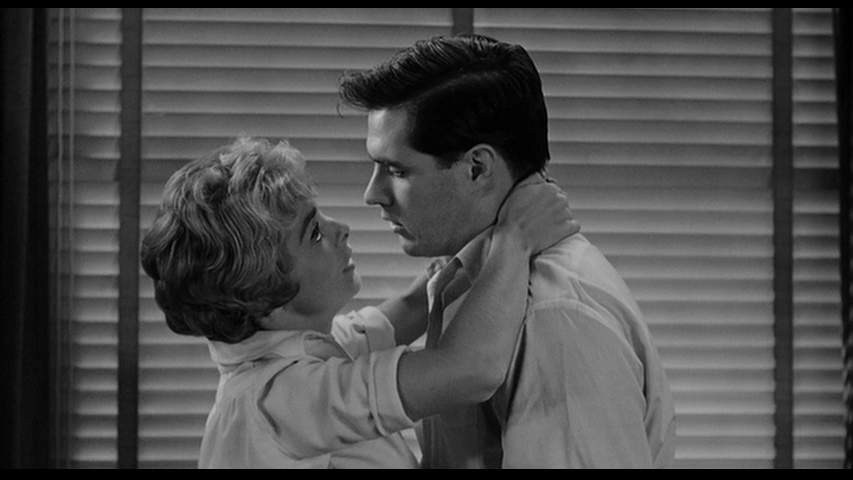
The scene is an Arizona hotel room and two lovers have just finished an afternoon tryst and are now engaged in a tense post-coital discussion, where she is tired of the secrecy in their relationship and he is preoccupied with his looming financial obligations.  As they slowly dress, they resolve to find a way to make it work.
Marion: “Oh Sam, let’s get married!”
[they kiss]
Sam: “Yeah.  And live with me in a storeroom behind a hardware store in Fairvale?  We’ll have lots of laughs.  Tell you what—when I send my ex-wife her alimony, you can lick the stamps.”
Marion: “I’ll lick the stamps.”
It’s the last time they’ll ever see each other.  And so begins the tale of Marion Crane and her fateful intersection with the now infamous Norman Bates.

Now, every cinephile has a special, highly personal list of films—films they understand as great, films whose importance they appreciate and whose influence on the art form and the culture is undeniable.  But films which they don’t like all that much.  Alfred Hitchcock’s 1960 Psycho is one of those films for me.  For I’ll readily admit that the film is remarkably made, and the vision of its director and the contributions of composer Bernard Herrmann, editor George Tomasini, opening credits maestro Saul Bass, and actors Anthony Perkins and Janet Leigh are all exemplary.  The evidence on the screen is without question and the status the film has in the horror genre and the classic film canon is well-deserved.
But the thing is, I just don’t find Psycho very scary or emotionally engaging.  It’s always been an academic exercise for me, whereas Hitch’s subsequent film, The Birds (1963) I find much more unnerving, provocative, subversive and terrifying.

I live in the Bay Area, where The Birds takes place (first in San Francisco, then north to Bodega Bay in Sonoma county).  My dad was born in Phoenix, where that lazy rendezvous occurs, and I’ve driven across the southwest several times, a route that Marion takes after stealing her employer’s money, so I feel like I have a personal connection to both landscapes depicted in the films.  Hitch always had a gift for setting, and each has an atmosphere that's very real and tangible, though very different.   But for me, it's in studying some of the deeper differences that perhaps best highlight why I prefer one so much more than the other.

Psycho rattles your cage but always keeps a certain moral polarity.  Marion may have made a poor decision (the theft) but is depicted as a fundamentally good and sympathetic person, as are beau Sam and sister Lila.  On the surface, Norman is meek and genial but ultimately, his murderous motives aren’t particularly complex: He is fundamentally disturbed, an Other with a mental schism that manifests in a tragic, divided self.  He lives outside civilization—first in a remote motel off the desert highway, and then in an institution for the insane, locked up and glibly reduced to a psychological diagnosis.
The Birds has greater complexities that get under your skin.  We first see Melanie (Tippi Hedren) and Mitch (Rod Taylor) flirting in a pet store off Union Square and they’re both attractive but a little off-putting.  It’s not a meet-cute.  The tension and chemistry crackle, and while we’re not sure which is more of a predator, both undeniably enjoy playing games.  And as the film continues, we watch them spar and tentatively feel each other out.  Of course, any romantic prospect goes unconsummated because by the time she’s tailed him to his home farther north, nature has started to rebel.  We don’t know why the birds attack; Hitchcock never explains it--though if you watch Melanie’s relationship with Mitch’s mother Lydia (Jessica Tandy), we’re given some clues.

But that all lives in the world of metaphor and symbolism.  In the meantime, the avian uprising takes its human toll, not in a few passers-by who check-in at the wrong establishment, but a full town under siege, with its population quickly devolving into panic and paranoia.  Psycho is about one unhinged individual well off the beaten path.  The Birds is about the end of the world.  Our world.  And while the shower scene in the former is a master class of cinematic construction, I know I would rather go that way than how poor Annie (Suzanne Pleshette) dies, being brutally pecked to death.  The most haunting shot in Psycho is that corkscrew camera move focusing on Marion’s lifeless eye, still fixed in a gaze of unbelieving horror.  It’s a tremendous, haunting moment.  But Farmer Fawcett in The Birds is the film’s first casualty and he has no eyes after the birds are done with him.  I find that far more nightmarish.
For me, the other thing I find frustrating about Psycho is that it peaks early, with that shower scene.  Everything after that for me is a slow decrescendo, an anti-climax.  We know the “twist” about Mother so there’s little sense of mystery building up to the mummified reveal, and while Anthony Perkins does a wonderful job in the role, Norman really is less a character and more the shell of a person co-opted by his dead mom long ago.  What we see of him is a front, a shadow of a victimized little boy, so when Marion dies, the most interesting person does, too.

But The Birds builds and builds and builds.  The schoolhouse.  The diner.  The sparrows through the chimney.  The gulls in the attic.  And just when you hope for a release valve, a return to normalcy, an explanation that sets things right, it never comes.  The birds have taken over.  Mitch and Melanie and the rest may depart their home, but they haven’t really escaped.  It’s one of Hitchcock’s darkest endings and certainly his most apocalyptic.  If the Earth ever wanted to fight back, we wouldn’t stand a chance.  For me, that’s an existential type of vulnerability far more resonant than being naked in the tub.
Hitchcock has always benefited from great composers over his career—most notably Herrmann but also Franz Waxman (Rebecca) and Miklos Rozsa (Spellbound), among others.  But The Birds has no score.  Instead, there’s only a daring aural soundscape that’s a cacophony of bird calls and shrieks—nothing tuneful, just din and chaos.  I think it shows an enormous amount of self-awareness and discipline for an artist like him to not fall back on familiar patterns and habits, and time and again, The Birds breaks the mold of what we’re accustomed to with Hitchcock.  It’s not a very funny film, as we’re often used to seeing in his work, but it is fantastic.
Of course, there are birds all over Psycho—the city of Phoenix, Marion CRANE, and all the examples of Norman’s taxidermy hobby.  They stay at silent attention in his parlor, ominous but stuffed.  It’s a strange pastime and a ghoulish one once we know his secret, but it’s also his most fascinating character detail.  The fact that these two films are back-to-back in Hitchcock’s career makes for a wonderful study in contrasts and an irresistible double bill.  

But for me, Psycho always remains largely a cold and analytic experience while The Birds continues to be a starkly visceral one, steeped in ambiguity and a perverse sense of wonder.  It’s the most cryptic of Hitchcock’s films, which is perhaps why it’s also one of his most satisfying.  Hitchcock was famous for being a control freak, meticulously mapping out every shot, leaving little to chance or spontaneity.  Most of his protagonists find themselves in a dark place, but through resourcefulness, creativity and luck, they figure out the truth and save the day.  The Birds is his most artistic expression of how easily we can become victims to randomness and powers far greater than ourselves which we can never control.  It is a masterpiece.
I don't know whether it's accidental that many of my favorite films of his take place in the Bay Area, starting with the sublime Vertigo (also SF and previously discussed here) and continuing with the exceptional Shadow of a Doubt (1943; filmed in Santa Rosa).  My mother had never visited Bodega Bay but she wanted to because of The Birds, so we recently went before she moved to her new home out east.  The schoolhouse is the most iconic location and instantly recognizable a half-century later, and while little else in the small town resembles the film, it's a beautiful area with some lovely views off the water. 

The Hitchcock stamp was Scott #3226.  If you look carefully at the color photo of him with the cigar, you’ll see that there’s a subtle die-cut in the stamp itself of his famous silhouette (in the upper left hand corner).  I can’t tell you how nerve-wracking it was to separate all these stamps when this Legends of Hollywood sheet was first issued, because the perforations were so close to that die-cut, and it was easy to have that inadvertently tear if you weren’t careful.

Hitchcock also has a stamp (Scott #4414o) from the Early TV Memories issue.  Alfred Hitchcock Presents aired from 1955-1962 so in the time frame of both of these productions.  The coastal bird stamps issued earlier this year are #4991-94.  The American kestrel is #3031, the ring-necked pheasant #3050, and the British Alfred Hitchcock stamp was issued in 1985. 

My 10 Favorite Hitchcock films

  1. Vertigo (1958)
  2. Strangers on a Train (1951)
  3. Shadow of a Doubt (1943)
  4. Notorious (1946)
  5. Rear Window (1954)
  6. The Birds (1963)
  7. North by Northwest (1959)
  8. The 39 Steps (1935)
  9. The Lady Vanishes (1938)
  10. Foreign Correspondent (1940)


Thursday, August 13, 2015

East Village People


I don’t really talk about my stamps much in real life.  People know about the blog (I’ll post a link periodically on Facebook or Twitter), but I don’t converse much about this pastime to friends nor volunteer that I have a blog--let alone what it’s about--in social situations.  The reason of course is that most people’s hobbies are not at all interesting to non-aficianados, and an innocent question in polite society could easily suck the unsuspecting down a vortex of hopeless minutae that one can instantly regret.
The perfect cinematic example of this is in Woody Allen’s very funny Manhattan Murder Mystery (1993), where a couple, Larry & Carol Lipton (Woody and Diane Keaton) slowly get embroiled in the possible murder plot of an unassuming neighbor, a passionate philatelist whose primary character trait is a gregarious eagerness to bore people with his collection, something Larry learns quickly when he and Carol first pay him and his wife a visit.
Paul (Jerry Adler): “Now let me show you a mint 1933 airmail—very rare and very beautiful.  Look at that.  And this plate block is quite unique because it has a flaw in the engraving.  See if you can see it.”
Larry: “It’s hard for me…”
Paul: “Give you a little hint, right down here in the corner.  Interesting.”
Larry: “That little tiny thing there?”
Paul: “That makes it quite valuable, you see.”
Larry: “Ah-ha.”
Paul: “And I just got in a commemorative set of issues that are going to be quite valuable, too.  Look at the color work there. Look at these presidentials.  Look at the color work.  Even the perforations are still intact.”

Of course, his hobby is open season for Woody’s commentary after their visit is over
Larry: “Jesus, couldn’t you keep the conversation going a little longer in there?  I was signaling you frantically.”
Carol: “I was just trying to be neighborly.”
Larry: “Neighborly?  If this guy showed me his stamp collection one more time…My favorite thing in life is to, you know, look at cancelled postage.”
 

Once the wife dies, supposedly of a heart attack, Carol’s suspicions are aroused, which are only fueled by a friend of theirs, Ted (Alan Alda):
Ted: “Maybe this guy killed her, you know?. Like he’s got like a young tootsie stashed someplace.”
Larry: “No, no, not this…you gotta, you gotta see this guy.  This guy gets his jollies from licking the back of postage stamps. He’s a boring, old…”
Ted: “I could see that.  Depending on whose picture is on the stamp.”
I suppose it’s a bizarre backhanded compliment to think that stamp collectors are so boring, we’re incapable of nefarious doings, but it turns out Ted is right, and along with the help of Woody’s client, writer Marcia Fox (Anjelica Huston), the unlikely foursome get to the bottom of some increasingly mysterious clues and developments, but not without some hilarious digressions along the way.
It may seem sacrilegious to say it, but I prefer this Manhattan to Woody’s more heralded Manhattan from 1979.  For me, that film, awash with Gershwin music and Gordon Willis’s B&W photography, has some marvelous elements but is less than the sum of its parts.  The film feels glossy, fabricated, with some good one-liners but dialogue that overall feels like it’s trying to one-up Annie Hall.  Everyone feels rooted in type and it never quite gels for me.  Plus, the most beautiful performance, Mariel Hemingway’s, is in the service of what still feels like a skeevy March-November romance.  It’s his most overrated movie, I think, and one that mostly inspires in me curiosity of what he could've done with Meryl Streep in more than just a bit part.


Mystery has modest intentions, but it actually does deliver on all cylinders.  The mystery is a good one, with the menace comic but also very real.  This is also probably Woody Allen’s least dysfunctional relationship depicted in film, with his reunion with Diane Keaton an effortless one.  Their dynamic of a married couple, still endlessly charmed by each other even though the irritations and restlessness of familiarity abound, is instantly believable.
It’s also a wonderful reassembling of two other major forces in Woody Allen’s best film, Crimes and Misdemeanors from four years earlier.  Here Alda still has that borderline-unctuous personality, but in a very likable way (think early MASH).  And Huston does a 180 from her ill-fated Dolores Paley.  She’s smart, fearless, stylish, and quick-witted.  In her career, she’s often traded on an ominous sensual presence in films like The Grifters or Prizzi’s Honor, but I think this is her sexiest role by far, and she’s fabulous.
It also is very knowing about the crime film, Woody being a voracious cinephile, and it upends the genre’s conventions at every turn.  There are few setpieces funnier in his films than the phone call with their suspect, each amateur sleuth armed with a tape player trying to keep a fabricated conversation on the rails.  And of course, the wry Lady of Shanghai climax is incredibly self-aware and undeniably perfect.  The film is a real gem.

Of course, we don’t actually see much of Paul’s collection, but that rare airmail stamp?  It’s gotta be this Century of Progress issue (Scott #C18).  Today’s mint value would be around $100, not bad but nothing compared to the Graf Zeppelin issues from just a few years earlier.  Then again, he does talk about an error on a plate block, so that would make things more, uh, interesting...
The New York stamp (Scott #3592) is from the Greetings from America issue, while the Cinematography stamp (#3772g) is from the American Filmmaking release.  George Gershwin is #1484, Glenn Miller #3098, and "Radio Entertains America" (#3184i) is from the Celebrate the Century series.  Marge Simpson (#4400) is voiced by Julie Kavner, who's appeared in 7 of Woody's projects, and Carrie Fisher (Princess Leia, #4143f) has appeared in just that one pictured.  As for the Martin Ramirez stamp from earlier this year (#4972)?  I thought it had a nice Art Deco vibe which suits that lovely period film nicely.


My 10 favorite Woody Allen films
  1. Crimes and Misdemeanors (1989)
  2. Zelig (1983)
  3. Midnight in Paris (2011)
  4. Annie Hall (1977)
  5. Bananas (1971)
  6. The Purple Rose of Cairo (1985)
  7. Hannah and Her Sisters (1986)
  8. Another Woman (1988)
  9. Manhattan Murder Mystery (1993)
  10. Sleeper (1973)

Friday, June 12, 2015

Running Wild with Wilder


Billy Wilder's hilarious Some Like It Hot (1959) has the following exchange between Jerry (Jack Lemmon) and Joe (Tony Curtis), after Jerry spent the night, in drag disguise, dancing with millionaire Osgood (Joe E. Brown).

Jerry: Have I got things to tell you!
Joe: What happened?
Jerry: I'm engaged.
Joe: Congratulations. Who's the lucky girl?
Jerry: I am.

I've seen this film on the big screen more times than I can count, and the one thing unusual about this exchange is that the audience reaction is so strong after "I'm engaged" that I've never once heard the next, to my mind funnier, joke clearly. It gets lost in the gales of laughter.


But given the breakneck speed of the film, it's easy to see why.  Few comedies I know are so dense with jokes as this one.  There are the recurring jokes (the one-legged jockey, Blood Type O), the meta-movie ones (the gangster film references, the Cary Grant impersonation, 30s matinee idols George Raft and Pat O'Brien in the cast), and the countless sexual innuendos.  All funny, all impeccably delivered.  But so many of the jokes also contribute to the actual plot, like a perfectly-oiled machine of cause and effect that make the story details of two musicians on the lam from the mob both highly unlikely and hilariously inevitable.

I've always loved Hot because it has edge and bite, but isn't an acid bath of cynicism like so much of Wilder's (admittedly terrific) work.  And it's a marvelous study of contrasts: male vs. female, Chicago winter and Miami warmth, a playful musical comedy with the highest body count of any Wilder film.  Finding the right tone for all these contradictions can be a high-wire act, but Billy balances them effortlessly.  And ultimately, it's a film about acceptance, embracing how fluid and foolish the human experience can be but still showing a generosity toward all its manic characters.

The Hotel del Coronado is featured heavily in the film, particularly when Sugar (Marilyn Monroe) in her bathing suit first meets Joe in his faux millionaire get-up on the beach behind the hotel.  Growing up in San Diego, the Hotel del was a constant fixture in the visual language of the city, as close to an icon as that suburban kingdom had. Coronado is actually an island off the coast, and the Coronado Bridge has this magnificent sweep, arcing its way along the city skyline. As a family, we didn't go there often (we were ensconced in the North County, near Escondido, the avocado capital) but any trip there represented a special occasion. The beach was beautiful, and never a hot mess of tourism like so many of the San Diego beaches were.

I grew up in the era of the TV show Simon & Simon, so I was used to seeing San Diego landmarks on screen, but Some Like It Hot, a film that never travels farther west than Chicago, was the first time I'd seen it in a movie, and even then, there was this geographic displacement. For there were Sweet Sue's Syncopators cavorting in the Florida surf, with the Hotel del behind them.  But it still created a connection for me, first rooting the glamour of Hollywood in something real and recognizable.


Some Like It Hot was also one of my ex-wife's favorite movies, and one that she'd never seen before meeting me. I remember going with her to see it in the theater and having that line so buried in laughter, she didn't even remember hearing it. So we returned home and I played the VHS for her so she could. I usually had a good sense of the kind of movie she'd like, and many of her subsequent favorites were ones I'd seen on my own the first time (as I often did while she worked late) and knew she would love: Eternal Sunshine of the Spotless Mind. The Wild Parrots of Telegraph Hill.  O Brother, Where Are Thou?

When we went back to visit San Diego, I took her to the Hotel del. It's a beautiful complex, and its modern amenities didn't detract from its classic Victorian grandeur (it was built in 1888). All the fixtures and details were gorgeous, and we even had Easter brunch there--as impressive and as indulgent a spread as I've ever seen. They have photos and ephemera from the film on display in the lobby, and the sand between your toes probably felt just like it did when Jack and Tony and Marilyn walked there 40+ years earlier.


That was long ago, and feels even longer. And so I wonder what those films I introduced her to and she loved so much mean to her now. As the film reminds us, nobody's perfect. But at least she tried to make things work. And in the end, she was the one who got the fuzzy end of the lollipop.  So I know there's plenty that she'll choose not to look back on, and I can't blame her.  Like that drowned out joke, the swell of emotion and memory can easily overwhelm many of the smaller details, no matter how good or rich or authentic they may have once been. 

For some people, movies, songs, and places are inextricably tied to a person or an experience. Therein lies their special beauty and their power. Some films can be timeless, but not everyone separates that larger appreciation with the more personal resonance they have. For some, those emotional associations are too strong, and the value they once had are no longer worth the poignancy they now bring.  And so it was with her, sometimes.  But I can't say.  We may not have been right for each other, but I hate the idea that Some Like It Hot might be as much out of her life as I am. I hope not.


The Marilyn Monroe stamp (Scott #2967) was the first in the Legends of Hollywood USPS series.  The Frank Capra stamp (Scott #4670) features in its illustration the Hotel del (which was also used to terrific effect 2 decades later in Richard Rush's excellent The Stunt Man).

My Favorite Films of 1959

1. Some Like It Hot
2. Rio Bravo (Hawks)
3. Hiroshima, Mon Amour (Resnais)
4. The World of Apu (Ray)
5. North by Northwest (Hitchcock)
6. Pickpocket (Bresson) 
7. Fires on the Plain (Ichikawa)
8. Floating Weeds (Ozu)
9. The 400 Blows (Truffaut)
10. Odds Against Tomorrow (Wise)