Showing posts with label Black Cinema. Show all posts

Sunday, May 20, 2018

Praise Be


Of all the MGM musicals ever made, spanning over half-a-century, only 2 have been memorialized on a US postage stamp.  One is, unsurprisingly, The Wizard of Oz, which I have discussed on this blog before.  The other?  Not any of the usual suspects, like Singin’ in the Rain or The Band Wagon or Meet Me in St. Louis.  The only other film is King Vidor’s Hallelujah (1929).

That was part of a 5-item postal issue on early Black Cinema (also discussed in an earlier post) and Hallelujah is easily the most famous of the 5, and a seminal work in the genre because even with sound in the movies less than 2 years old, you can see Vidor pushing the aesthetic envelope.  There’s certainly a lot to dissect about the film, from its ground-breaking origins (it was one of the first Hollywood studio films with an all-black cast) to its troubled legacy because of the narrative it helped fuel about African-American stereotypes.

But something that makes this film stand out among musicals is also something it has in common with another all-black MGM musical 14 years later, Vincente Minnelli’s Cabin in the Sky (1943).  And that’s the unique role that religion plays in both films.  For integral to both films’ messages is the ways church and God, music and ritual are hard-wired into black culture.

Hallelujah is about a sharecropping family whose eldest son Ezekiel (Daniel L. Haynes) gets lured into assorted temptations (gambling, women) and it’s his religious rise as a rabble-rousing pastor and eventual fall from grace, a victim of his vices, that comprise the backbone of the film.  Throughout, we see that singing—in the cotton fields, with neighbors, in church and nightclubs—is an important part of the family’s life.  Musicals have often been criticized for being “unrealistic” in having their characters spontaneously burst out in song, but in Hallelujah, it feels completely normal because song and community are intimately entwined.  Music brings people together, providing inspiration and comfort in a hard-scrabble life and so all the music numbers have an almost naturalistic feel—both the traditional spirituals but also the ones written for the film (most notably “Waiting at the End of the Road”, by Irving Berlin).

Cabin in the Sky is actually pretty similar in that Joe (Eddie “Rochester” Anderson) has his soul fought over by competing angels and demons as he is also tempted by gambling and women and faces a troubled path toward redemption that isn’t without its own pitfalls and distractions.  While Hallelujah is presented as melodrama and cautionary tale, Cabin is played for laughs and uplift, but it also has musical numbers that take place in the wide array of African-American centers of community: church, juke joints, backyards and work gangs.  Here, the musical heavy lifting is done by the marvelous Ethel Waters, who sings the title tune as well as the Oscar-nominated “Happiness Is a Thing Called Joe” (by Harold Arlen and E.Y. “Yip” Harburg).  But she gets tons of great support by Lena Horne and cameos from Louis Armstrong (as a demon) and Duke Ellington.

But it’s interesting that when you look at the films, the churches act as spiritual centers and this is in sharp contrast to decades of mainstream Hollywood musicals that rarely use churches as much more than narrative devices.  Ezekiel whips his camp meeting congregation into a religious fervor, and while his personal story is one of backsliding and hypocrisy, the message of love and confession is one that touches a nerve in his flock (and which is upheld without irony by the rest of his revivalist family).  Joe’s afterlife in eternity is genuinely at stake and fidelity and responsibility are depicted as paths toward a better marriage and better living.  The square Rev. Green (Kenneth Spencer) may not be nearly as fun as Rex Ingram’s hilarious Lucifer, Jr., but he has Joe’s best interests at heart—not just to follow a set of prescribed rules but to improve Joe’s relationship with the devoted Petunia (Waters).

I’m hard pressed to think of many examples of the great canon of American musicals pre-1970 that touch on central religious themes that way.  Sure, churches are abundant for social gatherings or weddings (“What a Lovely Day for a Wedding” from Royal Wedding or “Get Me to the Church on Time” from My Fair Lady).  Bible stories are alluded to in song lyrics, from Seven Brides for Seven Brothers’ “Sobbin’ Women” to Elvis singing “Hard Headed Woman” in King Creole.  But they’re little more than plot points, without any larger thematic resonance.  Heck, even Bing Crosby as a priest in Going My Way is rarely a fount of theological insight but rather a source of warm, friendly, homespun advice.  Ditto the nuns in The Sound of Music.

Which make Cabin and Hallelujah interesting to me, since they aren’t afraid to immerse themselves in the middle of a part of the American social fabric that most musicals are reluctant to touch.  Those other films may implicitly embrace what some might consider religious “values”, but Hallelujah explores the complex relationship between faith and character, and Cabin finds joy in spaces that can be both reverent and rambunctious.  Once the 70s kick in, we see stage adaptations like Fiddler on the Roof or Jesus Christ Superstar that more explicitly examine (and question) beliefs and traditions, but these early MGM musicals not only paved the way in bringing African-American casts and culture front-and-center to white audiences, but its worship sensibility, too.

Now, I did mention that only 2 MGM musicals have been depicted on a USPS stamp, but I should make a technical concession to Show Boat (1951, Sidney) for while the film itself is not on a stamp, the original Broadway musical is.

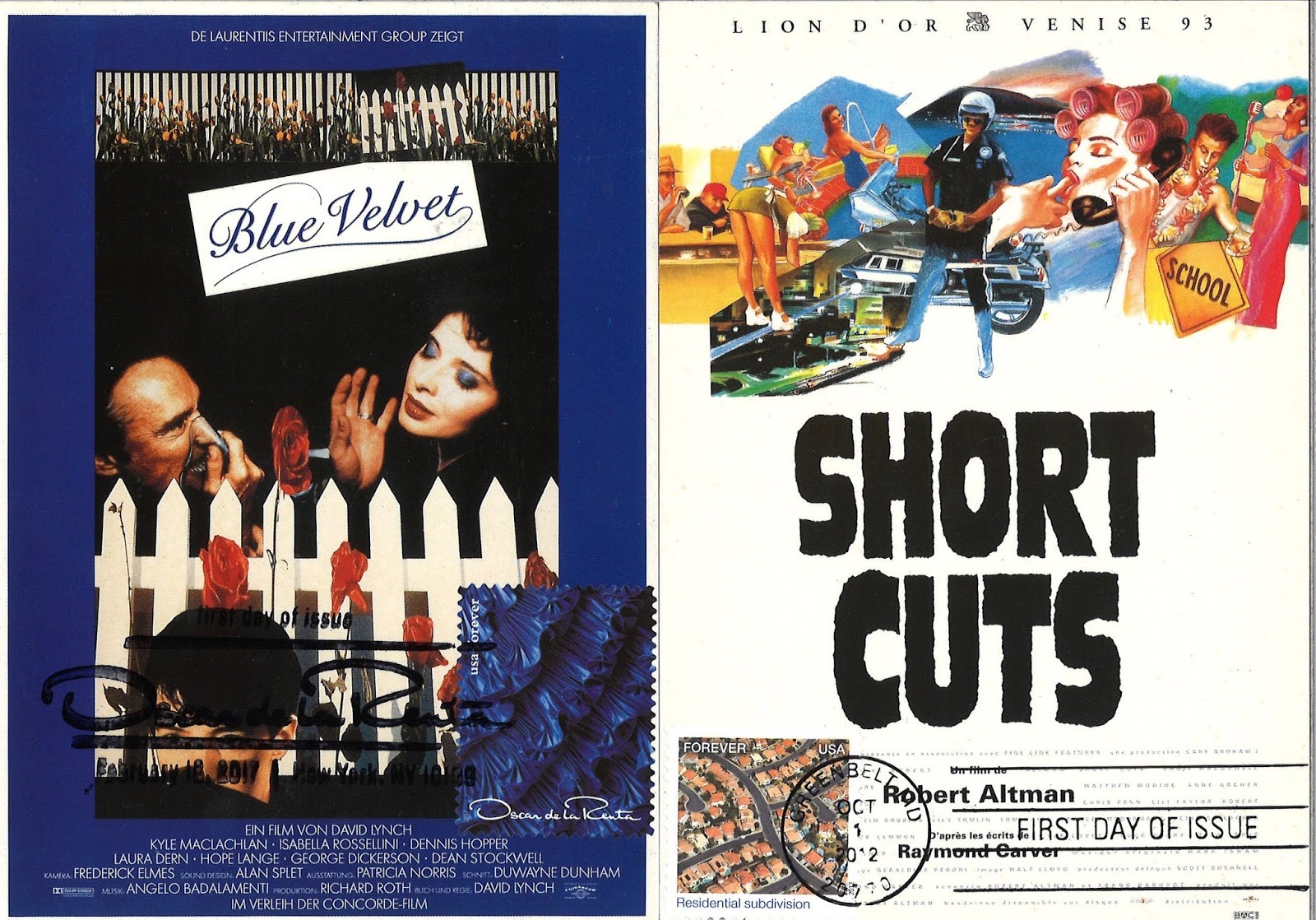
Hallelujah was released in time for the 2nd annual Academy Awards, and it was King Vidor’s second Best Director nomination.  He would earn five in his career—a record number in that category for someone who would never earn a competitive one.  He did receive an Honorary Oscar in 1978.  His nomination for Hallelujah is unusual in that the director nomination was the only one the film received.  This has only happened a handful of other times since: The Inn of the Sixth Happiness, Alice’s Restaurant, Blue Velvet, The Last Temptation of Christ, Short Cuts and Mulholland Dr.
Cabin was Minnelli's first feature film, and he would go on to helm two Best Picture winners that were MGM musicals: An American in Paris and Gigi, the latter earning him a Best Director statue, too.

For more entries in this weekend’s MGM musical blogathon, go here.


-->

Tuesday, April 25, 2017

2017 SFFILM & Cinequest Wrap


A big year for the newly branded SFFILM (formerly the San Francisco International Film Festival), which just celebrated its 60th anniversary.  Here are some thoughts and impressions of the terrific cross-section of their programs (20 features, 49 shorts) I was lucky to catch this year.

There were more archival films and live music performances than usual, including an unlikely merging of the two with a screening of George Lucas’s first film THX-1138 (the revised 2004 “Special Edition” re-release version, not the original 1971 version) accompanied by a hard-driving rock score from Asian Dub Foundation.  This meant that Walter Murch’s sophisticated sound design was inaudible (the entire film played with subtitles), but it helped play up the dystopic visuals, which still pack a wallop 40+ years later.  It’s still my former boss’s most mature movie and a fun one to revisit in the glories of the Castro Theater.  The Castro was also where a rare screening of Jerome Hiler’s experimental shorts (both old and new) occurred, also to live music from Will Oldham.

The Story of a Three-Day Pass (1968) was Melvin Van Peebles’s first film and that also enjoyed a rare archival screening.  Shot in France, it’s clearly a child of the Nouvelle Vague with its free-wheeling pacing and visual imagination, but also with what would be MVP’s familiar exploration of racial identity, brimming with wit and clear-eyed cynicism.  His next film would be his legendary Sweet Sweetback’s Baadasssss Song, and it was great fun seeing where that ballsy attitude originated.  Another standout retrospective screening was the Russian film A Long Happy Life (Shpalikov, 1967), also infused with a warm French sensibility, but in the classic tradition of Vigo or Pagnol and a lovely and poignant film I saw for the first time.

Since this was my first year visiting the Cinequest Film Festival in San Jose the month before (5 features, 58 shorts), I’ll also discuss some of my discoveries there, particularly since the new British drama Wilderness was a fitting companion to the Van Peebles film.  Both are about whirlwind interracial romances that take place in Europe around the same time (the late 60s).  And while it can’t completely avoid some narrative contrivances, the acting by the two leads (Katharine Davenport, James Barnes) is excellent and the eroticism is potent and very natural.  It’s sometimes hard to tell which festival features are destined for wider distribution but this one certainly deserves it.


Another one that does is the terrific Iranian thriller A Dragon Arrives!, part true-life mystery, part stylish 60s noir with some supernatural tensions, and part meta-examination of the melding of history and storytelling.  For those of us who love what the last couple of decades have brought us from that country via Kiarostami, Farhadi, and Makhmalbaf, this is a very, very different animal, but an exciting demonstration of western tropes taking root with Iranian themes and issues.

Festivals have often proven themselves a showcase for talented female filmmakers in ways that the studio and distribution worlds continue to fall short, and some of my favorite narrative films were directed by women (also not surprisingly, all international).  The best to these eyes was the Cinequest title Past Imperfect, grounded by a phenomenal performance by Evelyne Brochu about a woman who has her life turned upside down by having her son (formerly raised by family) thrust back into her life.  It’s a familiar premise, but handled with soulfulness and compassion, with an immense amount of gorgeous nighttime photography.

More wonderful female-helmed films included The Wedding Ring from Niger and The Wedding Plan (Burshtein) from Israel.  The latter is a very funny wry comedy in the spirit of Rohmer (one of my favorite directors) about a woman committed to a scheduled wedding for herself even though the groom is a complete mystery.  And the former is a beautiful, vivid tale of a woman living in Europe returning to her African homeland and navigating the tricky landscape of traditions around matrimony.  Both are warm, generous, and clear-eyed about making a stand in the face of cultural expectations—unapologetically feminist, with complex characters and conflicts.

There were also two quite lovely Latin American films that stood out.  The Winter is about a laborer in the Patagonian highlands who must take over managing a ranch from a seasoned veteran. Family Life is about a Chilean drifter who tries on a new identity during a housesitting gig.  While one has epic sweep with an eye for the isolation in landscape and the other is an urban drama with an immersive sexual immediacy, both are intimate meditations on the challenges of finding your place in the world.  And while it may have a few too many echoes with Brokeback Mountain, the English farm drama God’s Own Country, about a burgeoning rural, cross-cultural gay relationship, manages to meld sensibilities from both these films quite effectively, too.


When it comes to documentaries, the high-profile standouts I saw were the two on filmmaking, 78/52 (Philippe), about the shower sequence in Psycho, and Score: A Film Music Documentary (Schrader).  And while both are ambitious, on a micro- and macro-level respectively, they’re also both incredibly frustrating works.   78/52 does an interesting job of deconstructing the sequence (cue Walter Murch again for analysis) and provides some helpful connective tissue between this legendary scene and both Hitchcock’s work and film history in general.  But it revels too much in Hitchcock’s reputation as an auteur and provocateur; it’s all adulation when deconstructing the mythology of the man 50+ years later would’ve been more incisive (I discussed Psycho previously on my blog here).

Even more troubling is the film music doc, which tries to be both an historical overview and a broad examination of the creative process.  The latter is certainly much more effective than the former (where significant talents get short shrift), but as interesting as it is to see composers collaborate with film directors or conduct orchestras recording sessions, the film is blind to the conspicuous lack of women and people of color in this role.  This is particularly noticeable because so many contemporary composers are interviewed or filmed working on projects, virtually all of them white dudes.  It makes the craft feel like a big boy’s club, and while there might be an element of truth to this in an industry which still has a serious gender and racial imbalance in certain disciplines, it goes completely without comment throughout the film.  Amidst the air of simplified celebration, it’s the elephant in the room, and a token Rachel Portman or Quincy Jones can’t change that.


Some more effective documentaries included the remarkable The Force, about the Police Department in Oakland (my home) and the history of controversies it’s instigated through violence and scandal.  It’s a very clever film, giving the impression that access means the OPD embraces a new sense of transparency, only to discover that ugly cultural traditions behind the blue wall still run deep.  Talking the talk and walking the walk are very different things, and it’s a great lesson on why mistrust in a community can be pervasive when abuse of power goes ignore or unchecked.  Even better is In Loco Parentis, a thoroughly charming doc about a British boarding school and the loving, committed teachers on the staff.  Both films take a Frederick Wiseman-like view of their subjects (no interviews, voiceover, or score), which works incredibly well in both cases.

Also worth noting were two docs from Cinequest about a very different group of doctors.  Memento Mori (Thompson) is about the incredible logistical challenges and devastating emotion one encounters in the field of organ donation.  With The Twinning Reaction (Shinseki), sets of identical twins separated in infancy through a shady adoption agency under the guise of “scientific research” are interviewed--some reunited with their sibling and some not, but all dealing with the heart-breaking repercussions of a needlessly cruel policy that persisted for decades.  Not without their flaws, both are still well worth checking out.


10 Favorite new feature films

1. Past Imperfect (Teirlinck; Belgium)+
2. The Winter (Torres; Argentina)*
3. In Loco Parentis (Chianain/Rane; Ireland)*
4. A Dragon Arrives! (Haghighi; Iran)*
5. The Wedding Ring (Keita; Niger)*
6. The Force (Nicks; US)*
7. Wilderness (Doherty; UK)+
8.  God’s Own Country (Lee; UK)*
9. Family Life (Jimenez/Scherson; Chile)*
10. That Trip We Took with Dad (Lazarescu; Romania)+


10 Favorite new short films

1. Bagatelle II (Hiler)*
2. Pearl (Osborne; Virtual Reality version)+
3. Modern Houses (Dixon)+
4. A Brief History of Princess X (Abrantes)*
5. The Rabbit Hunt (Bresnan)*
6. Russian Roulette (Aston)+
7. The John Show (Sokolow)+
8. Real Artists (Wood)+*
9. Summer Camp Island (Pott)*
10. No Other Way to Say It (Mason)+

* = SFFILM; + = Cinequest


The Alfred Hitchcock stamp is Scott #3226, Bernard Hermann (who is featured in both films docs I mentioned) is #3341 and Editing, part of the American Filmmaking issue, is #3772h.  The Star Wars stormtroopers are #4143o and the stamp for the Sport of the Gods one-sheet (part of the Black Cinema release) is #4337.  The Jack O’Lanterns from last year’s Halloween issue are #5138 & 5139 .  The Iranian Film Festival is a cache I picked up at Westpex, which has its annual convention in San Francisco this coming weekend.  Hope to see you there!

Thursday, September 1, 2016

Like Silver


Happy Birthday to Lily Tomlin, who turns 77 today.  One of my favorite films of hers is also the best stamp film from the 70s, Robert Benton’s underrated neo-noir, The Late Show (1977).  In it, washed-up private eye Ira Wells (Art Carney) forms an unlikely alliance with new-agey flake Margo Sterling (Tomlin) after the case of her missing cat leads to blackmail, adultery and the murder of his former colleague, Harry Regan.
After an early gunfight in front of his home leads to the death of a small-time crook, Ira discovers a wallet-size album of stamps on the corpse and starts to process the clue with Margo and his lowlife tipster contact Charlie (Bill Macy). 
Margo: What’s that? Stamps?
Ira: The Whiting job
Margo: Who? Whiting? I’ve never heard of anyone named Whiting...
Ira: About 10 days ago, some place out in the valley.
Margo: Who is that?
Ira: That guy Whiting had a collection worth almost 50 grand.


Margo: Who is that? Who’s Whiting?
Ira (to Charlie): There’s a Murder One tied to it, right?
Margo: OK, don’t tell me, what do I care?
Ira: Two guys broke into a house out in the valley. They tied up Whiting and his wife and started to lift the stamps.  And then something must’ve gone wrong because they beat up Whiting and killed his wife.
Margo: Oh how disgusting, I don’t want to hear any more.
Ira: That’s what Harry was on to, right?
Charlie: How should I know? He didn’t say.
Margo: I don’t wanna hear anymore, you guys are too much!
Ira: Oh come on, Charlie, Harry knew about the stamps—what’s more, he told you about it, that’s why you knew what to look for on the bum!
Charlie: Kid, I swear, he didn’t tell me anything.  (sirens)
Ira: Hear that?  That’s the cops.  They’ll be here in a coupla minutes.  Now either you start to play it on the square with me, or I’ll feed you to them.  Which considering your record...
Charlie: You wouldn’t do that.  (beat)  OK, here’s the house number.  Harry is tailing this guy Brian, looking for Margo’s cat.  Then Brian and this pal of his pull off the Whiting heist.  The next day Harry comes to see me and lays out the whole thing, wants me to check out the reward angle.  I nose around, and sure enough, Continental Insurance is offering fifteen grand for the goddamn stamps. 
Ira: You guys were gonna split it.  Just the kind of cheap grift Harry would go for.

Soon after, the trail leads Ira to fence and underworld kingpin Ron Birdwell (Eugene Roche), whom he confronts:


Ron: What’s your business?
Ira: The Whiting job.
Ron: Postage stamps, right?
Ira: That’s right!
Ron: What’s that got to do with me?
Ira: The word is it could be tied in with you....Now stamps are a specialty item.  Not just anybody can move them.  So usually when a guy pulls a heist like that, he’s got the fence lined up in front.
As it turns out, the stamps are a red herring and the plot corkscrews out in other directions and they're never mentioned again.  And the stamps we see--all US--really aren't very special.  They are (as pictured from top to bottom):
  • Abraham Lincoln (1958, Scott #1113)
  • Forest Conservation (1958, #1122)
  • Wheels of Freedom (1960, #1162)
  • Employ the Handicapped (1960, #1155)

All four examples are in blocks of four and are taken from the original plate block (which I explained in a previous post), since you see the edge portion still intact.  But that still wouldn't make them particularly valuable.  What would make them valuable is if there were a perforation error, or if the image was off-center of the cut, or if there was an ink shift in the printing of the images.  Obviously, these we see in the film were just mocked up for some production design without any real concern about philatelic details.
And like the plotting itself, those details aren't what matter.  What counts is that Carney and Tomlin’s odd couple are an inspired pairing: he’s practical but crotchety, she’s quirky and deeply empathic and their oil & water chemistry add a lot of comic fizz to what is really a meditation on aging and loneliness.  Like one of my favorite noirs, The Big Sleep (Hawks, 1946), the plot is labyrinth-like but the real story is not the mystery but rather the character dynamics.  And while that film is saturated with sex, this one is grounded in melancholy as two perpetual misfits gradually find that trust and connection can appear under some of the most bizarre circumstances.  Robert Benton would go on to win an Oscar two years later for Kramer vs. Kramer, but I think this remains the best film he ever directed.  Go check it out.

My name is Sterling Hedgpeth and I’ve discussed the origin of my name, briefly, in a previous post, but it is a name I don’t encounter often—in real life or in pop culture, so whenever I see it (like Lily Tomlin’s character in The Late Show), I tend to remember it.  Of course, the greatest cinematic Sterling was Sterling Hayden who, whether in supporting or leading parts, made indelible marks in such classics as Dr. Strangelove, The Godfather, The Long Goodbye, Johnny Guitar, and The Asphalt Jungle.  He always brought an air of worn-down fatigue or coiled, violent energy to every film he did.  Definitely from the less-is-more school of Mitchum and Marvin, he died in Sausalito 30 years ago, just a few miles from where I go to work every day.  And aside from Sterling Morrison (the guitarist of the Velvet Underground), he may be my favorite Sterling to whom I’m not related.
Another great Sterling was Sterling Holloway, the indelible character actor with the gentle high-pitched voice, most famous for his contributions to the Disney canon: the Cheshire Cat in Alice in Wonderland, Kaa in The Jungle Book, and four shorts as Winnie the Pooh.  And although I’ve never known anyone personally whose last name was Sterling, the movies have offered us Oscar-nominee Jan Sterling (terrific 50s actress with ice in her veins in Billy Wilder’s An Ace in the Hole) and ever-present comic actress Mindy Sterling, best known as Frau Farbissina in the Austin Powers films.  And while his work has mostly been limited to TV, Sterling K. Brown did win an Emmy for his role in The People vs. O.J. Simpson, which I may get around to catching one day.
The only Oscar-winner with my name Is Stirling (with an i) Silliphant for the screenplay of In the Heat of the Night (Jewison, 1967).  Quite bizarrely, he also wrote the screenplay for The Liberation of L.B. Jones, whose main character is named Moan Hedgepath.  That movie even came out the year I was born!  This is one of only two variations of my last name I’ve ever seen in a movie (the other being Paul Mantee’s small role in The Great Santini) and my last name has always been misspelled like these variations.  While I’ve never seen Liberation, its cast (Lee J. Cobb, Anthony Zerbe, Lola Falana, Lee Majors, Barbara Hershey, Yaphet Kotto, Chill Wills, and Roscoe Lee Browne in the title role) intrigues me no end.
So here's a list of my 10 favorite characters named Sterling (first or last) in movies or TV
  1. Roger Sterling (John Slattery in TV's Mad Men)
  2. Whit Sterling (Kirk Douglas in Out of the Past - Tourneur, 1947)
  3. Nat Sterling (Denzel Washington in Courage Under Fire - Zwick, 1996)
  4. Margo Sterling (Lily Tomlin in The Late Show)
  5. Tony Sterling (Donald Woods in Fog Over Frisco - Dieterle, 1934)
  6. Sterling (Patrick Stewart in Jeffrey - Ashley, 1995)
  7. Sterling Archer (H. Ron Benjamin in TV's Archer)
  8. Tim & Lionel Sterling (Ray Milland & Edmund Gwenn in The Doctor Takes a Wife - Hall, 1940)
  9. Robert Sterling (Roger Moore as James Bond's alias in The Spy Who Loved Me - Gilbert, 1977)
  10. Jim Sterling (Mark Sheppard in TV's Leverage)


The Marilyn Monroe & Bette Davis stamps are Scott #2967 & 4350 respectively.  John Huston is #4671 and the Cinematography stamp from the American Filmmaking series is #3772g. Bambi, Alice in Wonderland and Dumbo are #3866, 3913, & 4194 while The Jungle Book (#4345) is a stamp I used on a card which I then forgot to send in to USPS, which is why it's missing the first-day-of-issue postmark.  The Sport of the Gods stamp (#4337) was part of the Black Cinema issue and the quilled paper heart love stamp (#5036) was issued earlier this year.


Wednesday, February 4, 2009

2008 Yearly Wrap


Bette Davis, Scott # 4350


Black Cinema series, including The Sport of the Gods, Scott #4337


Disney: The Art of Imagination issue, including 101 Dalmatians, Scott # 4342


Frank Sinatra, Scott # 4265


Tuesday, January 20, 2009

Yes We Can

When Do the Right Thing came out 20 years ago this year, did Spike Lee have any idea that a day like this would happen as soon as it has? I doubt it.


In Lee's masterpiece, it's not the heat but the humanity that ignites a racial firestorm in a colorful Bed-Stuy community one summer's day. The fashions may have changed, but the film is still as volcanic and mesmerizing as ever, from the opening credits of "Fight the Power" to that final image of the photo of the Rev. Martin Luther King, Jr., and Malcolm X, pinned to the wall of the burned-out Sal's pizzeria. And even though he may be more of an icon than a firebrand these days, I've enjoyed Lee's films since that Oscar-nominated effort--nowhere near as incendiary, but just as ballsy, opinionated, and unapologetic in its political and stylistic perspective.


The lyrics of the opening Public Enemy song includes the lines:

'Cause I'm black and I'm proud
I'm ready and hyped plus I'm amped
Most of my heroes don't appear on no stamps 

Certainly the USPS has done a great deal to tackle diversity in its stamp issues, but plenty of people of color hadn't made the cut when the film was released.  That line is also a testament to how people perceive postage stamps as historical markers--a symbol of what our country self-identifies as important to commemorate and celebrate.

Given that photo that Smiley tries to sell in the film, positioning the stamps of King and Malcolm side-by-side was too irresistible for the postmark, though back in 1999, I was still cagey about using the front of the one-sheet postcards for the FDCs, which is why I used the back. The King stamp (Scott #3188a) was part of the Celebrate the Century series, and Malcolm X (Scott #3273) was issued the same year.

When the Vintage Black Cinema series came out in 2008, I used that opportunity to put some additional stamps up front--the original USPS MLK Jr. stamp (Scott #1771) from 1978, as well as one of him released by the People's Republic of Benin the same year. I've never seen The Sport of the Gods (Vernot, 1921) but it was the stamp that best matched the others so that's the one I used.

I don't think anybody believes the next four years will be easy. But it'll be nice to have a POTUS who will indeed (one hopes) Do the Right Thing.