Showing posts with label Comic Books. Show all posts

Friday, June 9, 2017

All the World Is Waiting for You


Despite the remarkable ascendancy, critically and commercially, of the Marvel Comics cinematic Universe in the last decade, there is no denying that it has largely been one big sausage party.  Growing up as a Marvel comics fan, this was also true of the publisher itself.  Women heroes, when represented, were usually part of a team (Sue Richards, Scarlet Witch, Jean Grey) and there weren’t any female icons with the heft to carry their own title in any significant way.  When the USPS released a set of Marvel stamps ten years ago, the interests of gender parity meant including marginal characters like Elektra and Spider-Woman over far more famous heroes like Thor and Daredevil.  This was because Marvel simply didn’t have any females as big as their counterparts at DC, Wonder Woman or Supergirl.
And so the films have followed-suit, with Scarlett Johansson’s Black Widow (incredible ass-kicker but essentially power-free) doing most of the heavy lifting across five appearances to date.  Even when staffed with Oscar-winners like Halle Berry, Jennifer Lawrence and Anna Paquin, the Marvel films have rarely known what to do with them.  In fact, the only female-driven Marvel film so far has been Elektra, Jennifer Garner’s incarnation who got her own movie after first being introduced as a secondary character in a film where Ben Affleck played an urban vigilante.  Sound familiar?
So Patty Jenkins’s Wonder Woman is far overdue, especially when you consider that her DC colleagues Superman and Batman have had a combined total of 16 appearances in films since Christopher Reeve first began the modern era of superhero movies almost 40 years ago.  That’s one every 2.5 years.  And that’s not even counting The LEGO Batman Movie (2017’s fifth highest money-maker currently).
They say to never let the perfect be the enemy of the good, and Wonder Woman is good.  The business on Exposition Island is clunky (most origin stories are) but rich with Amazon badassery.  There’s not enough of Etta Candy (Lucy Davis) or Antiope (Robin Wright), though there is something delicious about having Princess Buttercup unleash her inner warrior.  The third act reveal of Ares is smart and well-thought out, but what it means is that through most of the film, there really isn’t a truly menacing villain as counterpoint to Gal Gadot’s imposing presence.  Danny Huston was a bigger threat in the Wolverine offshoot movie as a mere mortal, and is definitely no Red Skull.
For of course, Captain America: The First Avenger (2011) is the obvious analogue to Wonder Woman, a pair of noble neophytes waging war in the German (or Belgian) woods via historical flashback.  But the film that Wonder Woman more closely resembles, and a comparison I haven’t seen anywhere yet, is Luc Besson’s The Fifth Element, celebrating its 20th anniversary this year.  For like Diana, Milla Jovovich’s Leeloo is fierce but gentle, naïve but strong-willed, and doesn’t need anyone’s help to take out a room full of assailants.
But more importantly, their arcs are similar because they are their own McGuffin.  Diana thinks she’s carrying the God-Killer (her sword), but she actually *is* the God Killer, just like Leeloo is herself the Fifth Element.  Both have, late in the game, serious bouts of disillusionment with mankind and its propensity for war and violence.  But both overcome this despondency and very explicitly choose to manifest Love—not merely Eros (the stock & trade of comic book fantasy), but Agape, a higher spiritual extension of compassion, generosity and self-sacrifice.
In this sense, I think it resembles Man of Steel (Snyder, 2013), a film I’ll still argue is--while also flawed--underrated and misunderstood.  Both heroes are not mere saviors, but also a means to inspire those around them.  But while that film is cloaked in a brooding melancholy, Wonder Woman has clear-eyed optimism, even in the face of man-made horrors.  After Chris Nolan’s excellent but dark Batman trilogy set the tone for DC’s moody temperament, WW is exactly the shot-in-the-arm this comic series needs.  Which is why I worry about the upcoming Justice League movie, which will depict Diana a hundred years later.  Will she be more jaded and cynical?  She was the best thing about the bad Batman v Superman because she brought warmth and sass and energy.  But as the new movie demonstrates, her real heroic power is Love.  How much of that will survive when she joins this Super Boys Club with a different director at the helm?
The same weekend I saw Wonder Woman, I attended the SF Silent Film Festival.  And it was a welcome reminder of how the movies weren’t afraid of strong women back then, even if the times were far more conservative.  In Filibus (Roncoroni, 1915), the title role is a female mastermind—exceptional thief, daring impostor, and the head of a motley crew of outlaws with gadgets that would make James Bond green with envy.  In Outside the Law (Browning, 1920), Lon Chaney may have two roles (one heroic, one villainous) but it’s Priscilla Dean who calls the shots when she inherits a criminal empire from her father.  She balances being a reformist and a resourceful crook with equal aplomb.
But the real eye-opener for me was The Dumb Girl of Portici (1916), a remarkable collaboration between famous Russian dancer Anna Pavlova and pioneering director Lois Weber.  The first American woman to direct a feature-length film, Weber had dozen of titles under her belt by this time, but she was still known for contemporary dramas and social issue pictures.  This was a film on a completely different level—an epic period piece with a higher budget and bigger scale than she’d ever worked with before.  It reminded me of the talk of giving Patty Jenkins such an expensive tentpole picture after just one feature (the Oscar-winning Monster) and some TV work.
The final result?  Portici is a glorious achievement, with incredible tableaus, jaw-dropping camera movement, and a wonderful sense of drama amidst the herculean (or perhaps, Amazonian?) task of managing so many moving parts within a single frame.  The film isn’t perfect (it still suffers from some stiff dramaturgy typical of the time), but the achievement is impressive: a gorgeous restoration of a film that deserves to be better-known.
Which got me thinking: Why isn’t there a US postage stamp of Weber?  Or of any woman filmmaker for that matter?  Body and Soul (1925) was also featured at the festival, and both Oscar Micheaux and Paul Robeson, the film’s director and star respectively, have well-deserved US postage stamps.  In fact, there’s a wonderful series of stamps commemorating Black Cinema and a handful of film directors have been honored on stamps starting with D.W. Griffith.
 
But the only women who have been honored from the American film industry have been actresses—amazing, powerful, influential actresses, but still ones who never really worked outside the confines of that craft.  No directors or producers, no screenwriters or below-the-line artists.  Douglas Fairbanks has a US stamp, but not his wife Mary Pickford, one of the biggest stars of the silent era and a co-founder of United Artists.
No Lois Weber or Mabel Normand or June Mathis.  No Maya Deren or Dorothy Arzner or Ida Lupino (as important a director as an actress).  Not yet, at least. 

But I’ll keep hoping that one day, I can add a Frances Marion stamp to my Anna Christie card (part of her prolific writing career) or an Edith Head stamp to my Roman Holiday card (one of over 400 films to her credit as costume designer).  Or any number of women who were essential in making the movies magic.  History was often not kind to their placement in the industry or the opportunities afforded them.  Which makes their achievements that much more worth celebrating.  Wonder Women all.
These are the Scott #s for the stamps pictured:  
The Wonder Woman stamp from the DC Comics issue (lower right on Lynda Carter card) is #4084c.  The three stamps from the Wonder Woman issue a decade later are #5149, 5150, & 5151.  The other stamps pictured from the DC Comics issue are Superman (#4084k), Green Lantern (#4084b), the Flash (#4084p), Green Arrow (#4084d) and Hawkman (#4084j).  The Batman stamp was from the issue for that character (#4934).  On the Justice League card, you can see all 3 different types of postmarks.
The two stamps pictured from the Marvel Comics issue are Captain America (#4159o) and Elektra (#4159i).  The movie stars pictured are Paul Robeson (#3834), Greta Garbo (#3943), Audrey Hepburn (#3786) and Gregory Peck (#4526).  Oscar Micheaux is #4464.  Mary Pickford's Canadian stamp was issued in 2006.
The stamp for Charles Demuth's painting "I Saw the Figure 5 in Gold" is #4748a.  The textile worker (#4801k) is from the Building America series.  The Field Day stamp (#5182) is part of the brand new WPA posters series.


Monday, January 30, 2017

2016 Yearly Wrap

Parakeets, Scott #5124 - part of Pets issue

Shirley Temple, #5060

Sarah Vaughan, #5059 (w/Josh White #3215)

Mercury #5069 - part of The Planets issue

Everglades #5080l) - part of the National Park Service issue

Halloween Jack-o'-lantern #5140

Banana split #5095 - part of the Soda Fountain Favorites issue

Tulips #5049 - part of Botanical Art issue

Quilled Paper Heart, #5036


New Horizons probe #5078, part of the Pluto mini-sheet

Enterprise and planet #5134 - part of Star Trek issue

1953 Chevrolet #5102 - part of Pickup Truck issue (w/Hot Rod stamp #4909)


Wonder Woman (Bronze Age), #5150

Sunday, July 17, 2016

Boy Story


It certainly resides outside of popular opinion, but I liked Pixar’s latest, Finding Dory (Stanton/MacLane) much more than I did Finding Nemo.  I think that certainly has to do in part with how much I didn’t like the original, though the sequel brought some new insights into much sharper relief for me.  I remember my first impression about Nemo was how loud a movie it was. Headache-inducing loud. For a medium that conducts sound faster than air, it seems everyone still has to yell underwater.  Because everyone in Nemo yells.  A lot. I don’t remember modern submarine movies like U-571 or The Hunt for Red October being so loud, because while they may have huge explosions like Nemo does, they don’t have fish that shout constantly.
But watching Dory, I realized that the thing I really didn’t like about Nemo was Marlin.  In fact, all the parts of the first movie with “Sharkbait” and his aquarium comrades are a lot of fun.  And this has nothing to do with Albert Brooks, who is a terrific comedian and has been one of the best voiceover contributors to The Simpsons over the years (his Hank Scorpio is legendary).  I just couldn’t stand Marlin, just like I quickly grew to hate Harold Perrineau’s character (whose incessant cries of “Walt!” became a running joke for fans) on TV’s Lost.  Or how, as much as I love the actor Glenn Ford, I grew increasingly irritated with him in Vincente Minnelli’s film The Courtship of Eddie’s Father.
Now, I am not a parent.  And for reasons both social and biological, it’s almost a near certainty that I never will be one.  So I can’t relate to having kids and don’t presume to even come close to understanding the bond and attachment that grows out of raising and loving and nurturing children.  To whatever extent I can project or conjure those kinds of emotions, I also know they are almost certainly a pale shadow of the real thing.
So I don’t know what it’s like to be responsible for another human life like that.  But I do know what it’s like to live with parents who are overly-protective, highly reactive, incredibly judgmental, and obsessive glass-is-always-half-empty worriers.  This is not something I feel I can complain about, because it was always completely motivated by love, for which I’m deeply grateful.  But it is still also why I couldn’t wait to leave home and why I’m rarely nostalgic about anything in my childhood, because it was usually defined by things I couldn’t or shouldn’t do.
So I have a visceral reaction to Marlin which may be disproportionate but is still very real to me.  A lot of other parents I’ve known had one Marlin and one Dory—one person who was the practical, grounded, slightly fussy one while the other was the more fanciful, adventurous, slightly scattered one.  They would balance each other out and that’s why Dory is the best thing about Nemo and the corrective figure that Marlin badly needs.
Furthermore, I could identify with Finding Dory in a way I couldn’t with Nemo because it is a tale of misfits and outsiders: Hank the septopus (a sly shoutout to Loren Bouchard’s Home Movies), Destiny the whale shark and Bailey the beluga are all welcome additions to the maritime version of the Island of Misfit Toys.  They’re characterizations that are funny and touching, as are Dory’s parents, who worry but trust and empower, not smother.  And of course, Dory is at the center, a jewel among Pixar’s stellar assortment of wonderful characters, largely due to Ellen DeGeneres’s phenomenal performances across both films.  I’ve seen Nemo several times since (TV mercifully has a volume button) but I already know that Dory is one I’ll be revisiting even more.  I loved it.
Which is what makes the USPS issues of Pixar stamps a few years back even more frustrating since Dory was one of the few compelling female characters in the first 15 years of Pixar features, but she (and other women ) were slighted in what was already a highly boy-oriented landscape.
Here is the breakdown of boy vs girl characters depicted on the 10 Pixar stamps:
M: Bullseye, Buzz Lightyear, Carl Frederickson, Dash, Dug, Flik, Lightning McQueen, Linguini, Mater, Mike Wazowski, Mr. Incredible, Nemo, Remy, Squirt, Sulley, Wall-E, Woody (17)
F: Boo, Dot, Jessie (3)
Ouch.  No Dory, no Eva, no Elastigirl.  Heck, Bonnie Hunt has provided character voices in 3 different Pixar franchises and none of her incarnations are referenced either.  Up doesn’t have any women at all (who survive the opening montage) and Cars and Ratatouille both have single token females.  And the other features from that era aren't much better (A Bug's Life having the best assortment, via Hunt, Julia Louis-Dreyfus, Madeline Kahn, Phyllis Diller, and others).

The studio has gotten better with Brave and the exceptional Inside Out, both of which were made after the USPS stamp issue.  But the omissions still feel glaring and another release that includes Merida and Hope & Sadness along with those already MIA would be most welcome. 

By contrast, here is the breakdown by gender of the 5 years of Disney stamps (excluding Mickey, who appears once each year)
M: Aladdin, Baloo, Bambi, Beast, Donald Duck, Dopey, Dumbo, Flounder, Genie, Goofy, Jiminy Cricket, Mad Hatter, Lucky, Mowgli, Mustafa, Peter Pan, Pinocchio, Pluto, Pongo, Prince Charming, Simba, Thumper, Timothy the Mouse, Tramp (24)
F: Alice, Ariel, Aurora, Belle, Cinderella, Fauna, Flora, Lady, Merryweather, Minnie Mouse, Snow White, Tinkerbell (12)
So not great, but far better than a 1:6 ratio.  So why not another issue from Disney too, with Anna & Elsa, Lilo, Miss Bianca, Mulan, Pocahontas, Rapunzel, Tiana, and Vanellope von Schweetz to level the playing field a little?  Seems fair to me.
The Scott #s for the pictures Pixar stamps: Buzz (4555), Wall-E (4557), Bug's Life (4677), Nemo (4679), Woody (4680) & Monsters (4681).  The Disney stamps pictured are Little Mermaid (3914), Peter Pan (4193), Aladdin (4194), Sleeping Beauty (4344) & Jungle Book (4345) .  Elektra was part of the Marvel Comics series (4159i), Where the Wild Things Are part of the children's books issue (3992) and Barnum & Bailey part of the circus poster release (4903).  Sweet corn was #5005 and the tropical fish stamps are #3831f (taken from the Pacific Coral Reef sheet) , 2866, & 3320 respectively.
My Top 10 favorite Pixar movies
  1. Toy Story (1995, Lasseter)
  2. WALL-E (2008, Stanton)
  3. Toy Story 3 (2010, Unkrich)
  4. Inside Out (2015, Docter)
  5. The Incredibles (2004, Bird)
  6. Monsters, Inc. (2001, Docter)
  7. Finding Dory (2016, Stanton/MacLane)
  8. Toy Story 2 (1999, Lasseter)
  9. Up (2009, Docter)
  10. A Bug's Life (1998, Lasseter)


Thursday, August 21, 2014

Free Falling

It’s been a tough summer for cinematic San Francisco.  Last month, the post-apocalyptic wasteland of SF served as a battleground for Man vs. Monkey in Dawn of the Planet of the Apes.  Before that, a trio of horrific monsters laid waste to my City by the Bay in the recent reboot of Godzilla.  Not since Jeanette McDonald warbled her way through the devastation of the 1906 earthquake has the city taken such a pummeling on celluloid in one year.

I’ll admit I had fun in both films—neither was superb but the production values were high, the casts were game, and the silliness was within acceptable limits for these genre tentpole endeavors.  But between both, there was only one moment that really struck me as arresting and even, perhaps, magical.

To provide a little context: I am not an adrenaline junkie.  I don’t really participate in extreme sports, ride wild rollercoasters, or do high-octane adventure travels.  I love taking my time, enjoying the scenery.  I’m a walker, not a runner.  Heck, I don’t even know how to ride a bike.  But one thing I have done is jumped out of a plane.

It was my bachelor party, 15 years ago.  Instead of the typical bar crawl/strip joint routine, I wanted to go skydiving.  Not a tandem jump.  Not a static line.  A full free fall, where I pull the chute myself, land myself.  So that’s what we did.  We had to train for hours on what were essentially three procedures: (1) Jumping, (2) Pulling the chute, (3) Pulling the emergency chute if #2 didn’t go so well.  In fact, by the time our training was done, the winds were too high and we (the two groomsmen and myself) had to come back the next morning to jump.

And that’s what we did.  We each went one at a time, so the other two could be waiting on the ground when one landed.  I jumped first.  The hours of learning the same routine over and over was smart, because by the time you were standing at the plane's doorway, you were thinking about the steps you had to do and not about being thousands of feet above the ground.  The rule was that you jumped with two experienced skydivers, so while you weren’t attached in any way, they could keep an eye on you in your descent.

Similarly, there was a routine as you were falling to earth: Check your altimeter (to track your fall), check the horizon (for orientation), check in with each of your spotters (thumbs up sign).  Rinse, repeat.  Over and over.  The thing you discover very quickly is that it is very, very windy and very loud from the wind as you fall.  And the Earth is so far removed so far below, it almost seems abstract.  It’s unreal.  So while you’re conscious that it’s gradually getting closer, it doesn’t really feel like you’re falling.  You feel suspended in a way.  But you have your routine (rinse, repeat) so you don’t have much time to wrap your head around the unnatural particulars of your situation.  You just have one job: Land.

And then, at the right altitude, you pull the chute and you get this massive jerk and then you’re not suspended anymore, but you are floating.  You feel gravity more because of the harness you’re in, and you start adjusting to the handles that control your directions.  Your spotters kept falling so you are by yourself in the sky.  That’s when you can start enjoying the view and getting your bearings.  Those first moments are the most tranquil and beautiful.

Eventually, the spotter (who has now landed) checks in with you on the one-way radio in your helmet to start spotting you again, giving suggestions so you can best hit the landing zone.  Each descent is different, but mine consisted of a large circle that spiraled into tighter and tighter rotations until I was heading straight for the target.  Then, right before you touchdown, you pull the handles down hard, giving you one final gentle little air bubble in the chute, so you don’t land quite so hard.  Then, when you’re on the ground, you run to gather your chute so the wind doesn’t blow it (and you) farther afield.

It was awesome.  Not just the sensation of it, but knowing that I did it all myself.  I've focused on the mechanics of the jump because the truly amazing aspects really are impossible for me to describe.  I’ve never experienced anything like it, and though I haven’t done it again since (mostly because of cost), I would again in a heartbeat.

So there’s this scene towards the end of Godzilla where a dozen paratroopers (each holding a red smoke flare) jump over San Francisco, enshrouded with fog and smoke from the monster battle below.  And the camera follows Aaron Taylor-Johnson’s descent, with the only sound his breathing and the only music Ligeti’s haunting Requiem (made famous by Kubrick’s 2001).  In a movie full of noise and bombast, it’s a moment that borders on the spiritual as these falling angels dive straight into hell.  Remarkable.


The best part of Iron Man 3 was the harrowing barrel-of-monkeys rescue scene as a dozen Air Force One passengers plummet to earth.  My favorite part of the J.J. Abrams 2009 Star Trek reboot was the space jump.  In short, I’m a sucker for skydiving in the movies, even when the movie (Terminal Velocity, Moonraker, Point Break) isn’t very good.  Because it always makes me remember that day.

Raymond Burr was featured in the US release of the original Godzilla (1956, Honda/Morse).  Perry Mason premiered a year later.  The USPS Scott # for the stamp of that TV show is 4414n.  The Iron Man stamp is Scott #4159h

Sunday, August 18, 2013

Jesus Christ Superman


I’ll admit it.  Reflecting back on the big tentpole pictures of the summer, even the ones I found enjoyable seemed to evaporate from memory quickly.  But while it’s far from perfect, Man of Steel (Snyder) still lingers.

I think what I like about the film is that it addresses something that the other films have largely avoided, or only given lip service to: That Supes is genuinely super-human.  Not just extra-powerful, but almost godlike in his abilities (on a relative scale).  The devastation of Metropolis at the end is exhausting, given the overall film’s running time, but essential in conveying how humanity is mere cannon fodder if two true Super Men were to do battle.

But the irony is that despite the acknowledgment of this fact, the film is the least messianic about Superman than any we’ve ever seen.  In the Christopher Reeve incarnation, man is essentially powerless, and Superman must come and save the day for the planet time and time again.  At the end of Kill Bill, Part 2, Bill has a monologue on how the persona of Clark Kent is Kal-El’s commentary on (and veiled contempt for) mankind.  It’s a patronizing position, but apt because in those films, he’s all-powerful, but man is also hopelessly impotent.  This is even taken to the extent that Earth gains an entitlement complex by the time we reach Superman 3, where our hero is criticized for not always being able to save everyone, all the time.

However, despite being more powerful than any Superman we've seen thus far, Man of Steel's Superman is still less god, and more man.  His search for answers to his own identity make him more accessible, and his dedication to being an example for Earth, not an answer to all its troubles, is not mere lip service, as we see in the moving sacrifice of Col. Hardy and Dr. Hamilton (Chris Meloni & Richard Schiff, respectively) in the destruction of the Earth Builder.  Earth’s rescue is a collaboration; Supes may be the architect, but mankind has a real stake in its own salvation.  And that’s something we’ve never seen before.

I liked this film because it also (intentionally or not) harkened back to one of my favorite sci-fi films of the 70s, God Told Me To (Cohen, 1976).  In it, a supernatural being here on Earth assumes upon himself his own personal God complex.  And who can blame him?  A miraculous birth, powers far beyond his peers, in a society steeped in religion but agnostic when it comes to life on other planets—what else is he supposed to conclude other than that he represents a spiritual Second Coming?  And when you are dealing with someone who not only believes he’s God but has the power to back it up, what then?  It is director Larry Cohen’s finest film (Andy Kaufman’s too, incidentally), and it takes perverse pleasure in merging and melding these myths and cultural tropes that cinematic sci-fi usually keeps quite separate.

There were other things I liked about Man of Steel, too.  Krypton was a real place, with a real culture and history, not just a sound stage.  Zod is not just power mad; he’s a totalitarian on a genocidal mission, which makes him more believable and more horrifying.  True, Kevin Costner’s death is stupid and doesn’t have the poignancy of Glenn Ford's in the 1978 version, and the romance with Lois needed time to breathe.  It’s too fast, too sudden.  But Diane Lane, as Ma Kent, picks up the emotional slack and you see how the Kents would’ve raised their son with a stalwart code of values.  

But in the end, the film tries to explain Superman, not just accept him on faith.  In the original Superman, he just…shows up one day, out of the blue.  His appearance to humanity is completely arbitrary (unless it’s to save Lois’s life).  But here, Kal-El is forced to make a choice that redefines his purpose, and the planet’s own self-awareness, too.  His search for this purpose ends up bringing the Kryptonians to Earth.  His sense of responsibility is why he reveals himself, at long last.  Call it The Last Temptation of Clark.  Until now, the cinematic Superman was always one-dimensional, a goody-two shoes.  That’s what made him truly alien.  He isn’t even known by his superhero moniker here.  This is not just a reboot, but a new conception of the character altogether.  I’m curious to see where it goes.

Of course, my favorite silver screen Superman is still the one conceived by the Fleischer brothers in their marvelous cartoon shorts of the 40s.  Here's one gem from 1942.


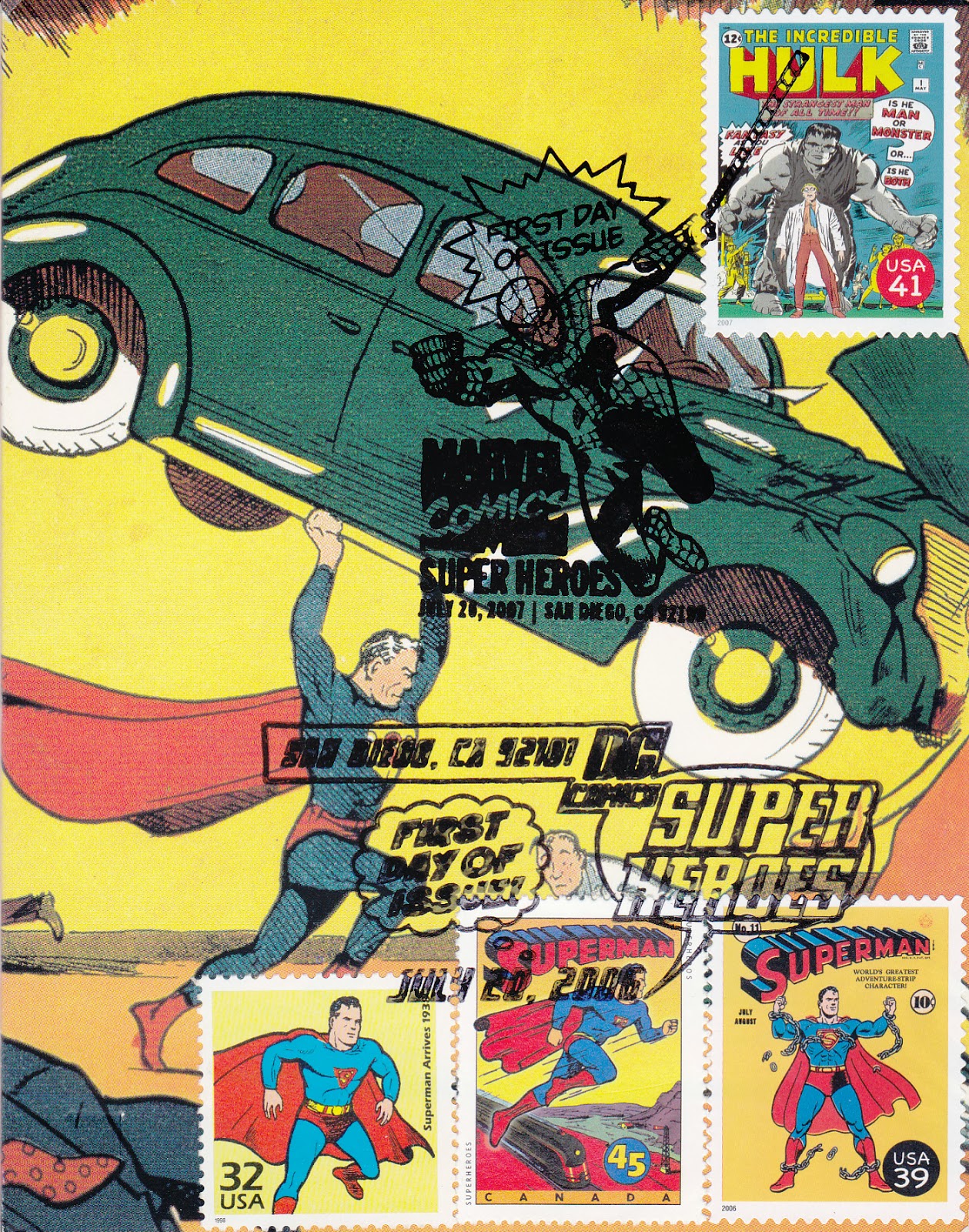
The first card (a greeting card, actually) has a Superman stamp issued as part of the DC comic book series (Scott #4084k) and is paired up with the Superman stamp that was part of the Celebrate the Century series (#3185f).  And Canada had a Superman stamp too, from 1995.  The other Superman stamp (#4084a) and FDC from that DC comic series is on the other card (a postcard), along with Supergirl (#4084i) from the same series.  As a concession to possible comic collectors, I also added a Marvel stamp on each of these cards from a subsequent release, too--hence The Hulk (#4159l) and Captain America (#4159e).

Wednesday, October 3, 2012

Shameless Plug


Though my job has nothing to do with postage stamps, it has everything to do with movies, so I thought it couldn't hurt to put in a quick shout out to my (relatively) new employer, the Mill Valley Film Festival, which runs from October 4-14 this year. It also seems unlikely that my collection will converge with our annual festival fare too often, but this year yielded a couple of offerings I couldn't ignore.

The first is the new documentary Wonder Women!, written and directed by Kristy Guevara-Flanagan and showing at our venues both in San Rafael and Mill Valley. Of course, this is a different film than the truly kick-ass 1973 Robert Vincent O'Neill one-sheet depicted, but the films (and stamps) dovetail nicely since this festival film is a self-described "Untold Story of American Superheroines" and mines the history of the DC Amazon princess and her pop culture legacy through print, film and TV that still resonates today.


Coincidentally, when these comic book stamps came out in 2007, I decided to use this postcard to feature all the women from the comics on postage stamps that I was aware of.  So featured here are Wonder Woman, Supergirl, Spider-Woman, and Elektra (Scott #'s 4084m, 4084i, 4159g & 4159i).

Also depicted is Brenda Starr from the USPS comic strip stamp series (Scott #3000t), plus two stamps from Canada of the comic book heroines Nelvana and Fleur de Lys (like the Brenda Starr stamp, issued in 1995)

Another film we're featuring is a 35th Anniversary screening of Star Wars, which originated from the mind of George Lucas, a Marin county resident (in fact, Skywalker Ranch isn't far from our offices here at the California Film Institute). For those who haven't had the pleasure of seeing it on a big screen in a while (or perhaps ever), it's bound to be an event to remember.


The Princess Leia & R2-D2 stamp is Scott #4143f.

I'll be doing film introductions and Q&A's every day throughout the festival, so who knows?  Maybe our paths will cross at the MVFF (it's our 35th anniversary, too).  Hope to see you there!

Sunday, August 5, 2012

The Beginning of a Beautiful Friendship

For practically as long as I can remember movies, I have known and adored Claude Rains.

Probably the first movie I really fell in love with was Casablanca (Curtiz, 1942), and in a movie teeming with wonderful characterizations, Rains’s Renault stood out as enormously appealing and inscrutable, perhaps the best thing in an irresistibly fine film. While the rest of the characters seemed designed to fulfill their specific destiny, all the real crucial choices in the film are Louis’, and it’s his arc of redemption that sells the film, making Rick’s sacrifice satisfying because with nobility comes camaraderie. The term "bromance" didn’t exist when I was in elementary school, but this was the perfect balance of admiration, acceptance, and loyalty—two cynics who are up to the challenge when their self-interest is superseded by something greater.

 Casablanca is rich with broad strokes of romance, nationalism, and honor, so it’s up to Rains to provide any real complexity. Even after multiple viewings, his motives are never obvious, his allegiances seemingly open and yet always suspect. While Rick revels in mystery, throwing out opaque answers and assertions of indifference, Renault is always plain-spoken—about his affections, his corruption, and his obvious delight in straddling every fence he can. He plays both ends against the middle down to the very last scene and Rains makes his character so amused by his own self-awareness that the character is instantly likeable even when far from respectable.


But that was classic Rains. In The Adventures of Robin Hood (Curtiz/Keighley, 1938), Basil Rathbone’s (wonderfully portrayed) villain is so miserable in his seriousness, while Rains’s Prince John relishes every syllable that he utters. In Mr. Smith Goes to Washington (Capra, 1939), his Senator Paine is a realist, and while he’s positioned as the antagonist, he’s not a one-dimensional bad guy. In fact, he’s a model of networking and backroom compromise, and with our current political landscape of brinksmanship and line-in-the-sand thinking, is his type any less palatable than a Jefferson Smith?

But he could be enormously touching, too. Witness his psychiatrist in Now, Voyager (Rapper, 1942) or the loving husband in Mr. Skeffington (Sherman, 1944), turning in incredibly compassionate performances that ground these “chick flicks” in a generous emotional authenticity that’s never maudlin. In Hitchcock’s Notorious (1946), he may be the villain, but compared to mercenary Cary Grant and compromised Ingrid Bergman, he comes across as surprisingly sympathetic…for a Nazi. Just because he was short doesn’t mean he couldn’t control the room (Exhibit A: They Won’t Forget—LeRoy, 1937), but Rains could also use his size to convey a weakness or moral temerity, and his Alexander Sebastian is a man clearly in over-his-head, terribly pliable by the forces of love and fear that control, and eventually doom, him.  His last scene is as shattering as anything he ever did.


In short, he was usually the best thing in the movies he worked on, and given his filmography, that’s high praise indeed. Even late in his career, he steals every scene he’s in in Lawrence of Arabia (Lean, 1962). It isn’t until the desert that O’Toole really blooms, so Rains’s world-weary diplomat Dryden is the one character who has the big picture in mind, standing on the outside looking in, with bemused skepticism at the posturing from all sides.

I hope he gets a stamp one day, perhaps part of a 20-pane sheet devoted to cinema’s great character actors (joining Agnes Moorehead, Walter Brennan, Thelma Ritter and many more). The closest he ever came was missing the cut with the Universal Monsters release, since his first film was The Invisible Man (Whale, 1933). But even then, he wouldn’t have really been depicted (we never see his features in the film; his voice does all the acting)--just a bandaged head and mask, the ultimate chameleon who could blend into any situation and a memorable introduction to a tremendous career.

The Bogart, Hitchcock and Grant stamps are part of the Legends of Hollywood series (Scott #’s 3152, 3226, & 3692 respectively). Erich Wolfgang Korngold was part of the film composers series (Scott #3344) while Green Arrow (Scott #4084d) was part of the DC Comics release. The  American filmmaking series provided the Film Editing stamp (Scott #3772h).

This post is part of the TCM Summer Under the Stars blogathon.  Be sure to check out all the stellar entries.

Wednesday, July 4, 2012

Freedom


"Then last week, as it must to all men, death came to Charles Foster Kane."

It was over 10 years ago now, but I still remember the phone call vividly. Catching up with mom like I always did, the content of the conversation wasn’t any different than usual—she was fine and Dad (an invalid, bedridden, and suffering from dementia for years) was no better or worse.

But there was something about the tone in her voice that was unusual, though impossible to pin down. And even though I couldn’t put my finger on it (and didn’t even know if she realized she had sounded different), I knew what I had to do.

So within a few hours, I was on the road, driving the 500 miles overnight to head back to the house I grew up in, surprising her that following morning at the door. I spent an hour just holding his hand, and then took a quick nap. After waking up, I joined her again in his room, and with each of us by his side, clasped hands again, we watched him peacefully pass. He was 93.

The end was simple. No profound last words, like Kane’s “Rosebud”. No frogs from the sky (though Jason Robards’s incredibly moving portrayal in Magnolia often reminded me of Dad’s last moments of lucidity, before his mind disappeared beyond our grasp). It was death at its most quiet and solemn. And for my Mom, who was his caretaker for years, and for him, a shell of his former self, it was a freedom for which I had long prayed for. He had had a good run, but that day was painfully overdue.

I got my blue eyes from him. My love for tennis (watching and playing) and travel (he visited 60 countries over 40 years working in the U.S. state department). We went to the same alma mater, graduating 63 years apart. Most of the life he lead before my Mom he kept close to his vest. But I do know that when he was my age, his first marriage hadn’t failed yet (mom was his second, and last). So a belief in second chances is something I might slowly learn to embrace from his example, too. We had few things in common, but a need for redemption from past failures is one of them.

He was born on the 4th of July, just like the song's Yankee Doodle Dandy (Walter Huston’s final scene w/Cagney’s George M. Cohan, in the film of the same name, is another beautiful cinematic deathbed moment, father and son saying goodbye). So when I celebrated Independence Day, it really was more about my Father than our Founding ones. The fireworks were always for him in our eyes. And when he died, my interest in the holiday largely died with him. It was nice and musical and colorful, but just wasn’t the same.  And never will be.

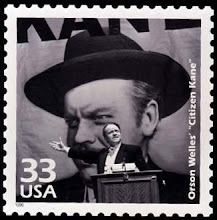
The 3 American flag stamps joining Captain America (Scott #4159e ) date back to 1957: Scott #’s 1094, 1132, and 1320. The US Citizen Kane stamp (Scott #3186o) I paired with one from Guyana. Bernard Herrmann’s first film score was for Kane, as was Orson Welles’s only Oscar (but for screenwriting, not directing).  The Scott #’s are 3341 & 3772b, respectively.

Saturday, April 7, 2012

Hero Sandwich


I already mentioned last year’s disappointing crop of comic book movies, and while there are high hopes for this year, I remain skeptical. I’m an enormous fan of Christopher Nolan’s version of the Caped Crusader, but has there ever been a third installment of a comic book franchise that didn’t suck? (The answer is Not Really). And while I enjoyed Sam Raimi’s first two Spider-Man movies immensely, it seems far too early to pump new blood into a body that hasn’t had time to get cold.

The two comic book titles I used to collect in middle school were Spidey and the Avengers, so the kid in me is excited about getting the team together, especially with the cast they have. But like the X-Men movies (which I haven’t cared for), will the assembling of the team be at the expense of any interesting characterization from its individual members? The pedigrees on all the films are certainly promising. We'll see.


We’ve already seen Batwoman, but here’s a one-sheet for the Batman theatrical movie (Martinson, 1966) with TV’s Adam West, which featured his four biggest villains united together against him and the Boy Blunder (Scott # 4084e & o). The one-sheet for Spider-Man 2 (2004) has the wall-crawler stamp (Scott #4159a) and the two Avengers comic book postcards feature stamps for Captain America (Scott #4159o), Iron Man (Scott #4159h & r), and the Hulk (Scott #4159l), all of whom will appear in the upcoming film.