Showing posts with label Earthscapes. Show all posts

Sunday, May 20, 2018

Praise Be


Of all the MGM musicals ever made, spanning over half-a-century, only 2 have been memorialized on a US postage stamp.  One is, unsurprisingly, The Wizard of Oz, which I have discussed on this blog before.  The other?  Not any of the usual suspects, like Singin’ in the Rain or The Band Wagon or Meet Me in St. Louis.  The only other film is King Vidor’s Hallelujah (1929).

That was part of a 5-item postal issue on early Black Cinema (also discussed in an earlier post) and Hallelujah is easily the most famous of the 5, and a seminal work in the genre because even with sound in the movies less than 2 years old, you can see Vidor pushing the aesthetic envelope.  There’s certainly a lot to dissect about the film, from its ground-breaking origins (it was one of the first Hollywood studio films with an all-black cast) to its troubled legacy because of the narrative it helped fuel about African-American stereotypes.

But something that makes this film stand out among musicals is also something it has in common with another all-black MGM musical 14 years later, Vincente Minnelli’s Cabin in the Sky (1943).  And that’s the unique role that religion plays in both films.  For integral to both films’ messages is the ways church and God, music and ritual are hard-wired into black culture.

Hallelujah is about a sharecropping family whose eldest son Ezekiel (Daniel L. Haynes) gets lured into assorted temptations (gambling, women) and it’s his religious rise as a rabble-rousing pastor and eventual fall from grace, a victim of his vices, that comprise the backbone of the film.  Throughout, we see that singing—in the cotton fields, with neighbors, in church and nightclubs—is an important part of the family’s life.  Musicals have often been criticized for being “unrealistic” in having their characters spontaneously burst out in song, but in Hallelujah, it feels completely normal because song and community are intimately entwined.  Music brings people together, providing inspiration and comfort in a hard-scrabble life and so all the music numbers have an almost naturalistic feel—both the traditional spirituals but also the ones written for the film (most notably “Waiting at the End of the Road”, by Irving Berlin).

Cabin in the Sky is actually pretty similar in that Joe (Eddie “Rochester” Anderson) has his soul fought over by competing angels and demons as he is also tempted by gambling and women and faces a troubled path toward redemption that isn’t without its own pitfalls and distractions.  While Hallelujah is presented as melodrama and cautionary tale, Cabin is played for laughs and uplift, but it also has musical numbers that take place in the wide array of African-American centers of community: church, juke joints, backyards and work gangs.  Here, the musical heavy lifting is done by the marvelous Ethel Waters, who sings the title tune as well as the Oscar-nominated “Happiness Is a Thing Called Joe” (by Harold Arlen and E.Y. “Yip” Harburg).  But she gets tons of great support by Lena Horne and cameos from Louis Armstrong (as a demon) and Duke Ellington.

But it’s interesting that when you look at the films, the churches act as spiritual centers and this is in sharp contrast to decades of mainstream Hollywood musicals that rarely use churches as much more than narrative devices.  Ezekiel whips his camp meeting congregation into a religious fervor, and while his personal story is one of backsliding and hypocrisy, the message of love and confession is one that touches a nerve in his flock (and which is upheld without irony by the rest of his revivalist family).  Joe’s afterlife in eternity is genuinely at stake and fidelity and responsibility are depicted as paths toward a better marriage and better living.  The square Rev. Green (Kenneth Spencer) may not be nearly as fun as Rex Ingram’s hilarious Lucifer, Jr., but he has Joe’s best interests at heart—not just to follow a set of prescribed rules but to improve Joe’s relationship with the devoted Petunia (Waters).

I’m hard pressed to think of many examples of the great canon of American musicals pre-1970 that touch on central religious themes that way.  Sure, churches are abundant for social gatherings or weddings (“What a Lovely Day for a Wedding” from Royal Wedding or “Get Me to the Church on Time” from My Fair Lady).  Bible stories are alluded to in song lyrics, from Seven Brides for Seven Brothers’ “Sobbin’ Women” to Elvis singing “Hard Headed Woman” in King Creole.  But they’re little more than plot points, without any larger thematic resonance.  Heck, even Bing Crosby as a priest in Going My Way is rarely a fount of theological insight but rather a source of warm, friendly, homespun advice.  Ditto the nuns in The Sound of Music.

Which make Cabin and Hallelujah interesting to me, since they aren’t afraid to immerse themselves in the middle of a part of the American social fabric that most musicals are reluctant to touch.  Those other films may implicitly embrace what some might consider religious “values”, but Hallelujah explores the complex relationship between faith and character, and Cabin finds joy in spaces that can be both reverent and rambunctious.  Once the 70s kick in, we see stage adaptations like Fiddler on the Roof or Jesus Christ Superstar that more explicitly examine (and question) beliefs and traditions, but these early MGM musicals not only paved the way in bringing African-American casts and culture front-and-center to white audiences, but its worship sensibility, too.

Now, I did mention that only 2 MGM musicals have been depicted on a USPS stamp, but I should make a technical concession to Show Boat (1951, Sidney) for while the film itself is not on a stamp, the original Broadway musical is.

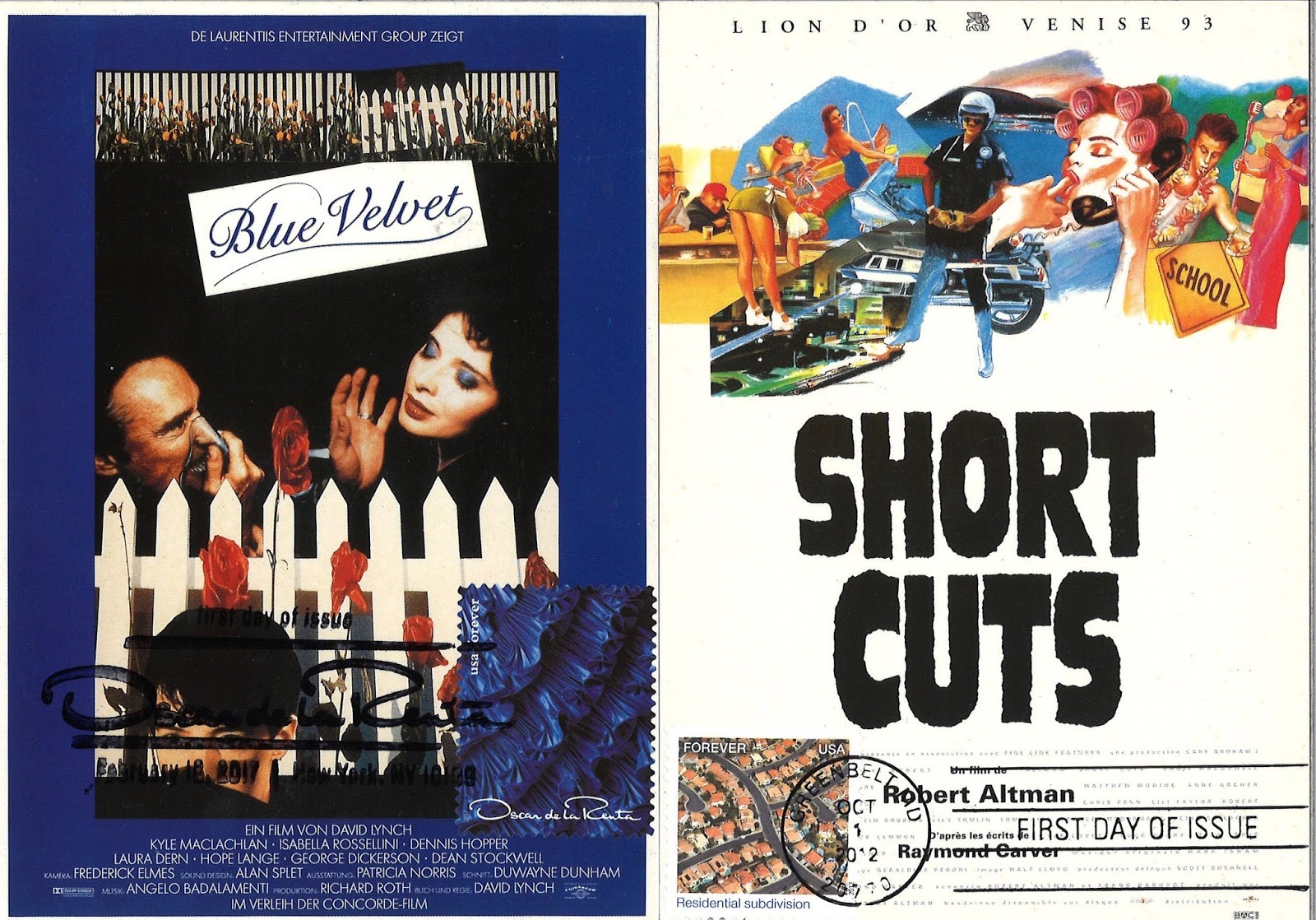
Hallelujah was released in time for the 2nd annual Academy Awards, and it was King Vidor’s second Best Director nomination.  He would earn five in his career—a record number in that category for someone who would never earn a competitive one.  He did receive an Honorary Oscar in 1978.  His nomination for Hallelujah is unusual in that the director nomination was the only one the film received.  This has only happened a handful of other times since: The Inn of the Sixth Happiness, Alice’s Restaurant, Blue Velvet, The Last Temptation of Christ, Short Cuts and Mulholland Dr.
Cabin was Minnelli's first feature film, and he would go on to helm two Best Picture winners that were MGM musicals: An American in Paris and Gigi, the latter earning him a Best Director statue, too.

For more entries in this weekend’s MGM musical blogathon, go here.


-->

Sunday, December 20, 2015

Kringle All the Way

-->
My first associations with Fred Astaire were with Christmas.  One of the first films I remember him starring in was the family-friendly TV movie The Man in the Santa Claus Suit (1979), where he is an ever-present holiday sprite in NYC as three different men find unlikely solutions to their respective problems through a Santa suit they rent from Fred.  Of course, there was the ubiquitous Holiday Inn (Sandrich/1942), which first introduced the song "White Christmas" (sung by co-star Bing Crosby).  But the earliest thing I remember was the Rankin-Bass Christmas special Santa Claus Is Coming to Town, narrated by Fred, which first aired in 1970, the year I was born.

Rankin-Bass, of course, were the producing pair (Arthur Rankin Jr. & Jules Bass) who created a series of animation specials, mostly Yuletide but other holidays too, that were prevalent when I was growing up.  Quite a few used puppets and stop-motion, including the first, 1964’s Rudolph, the Red-Nosed Reindeer, which received a postage stamp issue last year.  That’s an origin story for Rudolph, with Santa an established character and Burl Ives (as a North Pole snowman) acting as singing narrator.  SCIC2T follows the same template, with Fred a mailman who uses the letters from Santa he encounters as a springboard to explain Kris Kringle’s backstory.  He makes a terrific storyteller and even sings the title tune, a bonus pleasure.

Like Gene Kelly, the other legendary male dancer from Hollywood’s Golden Age, Fred Astaire doesn’t have a US postage stamp yet.  It’s always curious how the decision-making process is conducted for which film stars get memorialized by the USPS, either in the Legends of Hollywood series or an offshoot issue.  Certainly, he’s a profoundly influential figure in popular culture, both as singer & dancer, and while Bing has a stamp, as do Fred’s co-stars of the classic musicals Easter Parade (Judy Garland) and Funny Face (Audrey Hepburn), he's still waiting for one.  Fred’s only Oscar nomination was for the very unmusical The Towering Inferno (Guillerman/1974) and his co-star there, Paul Newman, also has a stamp.
In fact, the closest thing to a postage stamp in the US that Fred has is actually in his Rankin-Bass Xmas special, where all the credits are formatted as postal letters, with the characters depicted as stamps.

Though no longer mainstays on network TV, these specials still get rotation in December on other cable channels, like ABC Family.  Perhaps their best facet were the songs, which had nice memorable little hooks.  But revisiting Santa with my mom recently, I noticed something unusual: they cut one of the tunes, and a rather central one, since it’s the musical motif for Santa himself (whose theme recurs throughout the show).  The internet being what it is, it was easy enough to find the missing song, which has the following lyric, sung by Kris: 

If you sit on my lap today,
A kiss, a toy is the price you pay.
When you sit on my left knee, don’t be stingy.
Be prepared to pay.

While the song itself is innocently karmic (the love you give comes back to you), the quid pro quo aspect of coercing affection with the promise of gifts sends a very different message these days.

It’s also interesting that Kris and the future Mrs. Claus (the gorgeous redheaded school marm, naturally) are also essentially a common law union, never getting legally married, but finding  their vows to each other sufficient in a ceremony that’s spiritual but not “religious”.  It’s a curiously progressive stance that’s perfectly in sync with Jessica’s surprisingly adult torch song of non-conformity and sensory awakening “My World Is Beginning Today” (which also indulges in some heavy abstract animation, very unusual for these kiddie specials).  Her voice was done by Robie Lester, who only has a handful of credits but, curiously enough, did provide the singing voice for both of Eva Gabor’s Disney flicks: The Aristocats (1970/Reitherman) and The Rescuers (1977).
I’ll admit that I liked the rudimentary but charming animation style as a kid, and it served as my first introduction to quite a few classic film stars: Jose Ferrer and Greer Garson (The Little Drummer Boy, 1968), Shirley Booth and Dick Shawn (the latter as the hilarious Snow Miser in The Year Without a Santa Claus, 1974), and Jimmy Durante (the cel animated Frosty the Snowman, 1969).  Mickey Rooney--another legend one suspects has a stamp in his future--played Santa in both SCIC2T and Year Without...

But even memories of some of the more obscure specials linger.  Nestor, the Long-Eared Donkey (essentially, a Biblical Rudolph from 1977) had a four-legged parental death that moved me far more than Bambi’s mom did.  Jack Frost (1979) was a primer in how a girl can say she loves you but not, you know, love-loves you (leaving the title character in a bittersweet frozen friendzone).  And the awkward, skeptical, bespectacled kid mouse in Twas the Night Before Christmas (1974) was easily relatable given what I saw in the mirror every day.
Perhaps the best loved holiday special is the one that got a stamp this year: A Charlie Brown Christmas (1965/Melendez), which is celebrating its 50th Anniversary.  The Charles Schulz museum in Santa Rosa, CA, isn't far from where I live and well worth the visit.  It always has wonderfully-curated collections that show how savvy he was in observing human behavior through these kids who always had childish impulses and very adult sensibilities.  The TV special is no different in its critique of commercialism at the expense of more simple and compassionate priorities (and all with a terrific Vince Guaraldi score).

Personally, my favorite remains How the Grinch Stole Christmas (1966 and my first exposure to Boris Karloff) so if these TV specials are a trend with the USPS, I hope it gets an issue next--though as you can see, Dr. Seuss has gotten a few stamps from them already.


Santa from the Rudolph issue is Scott #4948.  The original Peanuts stamp is #3507 while Charlie Brown w/his tree is #5021.  Dr. Seuss is #3585, "The Cat in the Hat" #3187h and "Fox in Socks" #3989.  Paul Newman is Scott #5020 and the skyskraper stamp (#4710n) is from the Earthscapes issue. 101 Dalmatians and Lady and the Tramp are #4342 and #4028 respectively.  And Elvis is Scott #5009.


My 10 Favorite Fred Astaire films

1. Shall We Dance (Sandrich, 1937)
2. Swing Time (Stevens, 1936)
3. You Were Never Lovelier (Seiter, 1942)
4. Top Hat (Sandrich, 1935)
5. The Band Wagon (Minnelli, 1953)
6. Easter Parade (Walters, 1948)
7. Follow the Fleet (Sandrich, 1936)
8. Royal Wedding (Donen, 1951)
9. Silk Stockings (Mamoulian, 1957)
10. Funny Face (Donen, 1957)


Wednesday, January 30, 2013

2012 Yearly Wrap


 The Film Directors issue, including John Huston, Scott # 4671


The Pixar issue, including Finding Nemo, Scott # 4679.  Aquarium stamp is # 2866.


Jose Ferrer, Scott # 4666, here with Humphrey Bogart, Scott # 3152


 Choreographers issue, including Bob Fosse, Scott # 4701


Edgar Rice Burroughs, Scott # 4702


Earthscapes issue, including Highway Interchange, Scott # 4710o


Baseball All-Stars issue, including Joe Dimaggio, Scott # 4697, here with Marilyn Monroe, # 2967

Sunday, November 11, 2012

Premium Rush


Amidst all the big comic book adaptations and massive action tentpole films this last summer, the most exciting time I had in the theater was with a lean, modest movie about bike couriers called Premium Rush.

Confession: I don’t know how to ride a bike.  This surprises a lot of people, since learning to do so seems a ubiquitous part of growing up.  I guess I don’t have much of an explanation for it, except that there didn’t seem much point to when I was little.  I didn’t have any friends who lived near me.  In the suburban wasteland of San Diego, there was nowhere I wanted to go.  That I was nonathletic, physically uncoordinated didn’t help either.  I’m not sure how my younger sister learned, because the only advice my dad ever gave was “Don’t do that.”  But she wanted a paper route.  She was motivated, and I really didn’t care.

Then, as you get older, it becomes more embarrassing not knowing.  And more reasons come up to never learn.  I knew how to drive.  I moved to an urban center, where bicyclists appeared to take their lives into their own hands every day (when they weren’t having their bikes stolen).  I loved going for walks that went miles and miles.  Of course, as soon as someone would find out, they’d immediately offer to teach me, but that was usually just as quickly forgotten.  And the occasions to ride were so infrequent, it never really came up as an adult.  The one time I visited Amsterdam, the ideal place to make up for lost time, it was the middle of winter and completely iced over, so not even the most seasoned bicyclists were on the road.

So bike riding has an exotic allure for me that allows even simple movie scenes to have amazing power because of that visceral elusiveness.  The playfulness of Butch and Sundance.  The charming community of the Muppets on an outing together.  Or the excitement of Joseph Gordon-Levitt negotiating traffic, weaving around pedestrians, out-pedaling the bad guys with some McGuffin in his messenger bag.  Genuinely thrilling stuff.

This past summer was also the 30th anniversary of E.T.: The Extra-Terrestrial (Spielberg, 1982).  I remember the movie vividly growing up, because I was Elliott’s age, socially awkward and stuck in my own California suburban malaise.  I was enchanted by the film back then, even though I loved all kinds of movies and was the only kid I knew who already was familiar with The Quiet Man (the film ET watches when he and Elliott share their intoxicated, psychic connection).


So when it popped up on TV recently, I watched for a bit (it had been ages since I’d last seen it).  And while it may not have the epic scope or depth of feeling that Close Encounters does (to my mind, still Spielberg’s one masterpiece), I thought it still held up pretty well.  Until the famous bike chase.  As soon as Elliott, his brother and friends start barreling through backyards, evading the feds on their two-wheelers to John Williams’ propulsive music, I was completely enraptured, every nerve tingling.
For a kid at that age and that time, bikes were empowering.  Liberating.  Emotions I never really understood or experienced until I was much older, my suffocating adolescence behind me.  So this was my favorite part of the movie, maybe one of my favorite sequences in any 80s movie.  
Because it represented for me something both energizing and absent growing up.  It doesn't last long, but it's marvelous to watch.  And as soon as ET uses his alien mojo to send the bikes flying into the air, I changed the channel.  Because what made the movie special to me was over.

They say it’s never too late.  And I suppose that’s true.  But I have no bike, no helmet, no one to teach me, no easy means of learning, and no one to ride with.  The time and cost are real investments now.  And any recreational biking would still involve a lot of driving to get to where I can do so safely, which itself seems its own sort of vanity.  But that’s OK.  Not all bucket list items are meant to be checked off.  And I still have the movies, where even the most pedestrian fantasies can be brought to life.

E.T. was honored with a stamp in the Celebrate the Century 80s issue (Scott # 3190m) and specifically in the Special Effects stamp of the American Filmmaking series (Scott # 3772i).  A highlight of the film is the liberation of the frogs in the science class, and the Wonders of America series kindly obliged me a stamp (Scott # 4055), as did the residential subdivision in the Earthscapes issue (Scott # 4710k).  The E.T. stamp from the Republic of Tatarstan was issued in 2001.