Showing posts with label TV. Show all posts

Monday, January 30, 2017

2016 Yearly Wrap

Parakeets, Scott #5124 - part of Pets issue

Shirley Temple, #5060

Sarah Vaughan, #5059 (w/Josh White #3215)

Mercury #5069 - part of The Planets issue

Everglades #5080l) - part of the National Park Service issue

Halloween Jack-o'-lantern #5140

Banana split #5095 - part of the Soda Fountain Favorites issue

Tulips #5049 - part of Botanical Art issue

Quilled Paper Heart, #5036


New Horizons probe #5078, part of the Pluto mini-sheet

Enterprise and planet #5134 - part of Star Trek issue

1953 Chevrolet #5102 - part of Pickup Truck issue (w/Hot Rod stamp #4909)


Wonder Woman (Bronze Age), #5150

Friday, January 8, 2016

2015 Yearly Wrap


Martin Ramirez set, Scott # 4968


Medal of Honor set, Scott # 4822b


Coastal Birds set, Scott # 4994.  California condor stamp (1971), Scott # 1430


Penguins issue, Scott # 4989


Summer Harvest set, Scott # 5007


Elvis Presley, music icon series, Scott # 5009


Ingrid Bergman, Scott # 5012


Paul Newman, Scott # 5020


A Charlie Brown Christmas set, Scott # 5025

Thursday, August 21, 2014

Free Falling

It’s been a tough summer for cinematic San Francisco.  Last month, the post-apocalyptic wasteland of SF served as a battleground for Man vs. Monkey in Dawn of the Planet of the Apes.  Before that, a trio of horrific monsters laid waste to my City by the Bay in the recent reboot of Godzilla.  Not since Jeanette McDonald warbled her way through the devastation of the 1906 earthquake has the city taken such a pummeling on celluloid in one year.

I’ll admit I had fun in both films—neither was superb but the production values were high, the casts were game, and the silliness was within acceptable limits for these genre tentpole endeavors.  But between both, there was only one moment that really struck me as arresting and even, perhaps, magical.

To provide a little context: I am not an adrenaline junkie.  I don’t really participate in extreme sports, ride wild rollercoasters, or do high-octane adventure travels.  I love taking my time, enjoying the scenery.  I’m a walker, not a runner.  Heck, I don’t even know how to ride a bike.  But one thing I have done is jumped out of a plane.

It was my bachelor party, 15 years ago.  Instead of the typical bar crawl/strip joint routine, I wanted to go skydiving.  Not a tandem jump.  Not a static line.  A full free fall, where I pull the chute myself, land myself.  So that’s what we did.  We had to train for hours on what were essentially three procedures: (1) Jumping, (2) Pulling the chute, (3) Pulling the emergency chute if #2 didn’t go so well.  In fact, by the time our training was done, the winds were too high and we (the two groomsmen and myself) had to come back the next morning to jump.

And that’s what we did.  We each went one at a time, so the other two could be waiting on the ground when one landed.  I jumped first.  The hours of learning the same routine over and over was smart, because by the time you were standing at the plane's doorway, you were thinking about the steps you had to do and not about being thousands of feet above the ground.  The rule was that you jumped with two experienced skydivers, so while you weren’t attached in any way, they could keep an eye on you in your descent.

Similarly, there was a routine as you were falling to earth: Check your altimeter (to track your fall), check the horizon (for orientation), check in with each of your spotters (thumbs up sign).  Rinse, repeat.  Over and over.  The thing you discover very quickly is that it is very, very windy and very loud from the wind as you fall.  And the Earth is so far removed so far below, it almost seems abstract.  It’s unreal.  So while you’re conscious that it’s gradually getting closer, it doesn’t really feel like you’re falling.  You feel suspended in a way.  But you have your routine (rinse, repeat) so you don’t have much time to wrap your head around the unnatural particulars of your situation.  You just have one job: Land.

And then, at the right altitude, you pull the chute and you get this massive jerk and then you’re not suspended anymore, but you are floating.  You feel gravity more because of the harness you’re in, and you start adjusting to the handles that control your directions.  Your spotters kept falling so you are by yourself in the sky.  That’s when you can start enjoying the view and getting your bearings.  Those first moments are the most tranquil and beautiful.

Eventually, the spotter (who has now landed) checks in with you on the one-way radio in your helmet to start spotting you again, giving suggestions so you can best hit the landing zone.  Each descent is different, but mine consisted of a large circle that spiraled into tighter and tighter rotations until I was heading straight for the target.  Then, right before you touchdown, you pull the handles down hard, giving you one final gentle little air bubble in the chute, so you don’t land quite so hard.  Then, when you’re on the ground, you run to gather your chute so the wind doesn’t blow it (and you) farther afield.

It was awesome.  Not just the sensation of it, but knowing that I did it all myself.  I've focused on the mechanics of the jump because the truly amazing aspects really are impossible for me to describe.  I’ve never experienced anything like it, and though I haven’t done it again since (mostly because of cost), I would again in a heartbeat.

So there’s this scene towards the end of Godzilla where a dozen paratroopers (each holding a red smoke flare) jump over San Francisco, enshrouded with fog and smoke from the monster battle below.  And the camera follows Aaron Taylor-Johnson’s descent, with the only sound his breathing and the only music Ligeti’s haunting Requiem (made famous by Kubrick’s 2001).  In a movie full of noise and bombast, it’s a moment that borders on the spiritual as these falling angels dive straight into hell.  Remarkable.


The best part of Iron Man 3 was the harrowing barrel-of-monkeys rescue scene as a dozen Air Force One passengers plummet to earth.  My favorite part of the J.J. Abrams 2009 Star Trek reboot was the space jump.  In short, I’m a sucker for skydiving in the movies, even when the movie (Terminal Velocity, Moonraker, Point Break) isn’t very good.  Because it always makes me remember that day.

Raymond Burr was featured in the US release of the original Godzilla (1956, Honda/Morse).  Perry Mason premiered a year later.  The USPS Scott # for the stamp of that TV show is 4414n.  The Iron Man stamp is Scott #4159h

Thursday, July 10, 2014

Fab 50

 
When you see a lot of movies, it’s incredibly easy to take some for granted.  And so it’s been my whole life with Richard Lester’s A Hard Day’s Night (1964), the Beatles’ best movie and one I’ve seen plenty of times.  It’s smart, funny, loose & limber, and supremely enjoyable.
But until last Sunday, I’d never seen it on the big screen.  For how many surprises can a film you’ve seen over and over yield just from a change of venue?  As I’m repeatedly reminded, plenty.
My impression walking out of the film I thought I knew so well (in theaters again for its 50th anniversary) was of astonishment.  Wow.  From that first legendary chord, to the whirling chaos of the pursuit in the train station, and then from one song or setpiece to another, the sheer energy of the film—propulsive, buoyant, irreverent—is impossible to fully appreciate on the small screen, where many of the tropes that Night pioneered (the flurried editing, the hand-held mockumentary lensing, the music video pacing) have become a natural part of the visual language of TV.
But in the theater, where the immersive insanity (and dry whimsy) of the film are writ large, it’s another experience altogether.  Which is why, in a very real sense, as much as I love channels like TCM and the availability of older or obscure films on DVD, I don’t really consider ever having seen a movie until I’ve seen it in a cinema, the way it was meant to be seen.  It’s not just Bigger = Better; it’s that watching a film the way it was meant to be seen often completely changes your relationship with the way a shot is composed, the way the sound is designed, the way your attention can’t afford to drift.  In the movie house, the death of Frank Poole in 2001 in the vast silence of space is terrifying; at home, it’s like you left the Mute button on.
I remember the first time I truly was hit by this sledgehammer of truth.  I wrote my senior thesis in college on the films of David Cronenberg (this was right after Naked Lunch was released).  This meant watching The Brood (1979) countless times on my VHS player at home, until I thought I knew this nervy, bizarre movie inside and out.  But not long after, the Pacific Film Archive decided to program it, and so I went.   
And it devastated me.  The full spectrum of emotion that sometimes felt campy at home was now in its full, rich, grandiose power.  And the same goes Cronenberg's mise en scene.  There’s one shot, with two of the brood walking the lead’s daughter through the snow, all three in their colorful jumpers, that seemed little more than transitional in my living room, but was one of the most heart-breaking shots I’d ever seen sitting there in the dark.
This is why I see far more films in the theater every year (shorts and features) than I ever do at home.  I rarely buy DVDs and despise watching anything on the internet.  For movies, the cinema is their home and I’m lucky I live somewhere where the selection of films I can see that way is boundless.  But as the glorious rawness of this 1964 classic reminds me, I still have a lot of catching up to do.

It’s worth noting that in addition to the marvelous characterizations of the Fab Four, the wonderfully visualized songs (particularly “Can’t Buy Me Love”) and the anarchic hijinks, the film has a couple of postage stamp references as well.
Hanging out in their hotel room, their manager Shake brings in a batch of fan mail for Paul, John, and George--but not Ringo.  His bandmates playfully take the piss on their drummer until Shake returns with a batch twice as big just for Ringo himself.


Shake: “Hey, here”
John: “Are those yours?”
Shake: “No, they’re for Ringo”
John: “It must’ve cost you a fortune in stamps, Ringo”

Later, the boys visit a TV studio where they'll be performing at a broadcast.  Some dancing girls are rehearsing to an elevator-music version of "I Only Want to Dance with You".  As the practice ends, the Beatles' other manager Norm goes over their schedule:


Norm: “Now, you’ve got about an hour but don’t leave the theatre. Where are you going, John?”
John (with blonde): “She’s going to show me her stamp collection.”
Paul (grabbing brunette's hand): “So is mine”
Dancing girl: “But I haven’t got any stamps...”

The Beatles stamp (Scott #3188o) is from the Celebrate the Century series, while the Ed Sullivan stamp (#4414j) is from the Early TV Memories issue.


Top 10 Favorite Films of 1964

1. Dr. Strangelove (Kubrick)
2. Onibaba (Shindo)
3. The Umbrellas of Cherbourg (Demy)
4. A Hard Day's Night (Lester)
5. I Am Cuba (Kalatozov)
6. The Gospel According to St. Matthew (Pasolini)
7. The Naked Kiss (Fuller)
8. Man's Favorite Sport? (Hawks)
9. Woman in the Dunes (Teshigahara)
10. The Train (Frankenheimer) 

Top 10 Favorite Beatles songs
(note: none of them are from my favorite Beatles album, Revolver)

1. "Strawberry Fields Forever" 
2. "Here Comes the Sun"
3. "I Saw Her Standing There" 
4. "She's Leaving Home"
5. "Ticket to Ride" 
6. "Things We Said Today"*
7. "Hey Jude"
8. "I Feel Fine"
9. "While My Guitar Gently Weeps"
10. "In My Life"

*This is actually on the album A Hard Day's Night, but sadly not included in the movie itself.

Sunday, May 27, 2012

Horse Feathers


The immense outpouring of affection recently at the loss of Maurice Sendak filled me with joy and sadness—joy at the abiding legacy he left with so many people, and sadness because I was not one of them.  I never grew up with Where the Wild Things Are, or any of his other books.  I was probably in high school before I was even aware of who he was, and while that wasn’t too old to appreciate his genius, the opportunity his books had to tap into my childhood impulses of defiance, giving tacit approval to less decorous desires, was past.

Mine was a childhood of “Children should be seen and not heard”, of bedtime Bible stories and Little Golden Books.  Maurice Sendak, Judy Blume, were simply not on my radar at all.  The only element of subversive role modeling in my life, embracing anarchy and reveling in chaos, were the Marx Brothers.

To my parents, they were silly.  Cartoonish.  With cute musical numbers.  In short—harmless.

But while other classic comedians I was allowed to watch might fall into that characterization—Bob Hope or Danny Kaye, say—I knew the Marxes were different.  For they weren’t cowards.  They weren’t clowns.  They were jesters, fearless in the face of authority.  They were brazen with women, insulting toward tough guys, and irreverent towards anyone who told them what to do.  They were one-of-a-kind and hilarious.

And I loved them.  For they were a balm in a landscape of suburban propriety I had around me.  And the fact that my parents didn’t seem to get it—the satire, the innuendo (much of which went over my head, too), the blatant disrespect they represented—made them that much richer to me.  In a still water world, they were my din and tonic.

A Day at the Races (Wood, 1937) may be their last largely satisfying movie.  Once they moved to MGM, they began to gradually lose their fizz, but this was only their second film at the studio and their energy was still suitably manic and unrestrained, though some telltale warning signs (overly produced musical numbers, an increased sentimentality) are there, too.

While the Marxes would usually run rampant in the corridors of the elite (opera circles, ivory tower universities, luxury cruise liners), Races is unusual in that it straddles itself between a highly formal environment (the Shelton sanitarium) and the racetrack, where shysters, con men, and rascals like Groucho, Chico & Harpo are right at home.  

The horse in Races is High Hat, the final hope for the financially strapped hospital that has just recently acquired Hugo Z. Hackenbush (Groucho) as its chief-of-staff, at dowager Margaret Dumont’s insistence (though no one knows he’s actually a horse doctor).  That the racetrack adjoins the sanitarium means the action can move back and forth, with jockey Harpo and co-conspirator Chico prepping the horse for the big race.  The less said about Allan Jones, colorless love interest to sanitarium owner Maureen O’Sullivan, the better.

There are some memorable comedic setpieces. The legendary Tootsie-Frootsie ice cream negotiation between Chico & Groucho is still fantastic, and Chico & Harpo’s game of charades is fun, as are the boys’ examination of Dumont & foiled seduction of floozy Esther Muir.  And the climactic race is in the boisterous spirit of the football game in Horse Feathers, which takes a lot of the conventions of the sport and turns them on their head (and unlike most horse racing films, this is a steeplechase, which is fundamental in a final twist).  

But the film really belongs to Groucho.  His phone conversation with Leonard Ceeley is a miniature masterpiece, and his rumba number alternating between Dumont & Muir has its own perverse grace.  None of the other Marx boys could hold the screen on their own, for Chico perpetually needs a partner and Harpo risks becoming too precious left to his devices alone.  But give Groucho a dance floor or an empty hotel room and he’s master of the house. 

And speaking of dance numbers, Races is unique in Marx Brothers history as being the only one of their films nominated for an Oscar—Best Dance Direction for the genuinely bizarre “All God’s Children Got Rhythm”, which manages to combine terrific jitterbugging with unfortunate blackface in a bizarre tangent that has nothing to do with anything in the story (though the number is still a step up from another turgid Jones ballad).

The Marxes did end up getting an Oscar—an Honorary Achievement one in the early 1970s, when only Groucho was left alive.  One can only imagine the chaos they would’ve caused at a ceremony, worthy of Races’ gala or the climax of A Night at the Opera (still my favorite of their flicks).  But they had to become elder statesmen of comedy to finally get their due.

Which still, curiously, has not happened with the USPS yet.  For while Laurel & Hardy, Abbott & Costello, and W.C. Fields have gotten their stamp, the only mention they’ve gotten has been Groucho in the You Bet Your Life stamp (seen here as part of the Early TV Memories series, Scott #4414; coupled with horse racing, Scott #1528).  But their real impact as a group, making them still quite contemporary while the other artists I listed have dated some over the years, continues to go unrecognized.  Having a slate of stamps, with the mirror scene from Duck Soup, the stateroom scene from Opera, and the barrels in Monkey Business (to throw Zeppo a bone) would be perfect. And throw Tootsie-Frootsie in there, too.  For the Coconut in all of us.

For more entries in the Classic Movie Horse Blogathon

Saturday, November 19, 2011

Maximum Review


It’s been a while since I discussed maximum cards, and while they don’t pop up often in my collecting, the recent X-men post reminded me that I should highlight a few that I’ve created since I last wrote about them.

I don’t typically collect art postcards, but when the abstract expressionist issue came out, I went to one of the few remaining postcard stores I know and found this painting of Robert Motherwell’s "Elegy to the Spanish Republic #34" (Scot #4444g).  This is a maximum card in its most traditional sense.

I will admit to never having seen a single episode of The Honeymooners (Scott #4414t), but I found a few postcards for the show on E-Bay, including this one, which has Jackie Gleason’s face virtually identical in both stamp and card.  If you look carefully, though, you can see Art Carney’s face is slightly different in the two photos.  Still, pretty darn close. 


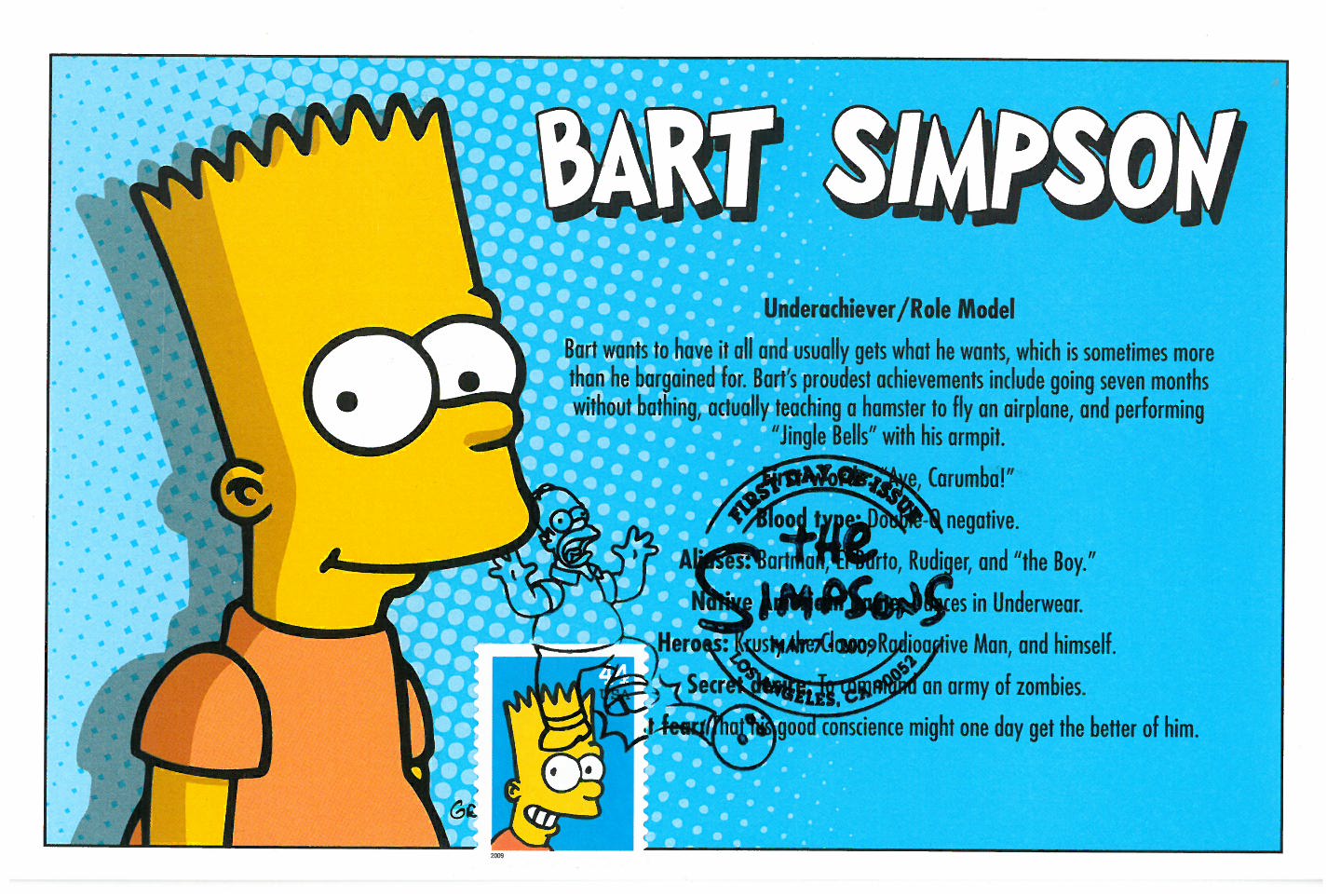
This profile of Bart Simpson (Scott #4401) also has a slightly different facial expression but given the matching background color, also comes very close as well.

And of all 20 different Disney stamps issued between 2004 and 2008, this stamp from Lady and the Tramp (Scott #4028) most closely resembles any of the postcards I used for the First-Day-of-Issue postmark.


Monday, March 1, 2010

2009 Yearly Wrap


Gary Cooper, Scott # 4421


Bob Hope, Scott # 4406


Classic Television sheet, including The Lone Ranger, Scott # 4414m


Wedding rings, Scott # 4397


The Simpsons, including Bart, Scott # 4401


50th Anniversary of Hawaii, Scott # 4415


Love stamps, including King of Hearts, Scott # 4404


Friday, February 19, 2010

Having a Ball


Of all the contrivances and far-fetched situations in Pretty Woman, the one that brought me most out of the movie was when Vivian (Julia Roberts) sits down to watch I Love Lucy and claims to have never seen the episode airing (“Lucy’s Italian Movie”, with the wine-stomping sequence). How in the world could someone from my generation make it to their mid-20’s and not have seen that? Growing up, Lucy was ubiquitous, airing constantly in endless rerun loops, a touchstone (along with The Twilight Zone) to television’s past that everyone seemed to have in common.

Of course, before Ricky & Ethel & co., Ball was a movie actress, though I’ve only seen a handful of her pics (most notably the entertaining Stage Door and Dance, Girl, Dance), though that’s still probably more than most. And she's terrific. She also had some turns on the musical stage, but it’s in that New York apartment that she’s best remembered, for it’s hard to imagine any movie showcasing her brilliant comedic timing & physicality as well as all those Lucy episodes. Being a child of an interracial couple, her marriage to Arnaz (and the inherent culture clashes involved) seemed perfectly normal to me, so I failed to see how ahead-of-its-time it was (as was her pregnancy on the show). It’s also interesting that the first time I ever encountered the name of Karl Freund, the extraordinary cinematographer of Metropolis, Dracula, and Camille, was on her show, where he helped pioneer multi-camera sitcom shooting. So in the movies, she was an able ensemble player, while on TV, she was nothing short of an hilarious revolutionary.

Ball is one of only three women in US Postal Service history to be on at least 3 different stamps (the others are Queen Isabella and Eleanor Roosevelt). The first, from the Celebrate the Century series (Scott #3187l),matches the postcard I had very nicely. The other two are from the Legends of Hollywood series (Scott #3523) and Early TV Memories (Scott # 4414b)