Friday, April 17, 2015

Riddle Me This


My name is Sterling and I am a Muggle.

Now in the Harry Potter films, this is not a particularly good thing. For while it's true that Harry defends the magical world against Voldemort and his pathological hatred of muggles and their mixed-breed offspring Mudbloods, muggles themselves don't come off too well in the movies. Most are just anonymous passers-by, oblivious to the central conflict at hand, but we never really get any insight into what the relationship between the magical realm and our realm is. We know that it is a secret, a veil of which needs to be maintained at all times. But as the worlds intersect more and more by installment six, The Half -Blood Prince, we never see what effect the destruction carried out in our world has on us muggles. The only concern is the safety of our magical heroes. For all the films are concerned, we might as well be living in the Matrix.

And while we hear of admirable muggles--Harry's mother and Hermione's parents, for example--we only get one genuine muggle characterization in the entire film series, the hateful, ignorant and cruel Dursleys, Harry's adopted parents. The world of Hogwarts is seen as an escape and validation for Harry, because the muggle world has nothing to offer him. They have unicorns and griffins, talking paintings and enchanted candy, and travel by levitation or teleportation. We use postage stamps. They use owls.

Being a muggle, I have not read the books. My familiarity with Harry's saga is defined (or confined) completely to the films. And while there's no question that the movies are gorgeously realized, another frustration I have with them is that all the attention to detail is committed to the appearance and atmosphere, while the story falls short for me, and that's largely because of its central villain, Voldemort.

Make no mistake, he's a sublime physical creation, embodied scarily by Ralph Fiennes in the final five films. He is grandiose, brandishing an air of theatricality while still looking like a cross between a corpse and a reptile. Bald, essentially noseless, with long spectral fingernails, he is grotesque but undeniably charismatic in his fluid motions and calm demeanor. He has an old-school sense of civility about him, masking a highly malignant spirit. He also has a sense of inevitability about himself, as if he knows he only has one destiny: to rule.

But to what end? He lusts for power, sure--he admits as much when we first meet him in The Sorcerer's Stone (as a growth on Professor Quirrell's head). And he has that platform on racial purity, ridding the magical world of muggle contamination. But then what? What are his designs on the muggle world? Except for one brief (and vague) intimation in The Deathly Hallows, part 1, no mention is made of what impact his rule will have on us. And even less is said about why he wants any of this in the first place.

The Harry Potter films are about choices--the choices Harry in particular makes and the impact they have on those around him. Whether to be compassionate or greedy, humble or vain, wise or impulsive. And much is made about how Voldemort and Harry are linked, not just thematically but literally connected, as if Harry might easily take the same path towards evil if he isn't careful.


But we never witness Tom Riddle, Voldemort's birth name and incarnation as a boy we see throughout the films, at similar crossroads. He is not a product of his choices, because we never see him choose. He is creepy, deceptive, surly from the beginning. Why the obsession with dark magic? Why this hatred of muggles? Why the fear of death? As film after film passes, we learn more about what he did, but never why he is what he is.

So as a villain, this makes him an abstraction--less a menace and more a mere plot device, lacking real motivation. From the beginning, people in the magical world are loathe to even utter his name. But why? What are they afraid of exactly? We know he killed Harry's parents and some others while Harry was an infant, but how close was he to truly ascending to tyranny? What was the magical world's reaction to this threat? He Whose Name Must Not Be Mentioned invokes horrible things at first, but after a while, their fear and denial becomes more knee-jerk and less understandable, and while we still have characters afraid to utter it by film number 8, it seems like just an empty conceit by then.

Even the Horcruxes, the objects to which Voldemort imparts parts of his soul to stave off mortality, had great promise if they actually spoke to his vulnerabilities, if they acted as metaphors for his character's weakness and fallibility. But they don't. There are just things, objects of personal significance, but aside from his diary (the first horcrux we're told about, in The Chamber of Secrets early in the series), none of them tell us anything more about him than we already knew. Their destruction represents a mechanical To Do list but has no larger character resonance.  Even the slight twist that Harry himself is a horcrux is admitted to just be an accident, and not part of Voldemort's design. In the end, Voldemort is defeated, evaporating into ash, remaining irritatingly one-dimensional.

But this is true of all the other villains, too. Draco Malfoy is an unrelenting bully and coward. His father, a slimy political animal. Bellatrix Lestrange is a psychotic. Peter Pettigrew, a blind sycophant. The one true villainous character who has depth, complexity, and fascinating contradictions is Severus Snape, who it turns out was never a villain at all! There are no conflicted bad guys like Gollum, no betrayals by good guys like Narnia's Edmund Pevensie. The good people stay good and the bad remain bad. Even the revelation Dumbledore might have had a more ignoble past only emerges after his death. Harry learns some valuable life lessons, makes some important choices, but it's largely in the framework of a black-and-white moral landscape.


Which, to me, is boring. Perhaps why my favorite film of the series is the one where Voldemort never appears in any form: The Prisoner of Azkaban. It helps that, in Alfonso Cuaron, it has the best director in the series. But it's also cleverly structured as a mystery and time travel film (with its own playful paradoxes) and less a morality tale. And while it has another example of a villain who really isn't (Sirius Black), it also has a good guy who remains a genuine threat: Professor Lupin, whose uncontrollable werewolf alter-ego is the closest thing to an Id we see in any of the films.


The Harry Potter stamps were a controversial choice when they were issued in 2013. Traditionally, USPS stamp subjects were American or at least iconic on a global level. You could argue the latter is true for the books and films, but usually time is the judge of that kind of legacy, and these stamps (British author, all British actors) so fresh off the success of the series appeared as a mercenary concession to popular entertainment. The Scott numbers for the stamps depicted: 4825 (Harry), 4830 (Hedwig), 4837 (Harry, Ron, Hermione), 4841 (Draco), 4842 (Harry w/wand), 4843 (Voldemort), and 4844 (Bellatrix). The last of these, of course, is on the one-sheet of James Ivory's A Room with a View (1986), which in addition to Helena Bonham Carter also featured Maggie Smith, who also got a Harry Potter stamp for playing Professor McGonagall.


Saturday, March 14, 2015

Zero Recall


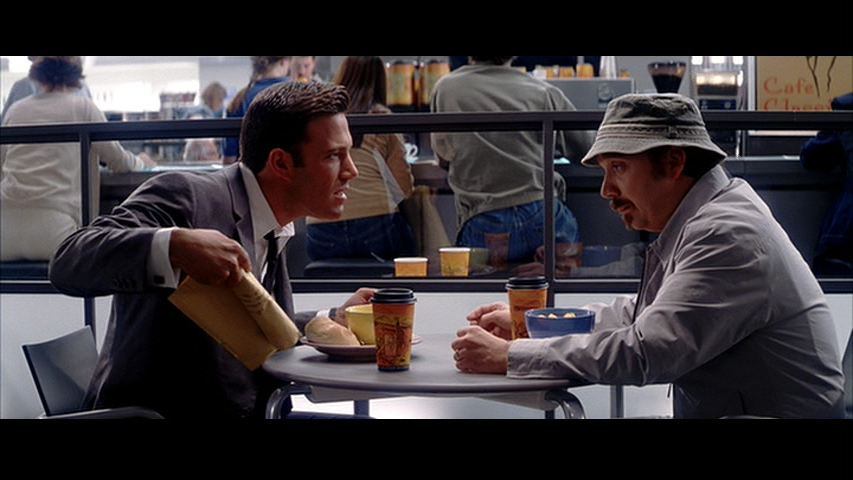
Happy Birthday to Albert Einstein, who was born on this date 136 years ago.  So why not discuss the action film where his postage stamps played a critical part of the story?  For I’ll be honest: I’m a sucker for time travel movies, so I have a weak spot for John Woo’s Paycheck (2003), flaws notwithstanding.
Now Paycheck is not a typical time travel movie because nobody actually travels through time.  Ben Affleck is an engineer-for-hire who builds a machine for billionaire Aaron Eckhart that can see into the future and right before getting his memory of the job erased (a scifi conceit that’s part of his employment contract), he leaves himself an envelope full of innocuous items—each of which his “future self” knows will (by virtue of using the machine) help him, since he can see that Eckhart plans to betray him.  From there, he is forced to go on the lam from both the law and a team contracted to kill him as he tries to unravel a past he doesn't remember.

What first arouses his suspicion is that despite expecting a nine-digit payday for his years of service, he discovers that he had mysteriously declined his salary (one of many things he can't recall after this amnesia procedure) and this envelope of random junk he left for himself is the only thing he’s left with.   He first receives the envelope (with cancelled postage) from the registrar at the company:
Registrar: Your personal items.  You only needed four stamps.
Ben: Oh, well, I guess I can afford the extra 50 cents.

This is before he learns from her that he gave up the paycheck he had earned, something he can hardly believe he would’ve done voluntarily.  But very quickly, he realizes (after a narrow escape using a couple of the items in the envelope) that giving up his salary was his way of telling himself that these items held enormous value while still getting that message past his employer who would’ve checked the envelope for anything unusual.
The rest of the movie is essentially one big chase film after that, so we see this envelope with the Einstein stamps over and over again, surviving shootouts and high-speed pursuits, since the contents of the envelope remain his only clues as to why he has been put in such peril.  Certainly, no philatelic items in film history are exposed to as much high-octane action as this set.


Eventually, he learns that he had a girlfriend (Uma Thurman) during his time at the company and despite not remembering anything about their relationship, he recruits her to his cause--she does remember him, after all--and she gets in on the action, too (although his assignment was top secret, so she doesn’t know exactly what he was working on either).
By this time in his career, Woo was on the verge of self-parody.  Face/Off (1997) was an irresistible acting tour de force as John Travolta and Nicolas Cage swap faces and personas, but all the incessant slow motion and flying doves and heavy-handed symbolism were getting to be predictable, silly stylistic flourishes.  The second Mission: Impossible film was completely undistinguished and the less said about the WWII Windtalkers the better.  So Paycheck is nice because the action is well-executed but isn’t as overly-orchestrated as we’re used to seeing from him.  And because Affleck is always problem-solving his way out of situations using the envelope’s items, it’s a movie that highlights the character’s brains over his brawn.
Ultimately, the stamps serve their most important purpose by explaining his situation.  He intuits that the excess postage itself was a clue and when inspecting the stamps closely, he sees that’s he embedded in Einstein's eye a set of microscopic pictures, “screen shots” from what he saw in the future-vision machine.   
They are a series of newspaper headlines from the future showing that rampant abuse of the machine would destroy the economy, aggravate international tensions, and ultimately lead to global war.  Up to this point, he was able to stay one step ahead of Eckhart because he had put (pre-amnesia) a poison pill in the programming of the machine, temporarily sabotaging it so it couldn't be used.  But now, he knows he has to go back and destroy the machine for good with his dwindling supply of envelope “assists”.
It’s important to point out that Albert Einstein does indeed have two different US stamps, an 8 cent and 15 cent issued in 1965 and 1979 respectively (Scott #s 1285 & 1774).  The stamp in the movie is neither of them.  So why manufacture a fake stamp?  One guess is that they needed a high denomination but still specifically wanted to use Einstein.  After all, Affleck does have this conversation with his one other close confidant, Paul Giamatti.
Giamatti: Look, if we know anything, we know that time travel’s not possible.  Einstein proved that, right?
Affleck: Time travel, yes.  But Einstein was very clear that he believed time viewing theoretically could be accomplished.
It’s from this conversation that they speculate how he was somehow able to anticipate these items being critically useful to him and, by extension, guess what he had been building in this mystery job assignment.  So the Einstein stamps not only see a ton of action, but they act as a thematic reference, too.
Paycheck isn’t a great film—Ben and Uma have zero chemistry and there are a few too many explosions by the climax—but I like the puzzle aspect of decoding the usefulness of each individual item, and the envelope itself and the persistent inventorying of its contents hearkens back to that other (far better) stamp movie, Charade.
This was the last film Woo made in the states, returning to a very different Hong Kong from when he made the legendary The Killer, Hard Boiled and A Better Tomorrow.  Here's hoping one day he makes his way back across the Pacific; it'd be interesting what the intervening years have taught him.

Friday, February 20, 2015

My Oscar Ballot

Picture: Boyhood
Actor: Michael Keaton, Birdman
Actress: Rosamund Pike, Gone Girl
Supporting Actor: Ethan Hawke, Boyhood
Supporting Actress: Patricia Arquette, Boyhood
Director: Richard Linklater, Boyhood
Original Screenplay: Nightcrawler
Adapted Screenplay: Inherent Vice
Cinematography: Mr. Turner
Production Design: The Grand Budapest Hotel
Editing: Whiplash
Costume Design: Inherent Vice
Score: The Grand Budapest Hotel
Song: "Glory",  Selma
Sound Mixing: Birdman
Sound Editing: Interstellar
Visual Effects: Dawn of the Planet of the Apes
Make-Up: Guardians of the Galaxy
Animated Feature: Song of the Sea
Animated Short: The Dam Keeper
Documentary Short: Our Curse
Foreign Language Film: Timbuktu

Thursday, August 21, 2014

Free Falling

It’s been a tough summer for cinematic San Francisco.  Last month, the post-apocalyptic wasteland of SF served as a battleground for Man vs. Monkey in Dawn of the Planet of the Apes.  Before that, a trio of horrific monsters laid waste to my City by the Bay in the recent reboot of Godzilla.  Not since Jeanette McDonald warbled her way through the devastation of the 1906 earthquake has the city taken such a pummeling on celluloid in one year.

I’ll admit I had fun in both films—neither was superb but the production values were high, the casts were game, and the silliness was within acceptable limits for these genre tentpole endeavors.  But between both, there was only one moment that really struck me as arresting and even, perhaps, magical.

To provide a little context: I am not an adrenaline junkie.  I don’t really participate in extreme sports, ride wild rollercoasters, or do high-octane adventure travels.  I love taking my time, enjoying the scenery.  I’m a walker, not a runner.  Heck, I don’t even know how to ride a bike.  But one thing I have done is jumped out of a plane.

It was my bachelor party, 15 years ago.  Instead of the typical bar crawl/strip joint routine, I wanted to go skydiving.  Not a tandem jump.  Not a static line.  A full free fall, where I pull the chute myself, land myself.  So that’s what we did.  We had to train for hours on what were essentially three procedures: (1) Jumping, (2) Pulling the chute, (3) Pulling the emergency chute if #2 didn’t go so well.  In fact, by the time our training was done, the winds were too high and we (the two groomsmen and myself) had to come back the next morning to jump.

And that’s what we did.  We each went one at a time, so the other two could be waiting on the ground when one landed.  I jumped first.  The hours of learning the same routine over and over was smart, because by the time you were standing at the plane's doorway, you were thinking about the steps you had to do and not about being thousands of feet above the ground.  The rule was that you jumped with two experienced skydivers, so while you weren’t attached in any way, they could keep an eye on you in your descent.

Similarly, there was a routine as you were falling to earth: Check your altimeter (to track your fall), check the horizon (for orientation), check in with each of your spotters (thumbs up sign).  Rinse, repeat.  Over and over.  The thing you discover very quickly is that it is very, very windy and very loud from the wind as you fall.  And the Earth is so far removed so far below, it almost seems abstract.  It’s unreal.  So while you’re conscious that it’s gradually getting closer, it doesn’t really feel like you’re falling.  You feel suspended in a way.  But you have your routine (rinse, repeat) so you don’t have much time to wrap your head around the unnatural particulars of your situation.  You just have one job: Land.

And then, at the right altitude, you pull the chute and you get this massive jerk and then you’re not suspended anymore, but you are floating.  You feel gravity more because of the harness you’re in, and you start adjusting to the handles that control your directions.  Your spotters kept falling so you are by yourself in the sky.  That’s when you can start enjoying the view and getting your bearings.  Those first moments are the most tranquil and beautiful.

Eventually, the spotter (who has now landed) checks in with you on the one-way radio in your helmet to start spotting you again, giving suggestions so you can best hit the landing zone.  Each descent is different, but mine consisted of a large circle that spiraled into tighter and tighter rotations until I was heading straight for the target.  Then, right before you touchdown, you pull the handles down hard, giving you one final gentle little air bubble in the chute, so you don’t land quite so hard.  Then, when you’re on the ground, you run to gather your chute so the wind doesn’t blow it (and you) farther afield.

It was awesome.  Not just the sensation of it, but knowing that I did it all myself.  I've focused on the mechanics of the jump because the truly amazing aspects really are impossible for me to describe.  I’ve never experienced anything like it, and though I haven’t done it again since (mostly because of cost), I would again in a heartbeat.

So there’s this scene towards the end of Godzilla where a dozen paratroopers (each holding a red smoke flare) jump over San Francisco, enshrouded with fog and smoke from the monster battle below.  And the camera follows Aaron Taylor-Johnson’s descent, with the only sound his breathing and the only music Ligeti’s haunting Requiem (made famous by Kubrick’s 2001).  In a movie full of noise and bombast, it’s a moment that borders on the spiritual as these falling angels dive straight into hell.  Remarkable.


The best part of Iron Man 3 was the harrowing barrel-of-monkeys rescue scene as a dozen Air Force One passengers plummet to earth.  My favorite part of the J.J. Abrams 2009 Star Trek reboot was the space jump.  In short, I’m a sucker for skydiving in the movies, even when the movie (Terminal Velocity, Moonraker, Point Break) isn’t very good.  Because it always makes me remember that day.

Raymond Burr was featured in the US release of the original Godzilla (1956, Honda/Morse).  Perry Mason premiered a year later.  The USPS Scott # for the stamp of that TV show is 4414n.  The Iron Man stamp is Scott #4159h

Thursday, July 10, 2014

Fab 50

 
When you see a lot of movies, it’s incredibly easy to take some for granted.  And so it’s been my whole life with Richard Lester’s A Hard Day’s Night (1964), the Beatles’ best movie and one I’ve seen plenty of times.  It’s smart, funny, loose & limber, and supremely enjoyable.
But until last Sunday, I’d never seen it on the big screen.  For how many surprises can a film you’ve seen over and over yield just from a change of venue?  As I’m repeatedly reminded, plenty.
My impression walking out of the film I thought I knew so well (in theaters again for its 50th anniversary) was of astonishment.  Wow.  From that first legendary chord, to the whirling chaos of the pursuit in the train station, and then from one song or setpiece to another, the sheer energy of the film—propulsive, buoyant, irreverent—is impossible to fully appreciate on the small screen, where many of the tropes that Night pioneered (the flurried editing, the hand-held mockumentary lensing, the music video pacing) have become a natural part of the visual language of TV.
But in the theater, where the immersive insanity (and dry whimsy) of the film are writ large, it’s another experience altogether.  Which is why, in a very real sense, as much as I love channels like TCM and the availability of older or obscure films on DVD, I don’t really consider ever having seen a movie until I’ve seen it in a cinema, the way it was meant to be seen.  It’s not just Bigger = Better; it’s that watching a film the way it was meant to be seen often completely changes your relationship with the way a shot is composed, the way the sound is designed, the way your attention can’t afford to drift.  In the movie house, the death of Frank Poole in 2001 in the vast silence of space is terrifying; at home, it’s like you left the Mute button on.
I remember the first time I truly was hit by this sledgehammer of truth.  I wrote my senior thesis in college on the films of David Cronenberg (this was right after Naked Lunch was released).  This meant watching The Brood (1979) countless times on my VHS player at home, until I thought I knew this nervy, bizarre movie inside and out.  But not long after, the Pacific Film Archive decided to program it, and so I went.   
And it devastated me.  The full spectrum of emotion that sometimes felt campy at home was now in its full, rich, grandiose power.  And the same goes Cronenberg's mise en scene.  There’s one shot, with two of the brood walking the lead’s daughter through the snow, all three in their colorful jumpers, that seemed little more than transitional in my living room, but was one of the most heart-breaking shots I’d ever seen sitting there in the dark.
This is why I see far more films in the theater every year (shorts and features) than I ever do at home.  I rarely buy DVDs and despise watching anything on the internet.  For movies, the cinema is their home and I’m lucky I live somewhere where the selection of films I can see that way is boundless.  But as the glorious rawness of this 1964 classic reminds me, I still have a lot of catching up to do.

It’s worth noting that in addition to the marvelous characterizations of the Fab Four, the wonderfully visualized songs (particularly “Can’t Buy Me Love”) and the anarchic hijinks, the film has a couple of postage stamp references as well.
Hanging out in their hotel room, their manager Shake brings in a batch of fan mail for Paul, John, and George--but not Ringo.  His bandmates playfully take the piss on their drummer until Shake returns with a batch twice as big just for Ringo himself.


Shake: “Hey, here”
John: “Are those yours?”
Shake: “No, they’re for Ringo”
John: “It must’ve cost you a fortune in stamps, Ringo”

Later, the boys visit a TV studio where they'll be performing at a broadcast.  Some dancing girls are rehearsing to an elevator-music version of "I Only Want to Dance with You".  As the practice ends, the Beatles' other manager Norm goes over their schedule:


Norm: “Now, you’ve got about an hour but don’t leave the theatre. Where are you going, John?”
John (with blonde): “She’s going to show me her stamp collection.”
Paul (grabbing brunette's hand): “So is mine”
Dancing girl: “But I haven’t got any stamps...”

The Beatles stamp (Scott #3188o) is from the Celebrate the Century series, while the Ed Sullivan stamp (#4414j) is from the Early TV Memories issue.


Top 10 Favorite Films of 1964

1. Dr. Strangelove (Kubrick)
2. Onibaba (Shindo)
3. The Umbrellas of Cherbourg (Demy)
4. A Hard Day's Night (Lester)
5. I Am Cuba (Kalatozov)
6. The Gospel According to St. Matthew (Pasolini)
7. The Naked Kiss (Fuller)
8. Man's Favorite Sport? (Hawks)
9. Woman in the Dunes (Teshigahara)
10. The Train (Frankenheimer) 

Top 10 Favorite Beatles songs
(note: none of them are from my favorite Beatles album, Revolver)

1. "Strawberry Fields Forever" 
2. "Here Comes the Sun"
3. "I Saw Her Standing There" 
4. "She's Leaving Home"
5. "Ticket to Ride" 
6. "Things We Said Today"*
7. "Hey Jude"
8. "I Feel Fine"
9. "While My Guitar Gently Weeps"
10. "In My Life"

*This is actually on the album A Hard Day's Night, but sadly not included in the movie itself.

Sunday, May 4, 2014

Happy Star Wars Day!

Star Wars (Lucas, 1977) has always been part of my cultural landscape, coming out in the theaters when I was 6.  I actually remember the weekend it came out, not because I went to see it (my parents wouldn't let me, disliking "Wars" in the title) but because the following Monday everyone at school was asking each other, "Do you think Darth Vader lives?" and me not having a clue what people were talking about.

But I did eventually see it on re-release, and then repeatedly on video, at student union screenings of the trilogy and the eventual Special Edition after I'd graduated from college, astounded at the lines circling the block waiting to pile into the Coronet in San Francisco, supposedly George's favorite cinema to see the films with the public (and now, like most single-screeners in the Bay Area, long closed).

It was an easy film to take for granted, primarily because it was so ubiquitous, and because The Empire Strikes Back was such a smarter, darker, more provocative, more mature film and easily the best in the series.  A New Hope (as it would eventually be called) was a fine movie that changed the industry forever (for better and for worse), but I found myself easily relegating it to afterthought status, even after getting hired by Lucasfilm and diving deep into the history of that production.  But something happened during my time at Skywalker Ranch that changed all that.

In anticipation of the release of Episode III, I was called upon to do a Quality Control assignment (one of my disciplines there). It turns out, George's best friend (with an alliterative name) was being given his own personal print of Ep3 to see. However, it was decided that he should also have a copy of Ep4 so that they could be run consecutively, back-to-back (for the purpose of highlighting all the continuity embedded therein). But since this was going to be at this famous filmmaker's personal deluxe home cinema, we were to send him the best print possible.

Now while I had been exposed to Ep4 many times while working there, it was always in bits and pieces, on DVD or my computer work station, or on a flatbed watching dailies, but always with a "job" in mind, deconstructing visuals or analyzing audio for a variety of reasons. But I didn't even remember the last time I'd seen the film on a big screen, though it was probably around '97 (almost a decade earlier) when the SE first came out.

And one cardinal rule I had discovered while working there is that the really really great films never got old (I count Empire and Raiders as the only two from the studio that fit that criteria), the bad films stayed bad, and those I thought in the pretty good range, you still hit an exhaustion threshold over time. I always considered the first Star Wars one of those.

So here I was, with a pristine 35mm print of New Hope, one that was struck off one of the master negatives, told to QC it start-to-finish to make sure it looked good (no one even knew the last time it had been examined). Yes, this was the Special Edition version, but it was still me all alone in the theater at ILM, about to watch a stunning print of this film.


I thought I'd be jaded, or a little bored with the familiarity of it, or too wrapped up in my assignment to actually have fun. But I was wrong. I was transfixed, and while I have issues with the film, everything that made it so remarkable, so amazing and creative and ambitious an accomplishment, all popped out again, so vividly and lovingly, as if to remind me of all the things I had indeed taken for granted. The eyes of a nine-year-old and a 37-year-old converged as I dove deep into George's universe of imagination.

Personally, I love being alone in a big theater watching a movie. There's something very special about the experience, as if it's being held just for me. Well this one was, with as good a print and as exemplary a theater as existed anywhere--and it was far far better than I could've imagined. I left beaming. I'll never forget it.

The Scott # for the Star Wars stamps pictured are all #4143, with the following letters denoting the Millennium Falcon (b), Leia & R2 (f), C-3PO (g), Obi-Wan Kenobi (i) and Darth Maul (k).  The Yoda stamp was a separate issue later that year, #4205. 


Saturday, March 1, 2014

My Oscar Ballot

Picture: 12 Years a Slave
Actor: Bruce Dern, Nebraska
Actress: Amy Adams, American Hustle
Supporting Actor: Jared Leto, Dallas Buyers Club
Supporting Actress: Lupita Nyong'o, 12 Years a Slave
Director: Steve McQueen: 12 Years a Slave
Original Screenplay: Her
Adapted Screenplay: Before Midnight
Cinematography: Inside Llewyn Davis
Production Design: Her
Editing: Gravity
Costume Design: The Grandmaster
Score: Philomena
Song: "Let It Go", Frozen
Sound Mixing: Gravity
Sound Editing: All Is Lost
Visual Effects: Gravity
Make-Up: Jackass Presents: Bad Grandpa
Animated Feature: Frozen
Animated Short: Feral
Documentary Feature: The Act of Killing
Documentary Short: Facing Fear
Live Action Short:  Just Before Losing Everything
Foreign Language Film: The Missing Picture