Star Wars (Lucas, 1977) has always been part of my cultural landscape, coming out in the theaters when I was 6. I actually remember the weekend it came out, not because I went to see it (my parents wouldn't let me, disliking "Wars" in the title) but because the following Monday everyone at school was asking each other, "Do you think Darth Vader lives?" and me not having a clue what people were talking about.
But I did eventually see it on re-release, and then repeatedly on video, at student union screenings of the trilogy and the eventual Special Edition after I'd graduated from college, astounded at the lines circling the block waiting to pile into the Coronet in San Francisco, supposedly George's favorite cinema to see the films with the public (and now, like most single-screeners in the Bay Area, long closed).
It was an easy film to take for granted, primarily because it was so ubiquitous, and because The Empire Strikes Back was such a smarter, darker, more provocative, more mature film and easily the best in the series. A New Hope (as it would eventually be called) was a fine movie that changed the industry forever (for better and for worse), but I found myself easily relegating it to afterthought status, even after getting hired by Lucasfilm and diving deep into the history of that production. But something happened during my time at Skywalker Ranch that changed all that.
In anticipation of the release of Episode III, I was called upon to do a Quality Control assignment (one of my disciplines there). It turns out, George's best friend (with an alliterative name) was being given his own personal print of Ep3 to see. However, it was decided that he should also have a copy of Ep4 so that they could be run consecutively, back-to-back (for the purpose of highlighting all the continuity embedded therein). But since this was going to be at this famous filmmaker's personal deluxe home cinema, we were to send him the best print possible.
Now while I had been exposed to Ep4 many times while working there, it was always in bits and pieces, on DVD or my computer work station, or on a flatbed watching dailies, but always with a "job" in mind, deconstructing visuals or analyzing audio for a variety of reasons. But I didn't even remember the last time I'd seen the film on a big screen, though it was probably around '97 (almost a decade earlier) when the SE first came out.
And one cardinal rule I had discovered while working there is that the really really great films never got old (I count Empire and Raiders as the only two from the studio that fit that criteria), the bad films stayed bad, and those I thought in the pretty good range, you still hit an exhaustion threshold over time. I always considered the first Star Wars one of those.
So here I was, with a pristine 35mm print of New Hope, one that was struck off one of the master negatives, told to QC it start-to-finish to make sure it looked good (no one even knew the last time it had been examined). Yes, this was the Special Edition version, but it was still me all alone in the theater at ILM, about to watch a stunning print of this film.
I thought I'd be jaded, or a little bored with the familiarity of it, or too wrapped up in my assignment to actually have fun. But I was wrong. I was transfixed, and while I have issues with the film, everything that made it so remarkable, so amazing and creative and ambitious an accomplishment, all popped out again, so vividly and lovingly, as if to remind me of all the things I had indeed taken for granted. The eyes of a nine-year-old and a 37-year-old converged as I dove deep into George's universe of imagination.
Personally, I love being alone in a big theater watching a movie. There's something very special about the experience, as if it's being held just for me. Well this one was, with as good a print and as exemplary a theater as existed anywhere--and it was far far better than I could've imagined. I left beaming. I'll never forget it.
The Scott # for the Star Wars stamps pictured are all #4143, with the following letters denoting the Millennium Falcon (b), Leia & R2 (f), C-3PO (g), Obi-Wan Kenobi (i) and Darth Maul (k). The Yoda stamp was a separate issue later that year, #4205.
Sunday, May 4, 2014
Saturday, March 1, 2014
My Oscar Ballot
Picture: 12 Years a Slave
Actor: Bruce Dern, Nebraska
Actress: Amy Adams, American Hustle
Supporting Actor: Jared Leto, Dallas Buyers Club
Supporting Actress: Lupita Nyong'o, 12 Years a Slave
Director: Steve McQueen: 12 Years a Slave
Original Screenplay: Her
Adapted Screenplay: Before Midnight
Cinematography: Inside Llewyn Davis
Production Design: Her
Editing: Gravity
Costume Design: The Grandmaster
Score: Philomena
Song: "Let It Go", Frozen
Sound Mixing: Gravity
Sound Editing: All Is Lost
Visual Effects: Gravity
Make-Up: Jackass Presents: Bad Grandpa
Animated Feature: Frozen
Animated Short: Feral
Documentary Feature: The Act of Killing
Documentary Short: Facing Fear
Live Action Short: Just Before Losing Everything
Foreign Language Film: The Missing Picture
Actor: Bruce Dern, Nebraska
Actress: Amy Adams, American Hustle
Supporting Actor: Jared Leto, Dallas Buyers Club
Supporting Actress: Lupita Nyong'o, 12 Years a Slave
Director: Steve McQueen: 12 Years a Slave
Original Screenplay: Her
Adapted Screenplay: Before Midnight
Cinematography: Inside Llewyn Davis
Production Design: Her
Editing: Gravity
Costume Design: The Grandmaster
Score: Philomena
Song: "Let It Go", Frozen
Sound Mixing: Gravity
Sound Editing: All Is Lost
Visual Effects: Gravity
Make-Up: Jackass Presents: Bad Grandpa
Animated Feature: Frozen
Animated Short: Feral
Documentary Feature: The Act of Killing
Documentary Short: Facing Fear
Live Action Short: Just Before Losing Everything
Foreign Language Film: The Missing Picture
Tuesday, January 14, 2014
Of Tramps and Vamps
This past weekend was the 100th anniversary of
Charlie Chaplin’s introduction of his Little Tramp character in the 1914 short film
Kid Auto Races at Venice and there is probably no single character in cinematic history so
universally recognized or instantly iconic as him. As you can see in these stamps, from various
decades and continents, the Tramp belonged to the world, and was embraced for
the hope and humanity he represented.
But 1923 was an unusual year for Charlie Chaplin. After enormous success at the Essanay and
Mutual studios, he was now at First National, fresh from his first feature
film, the incredibly popular and moving The Kid (1921). He was still making shorts, but with nowhere
near the same manic productivity of the previous handful of years. He was an artist in transition, and faced
with the prospect of creating an ambitious follow-up, he took an unusual turn—one
unlike any in his remarkable career.
A Woman of Paris (subtitled “A Drama of Fate”) opens with
the following disclaimer:
TO THE PUBLIC: In order to avoid any misunderstanding, I
wish to announce that I do not appear in this picture. It is the first serious drama written and
directed by myself. – CHARLES CHAPLIN.
No ambiguity about his intentions, Chaplin wanted to make a
movie that wasn’t propped up by levity or his own comedic presence. And the story is a familiar one: a provincial
ingénue, unhappy with her home and romantic life, goes to the big city, where
she becomes torn between a wealthy benefactor and her beau from her past life.
The film, quite frankly, is an impressive endeavor, but also
a bit of a mess—albeit an illuminating one, because it brings into sharp relief
what a master storyteller Chaplin typically was, and how his rigorous
discipline in creating comic set-ups was a reflection of his insistence on
having motivation and characterization contribute to a larger narrative unity.
When the film opens, we already see Marie St. Clair (Chaplin
regular Edna Purviance) and Jean Millet (Carl Miller) ready to elope. Summarily banished from her own house and
rejected by his parents, she’s taken by him to the train station to purchase tickets
to Paris while he quickly returns home to pack a few items before meeting back
up with her. A family tragedy delays
him, but despite his efforts to explain the situation, she simply hangs up on
him and, without a penny or possession, goes to Paris alone.
While we do later learn that Jean is unreliable and easily
swayed by parental pressure, we haven’t seen this yet. It is his idea to take Marie in when her step-father abandons her. It is his idea to
move forward with their plans to marry.
Why does she give up on these dreams so quickly, and without even giving
him a chance to explain? We know very
little about the couple, but she is quickly characterized as one ready to
appease and acquiesce; so where does this spirit of reckless abandon come from?
Then, an intertitle: “A year later in the magic city of
Paris, where fortune is fickle and a woman gambles with her life.” And now Marie is traveling in the uppermost
circles of Paris society. She has a
stable of vain and fashionable friends, all well-to-do (if perhaps fellow
gold-diggers). She is the kept woman of
the richest bachelor in Paris, Pierre Revel (Adolphe Menjou). She is cavalier enough about her opulent lifestyle
that she isn’t worried about the prospect of losing her meal ticket when Revel
becomes engaged (for business reasons) to another woman, but she is also still conventional
enough that she objects to his remaining her sugar daddy, even though it’s an
arrangement he wants to maintain because of his affection for her.
How did this traditional country girl ascend so fast to this
high social tier? How did she adapt such
a sophisticated, almost cynical, attitude so quickly? We see not a sliver of this potential in the
first act of the film, so this transition feels incongruous and jarring. And then, invited to an upper-class friend’s
party, she happens on the wrong apartment by accident and discovers Jean living
with his widowed mother in the same building.
How did they move to Paris so quickly, and how are they able to support
this quality-of-life change on Jean’s profession as an artist?
And how likely is it that Revel would’ve never heard Marie mention Jean over the course of their affair? Again, no answers.
And this comes as quite a shock coming from Chaplin. His films are brilliant examples of the
intricate mechanism of set-up and payoff, where he establishes early a prop, a
character foible, a deep-seeded intention, a simmering conflict, all so that
when these elements align, a convincing foundation has been laid and the
convergence of these story points harmonize to beautiful effect.
His films are filled with coincidence and unlikely
incidents, but they never stink of contrivance because he has planted the necessary
seeds in a way that is meticulous, visually deft, but also quite
hilarious. And here may be one important
factor—because when we laugh, we as an audience are willing to forgive much
that might otherwise suspend our disbelief.
But I think it goes deeper than that. Chaplin’s obsession with multiple takes and
working out the minutest of details is legendary, and this relentless perfectionsim
was critical in making many of his most famous sequences work so
effectively. A Woman of Paris suggests
that these comic set-ups were instrumental in driving this exacting narrative
cause-and-effect, for divorced from any humorous context, the motivations in
this “serious” drama are flimsy and the characterizations underdeveloped.
“A Drama of Fate” suggests a certain inevitability to Marie’s
story, that her future was preordained by bad luck and the world’s
cruelty. But whereas Chaplin can mine
deep emotional undercurrents from his comic set-ups (another part of his
genius), there is little to invest in with Marie’s tale because she is less the
victim of class or patriarchy and more her own bad, almost random, choices. There is lots of melodrama, but little that
is tragic. Just frustrating.
This translates to the casting as well. Purviance showed great comedic chops in
his films, but also genuine emotional warmth and range; but here she seems adrift,
not quite knowing where to take her character.
Marie is obviously meant to be a complex persona, but it never quite
elevates beyond the contradictory. Unquestionably
the best performance is by Menjou, who controls every scene he’s in, and even
though his part of the wealth, materialistic temptation is usually the heavy in these morality tales, he is not only
the most charismatic person in the film, but also the most sympathetic—because he
knows what he wants, refuses to be a hypocrite, but still displays real
feeling, too. Was Chaplin a better
evaluator of performance when he was acting in a scene? Did performing opposite him bring out
unexpected qualities from his co-stars?
It’s tough to say, but Woman certainly raises these questions.
Don’t get me wrong, there is much to admire in Woman. Chaplin shows his gift for composition often,
and brings enormous amount of energy to the various crowd scenes. The story does have a real adult and
sophisticated sensibility. And there are
still small little touches, visual grace notes, that act as emotional shorthand
in individual moments. Plus, the ending is an unexpected one, although still in compliance with reaffirming gender roles of the time. It is only the larger
arc that I find unsatisfying, these merits notwithstanding. But it
does one make one wonder how Chaplin’s directorial skills would’ve developed if
he’d pursued more projects like this in his career. As it stands, A Woman of Paris remains a
one-off for him—a fascinating experiment in a legendary career.
Chaplin’s last “short”, (actually a four-reeler) was also in
1923, The Pilgrim. After that, it would
only be features, with the masterpiece The Gold Rush (1925) right on the
horizon, though this exacting nature would mean his productivity would slow
down while his contemporaries Buster Keaton and Harold Lloyd, with two features
each in 1923, would stay at full throttle until the silent era ended. But he would prove with each subsequent film, that the wait was well worth it.
Saturday, December 14, 2013
Loy Joy
She was the perfect movie wife: smart, snarky, long-suffering but rarely
suffering foolishness. She had an
effortless upper-crust style but looked right at home slumming with the
rabble. She was sexy but not showy,
playful but demure, usually one step ahead of her male counterpart but never
feeling the need to prove it. She was a
great actress but never the one to carry a vehicle the way a Davis or Crawford
or Stanwyck or Dietrich or Garbo or Garson did.
She was the perfect complement to her leading man, both the sizzle and
the steak. You could say that Myrna Loy,
who died on this date 20 years ago, was pigeon-holed as the ideal partner,
fiercely independent in spirit but never really alone, and maybe that kept her
away from roles that brought attention to her chops. She was never nominated for an Oscar or
Golden Globe or received any award from a critics group until the Lifetime
Achievement accolades finally came, decades after her best parts were behind
her.
You could say that the pivot point was The Thin Man (Van Dyke,
1934). Because before that, she was typecast
as the jazz-age vamp, the sultry femme fatale or the “Asian” bad girl, but most
of these films (many of them silent) are either lost or largely unknown. In my favorite film of hers, Rouben
Mamoulian’s brilliant Love Me Tonight (1932), she’s a sexually voracious
debutante stealing every scene she’s in—lusty, hilarious and irresistible. But Nora Charles would cement how we see her
now.
Like most film series, The Thin Man movies suffer from the law of
diminishing returns, with each subsequent installment priceless in the repartee
she had with William Powell but fairly interchangeable when it came to the
plots and culprits. In fact, she made 8
other films with Powell and I prefer quite a few of them more than the other
Nick & Nora adventures—testimony to how it wasn’t just the conceit of the
mysteries that held those films together, but their boundless chemistry (along
with Asta, the greatest dog comic in cinema history).
Perhaps my favorite two Thin Man films outside the original are also
ones that have postage stamp references.
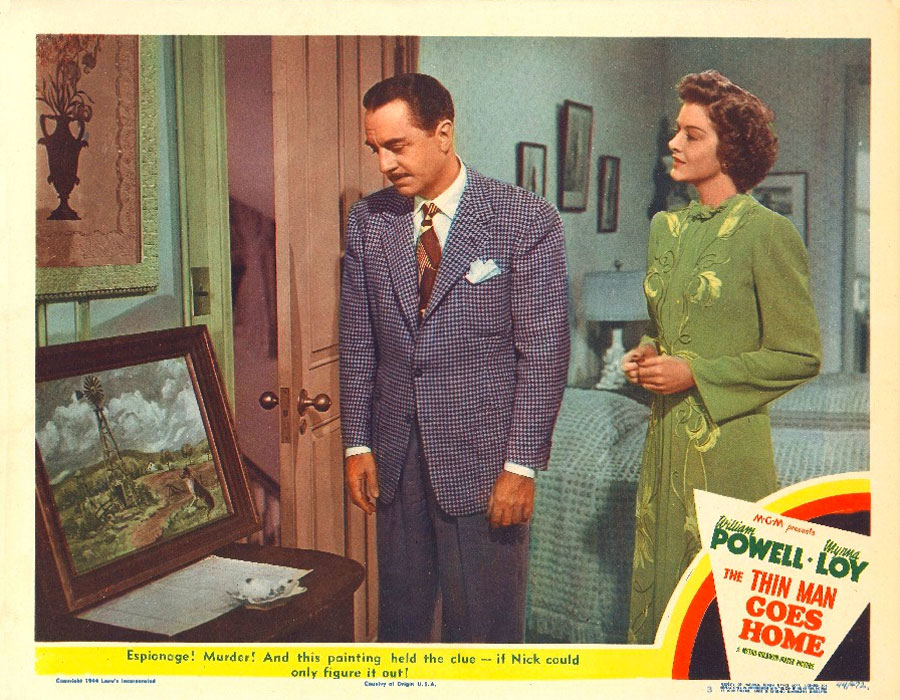
The Thin Man Goes Home (Thorpe, 1944) has Nick & Nora return to
Nick’s hometown and disapproving father (a very funny Harry Davenport), only to
get caught up in international intrigue.
In the climax, we learn that the villain is Lloyd Corrigan, who actually
committed the murder in question instead of spending time with his stamp
collection, which he had used as an alibi.
I’m guessing he probably does have a stamp collection (who would lie
about that?) so chalk that up as another Evil Philatelist, a fun cinematic
sub-genre I’ve mentioned before. This is
also the installment where Loy has the most to do, since Nick’s reluctance to
take on the case means Nora’s intrepid nosiness proves critical in assembling
some vital clues. And legendary
character actresses Anne Revere and Lucile Watson show up for good measure.
In Shadow of the Thin Man (Van Dyke, 1941), Nick looks into the death of
a jockey at a racetrack. In one scene,
reporter (and friend of the Charles’) Barry Nelson is found rummaging through
the office of a gambling boss and hood Alan Baxter confronts him by saying,
“What were you looking for, a stamp?” It
doesn’t take long before Baxter is also dead and Nelson framed for his
murder.
I like this film because it
takes place in the SF Bay Area—the racetrack scenes were shot at Golden Gate Fields
in Berkeley (which I pass every day going to work), and the film includes a
scene where Nick is pulled over for speeding on the Oakland Bay Bridge, back
when you could drive east-bound on the upper deck (long before The Graduate
made such a commute a glaring continuity error). And it has a priceless setpiece where Nick
& Nora attend a pro wrestling match.
That, and Nick Jr. (their son, introduced in the prior Another Thin Man)
is cute enough without suffering from Cousin Oliver syndrome.
Neither Loy nor Powell have US postage stamps. In fact, the only person to be honored with a stamp to appear in the series is Jimmy Stewart, who played a very atypical role in the second installment, After the Thin Man.
Favorite Myrna Loy and/or William Powell films (all films cited
feature both except * = Loy, + = Powell)
- Love Me Tonight (Mamoulian, 1932) *
- The Best Years of Our Lives (Wyler, 1946) *
- The Thin Man (Van Dyke, 1934)
- One Way Passage (Garnett, 1932) +
- Double Wedding (Thorpe, 1937)
- Libeled Lady (Conway, 1936)
- I Love You Again (Van Dyke, 1940)
- Love Crazy (Conway, 1941)
- Mister Roberts (Ford/LeRoy, 1955) +
- A Girl in Every Port (Hawks, 1928) *
Sunday, December 1, 2013
When we play our Charade
Charade (Donen, 1963) celebrates its 50th
Anniversary this week,
and over the
years, it has earned a reputation, oft-repeated, as “the best Hitchcock film
Hitchcock never made.” Now, I love
Charade, and not just because it’s the best postage stamp film ever. It’s
an irresistibly entertaining comedy-thriller, with wonderful Paris locations,
great lines of dialogue, and a fizzy, playful tone, all fueled by incredible
chemistry between Cary Grant & Audrey Hepburn (their only film
together).
But I’ve
always hated that Hitchcock meme because it shows a fundamental failure to
understand what the great Sir Alfred was all about. For while Charade is enormous fun, it really
isn’t about anything except thrills and laughs and clever reversals. And while Hitch certainly employed all those
things, he was far more reflective, and far more subversive. His is the cinema of sex and psychology, of
paranoia and pursuit, of fever dreams and salient nightmares. His humor was darker, his action laced with
malevolence. He showed a real fear of
institutions and a suspicion of normalcy, with his characters regularly haunted
and hounded out of their routines.
Hitch lived
with the moniker “The Master of Suspense”, which often served as a back-handed
compliment, since it appreciated his technical craft while also relegating him
to a genre hack, a niche and unserious talent.
He certainly made worse films than Charade, but I’m hard-pressed to
think of many that were as lightweight.
Charade is a delicious soufflé. But
Hitch was filet mignon. So “the best
Hitchcock film Hitchcock never made” should reflect his artistry and pathology,
not just his deceptive smoke & mirrors.
Something by Chabrol, perhaps. Or
Polanski or Suzuki.
Police inspector: “One wallet, containing four thousand francs; one agenda...; one ticket of passage to South America; one letter, stamped but unsealed...; one key, to your apartment; one comb; one fountain pen; one toothbrush; one tin of tooth powder. That is all.”
Of course, we eventually learn that the envelope actually
contains three incredibly rare and valuable stamps, a discreet and portable way
to move the fortune. I won’t discuss the
specifics around the stamps in question (which were conceived especially for the movie),
primarily because I couldn’t do it any better than this detailed and illuminating blog post about philatelic values and the real-life counterparts
to this narrative McGuffin. Definitely check
it out.
But the movie is very clever about disguising what is
ultimately a preposterous resolution.
Early in the film, our damsel in distress Reggie (Hepburn) has
the following chat with Jean-Louis, the young son of her friend Sylvie:
JL: When you get your divorce, are you going back to America?R: Well, don’t you want me to stay?JL: Yes, of course, but if you went back and then wrote me a letter...R: ...You could have the stamps! I’ll get you some here, ok?JL: OK
This is before she learns her husband is dead or about the
money and the bag, and it’s a throwaway exchange but a nice way to seed the
idea of stamps being important later on when Jean-Louis goes to the stamp mart
(which is obliquely mentioned in the agenda).
Similarly, the film is coy about how it shows the envelope,
mixing it in among the other assorted items and, when more closely inventoried
by Reggie and her mysterious ally (Cary Grant), dismissed quickly out of
hand. More emphasis is placed on the
contents of the envelope, an innocuous letter to her, than the envelope
itself—a sly little head fake by screenwriter Peter Stone. We only get two brief looks at the stamps
before the big reveal, one when baddies James Coburn & Ned Glass examine the bag's contents, and another when Audrey & Cary revisit the clues.
"Everybody and his Aunt Lillian’s been through that bag, including me...I’ve been into it at least once a day. Somebody would have seen it.""It’s there, Reggie. We’re looking at it right now. Something on that bed is worth a quarter of a million dollars."
Of course,
it defies credulity that the French police, a member of the US treasury
department, and 3 criminals (not to mention our heroine) would not notice that
something was unusual about 3 stamps on a single envelope for a domestic
mailing, or that none of the stamps are French and all are from different
countries! But that’s the genius of a
McGuffin, which is simply a vehicle to keep the plot moving. And one of the beauties of Charade is that it has terrific pacing while also allowing lots of room to let the romance breathe. It’s also a very funny movie without ever losing its sense
of genuine menace, and Cary’s allegiances are always jumping back and forth
(hero or villain?) believably. And of
course, the stamps are a great 11th-hour twist, but not the only one.
So
approaching the climax, the final entry in her husband’s agenda brings Cary
& Audrey to the Jardin des Champs Elysees.
They don’t know what they’re looking for so they split up and Cary
tails the last remaining heavy, Tex (Coburn) as he wanders among a
cluster of vending stalls. Suddenly, both he and Tex have a wordless epiphany, punctuated by
lots of quick close-ups of stamps.

As they both
return to grab the stamps from the travel bag, we return to Audrey still at the
garden, who runs into Sylvie.
R: Sylvie! What are you doing here?S: I’m waiting for Jean-Louis.R: Oh, what’s he up to?S: He was so excited when he got the stamps you gave him this morning. He said he’d never seen any like them.R: I’m glad. What’s all this?S: The stamp market. It’s there every Thursday afternoon. That’s where Jean-Louis trades his stamps.R: Good Lord, where is he?S: What’s the matter, Cherie?R: The stamps! They’re worth a fortune!
Having gone to quite a number of
philatelic conventions in my time, all the production design and displays in
this sequence are very convincing, so I suspect the stamp mart is a real thing (though one I've never sought out in the 3 times I've traveled to Paris).
When they finally find Jean-Louis, it’s too late:
R: (taking a bag of stamps from him): What’s this?JL: A man gave me all those for only three.
The vendor has closed his stall, so they find him in what appears to be his home (with philatelic items scattered everywhere)
Stamp Vendor: I was expecting you. I know you would come. Look at them, madame. Have you ever in your entire life seen anything so beautiful?Reggie: I’m sorry, I don’t know anything about stamps.SV: I know them as one knows his own face, though I had never seen them. This one, a Swedish four shilling called Da Gula Fyraskillingen, printed in 1854.R: What is it worth?SV: Oh, the money is unimportant.R: I’m afraid it’s very important.
SV: Well, in your money, perhaps $85,000.R: And the blue one?SV: Oh, it’s called the Hawaiian Blue. In 1894, the owner was murdered by a rival collector who was obsessed to own it.R: And what is its value today?SV: $65,000.
SV: Ah, the best for last. Le chef d’oeuvre de la collection. The masterpiece. The most valuable stamp in the world. It’s called the Gazette Maldave. It was printed by hand on colored paper and marked with the initials of the printer. Today, it has a value of $100,000. I’m not a thief, madame. I knew there was some mistake.R: You gave the boy a great many stamps in return. Are they for sale now?
SV: Let me see, 350 European, 200 Asian, 175 American, 100 African and 12 Princess Grace commemorative. Which comes to 10 Francs. And don’t forget these. (hands her the stamps from the envelope)R: Thank you. I’m sorry.SV: Oh, no. For a few minutes they were mine. That is enough.
I’ve always
loved this exchange for a number of reasons.
It shows a stamp enthusiast who is passionate and learned, but also has
enormous integrity. It views stamp
collecting as a portal into history, intrigue, and craftsmanship. And the cheap bag of stamps is a very
familiar fixture at stamp stores, showing that it’s a hobby that’s accessible
to even the most modest amateur and not just a pastime for the effete and
elite.
One other thing about the value of the stamps (beyond what the link above breaks down): Nothing is said about how sticking the stamps on the envelope potentially devalued them. $250K may be the cumulative sales price, but would the US be able to recoup the money now that the stamps are affixed to something? Or will some intern have to soak the envelope in water to slide the stamps off and allow them to carefully dry separately again?
Some other details: The stamp vendor mentions
a Princess Grace commemorative stamp, and in the stamp montage, you can
actually see one (from Monaco). Other
stamps on display include pictures of Lincoln & FDR, Charles De Gaulle
& Louis XIV, and the 1960 Winter Olympics (in Squaw Valley, CA). No US stamps are depicted, but there are ones from France, the Congo, Madagascar, French West Africa and French Equatorial Africa. Incredibly, on display is even one stamp I’ve
used in my own hobbying, an Eiffel Tower stamp from 1939, which I used to
supplement this one-sheet for The Lavender Hill Mob (which is also one of Audrey
Hepburn’s earliest film appearances).
Another
thing I love about Charade is that it’s a film that loves the City of Lights
without indulging in the stereotypical Paris porn like so many American movies
do (Exhibit A: Donen & Hepburn’s previous collaboration, the musical Funny
Face). There's some wonderful Parisian street scenes and plenty of atmosphere without relying on the cliche locations. Even when it does feature a
tourist spot like Notre Dame (also visible in that stamp screen shot), it’s as
a self-referential joke.
Donen is one
of my favorite directors and has always had a wonderful eye for movement in his
legendary musicals, and that skillset serves him well here, in a thrilling
rooftop fight between Cary and a hook-handed George Kennedy, and also in the
climax under the stage of the Comédie-Française, a masterclass sequence of using sound and
movement to enhance suspense. All before that final surprise happy ending, and Cary's last line of the film: "Well, before
we start that, may I have the stamps?"
Donen
doesn’t have a stamp (yet), but Cary & Audrey both do. They are Scott # 3692 and 3786
respectively. The flavorful score is by
Henry Mancini, whose stamp is Scott # 3839 (Charade is even mentioned on the stamp
itself). All 3 postmarks are on the reverse side of my one-sheet postcard that opened this article. The Hitchcock stamp from the
Legends of Hollywood series Is # 3226 and the one from the Golden Age of
Television is # 4414o . Obi-Wan Kenobi is Scott # 4143i from the Star Wars issue.
Subscribe to:
Posts (Atom)