Wednesday, June 26, 2013

A Beautiful Thing


A wedding, a promise, a ring
And the moral weight that they bring
Are now to All free
With sweet Dignity
For Love is a Beautiful Thing

Monday, April 22, 2013

The Answer to Life, the Universe, and Everything


Every Douglas Addams aficionado knows what the title means: In The Hitchhiker’s Guide to the Galaxy, the number 42 is that (cryptic) answer.  And any baseball fan knows that 42 is perhaps the most important number in a sport unequaled in its love of stats and numerics.

I’m 42.  I have loved baseball for as long as I can remember.  I was a pretty good 3rd baseman and without a doubt the worst hitter our league had likely ever seen.  Our local team the Padres were hopeless cellar dwellers for most of my time living in San Diego.  But I didn’t care.  I collected the cards, followed the standings, fill out box scores at home watching televised games on Saturday afternoons.  A game that’s often mocked for its more boring attributes was one I found simple and meditative and beautiful.

Jackie Robinson was probably the first black person I ever read about, and likely the window into American racial politics for this middle-class kid in a lily-white suburb.  And it’s a tremendous story of bravery through stoicism, conviction, and alliance building, a model of living by example in the face of unthinkable pressure.

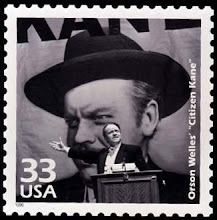
So while I’m not sure if the recently-released movie 42 (Helgeland) is great cinema, it is great baseball and, to these eyes, the best biopic of the sport ever made.  Fans might quickly jump to The Pride of the Yankees (1942, Wood) a film that, at every turn, tries to avoid baseball as much as possible.  Never for a second do I believe Lou Gehrig as a cornpone Mr. Deeds clone as Gary Cooper portrays him.  He talks about his love for the game the same way he does his love for his mother—in a way that reeks of Americana clichés but has no appreciation for the sport itself (the film rarely shows on-field action except in redundant montages).  Instead, the film concentrates on the marriage of the Gehrigs, reducing his story to that of a nice guy who gets very sick who happened to wear a Yankee uniform.


 I have a knee-jerk revulsion of films that treat historical anecdote as drama (Argo being the most recent well-lauded example).  Just because something “happened” doesn’t mean it’s inherently dramatic.  Drama at its best is not just suspenseful proceedings; it should shine a window into the human condition.  Yes, the last 3 minutes of The Pride of the Yankees are moving, but that can't erase the 2 hours of tedium and sentimentality that precedes it.  The film never tells us why Gehrig was great; it just assumes as much and is content to tell us its sad story.  True, in 1942, the sting of his death (only 4 years earlier) was still fresh and no doubt informed the praise it got at the time.  But the ongoing devotion the film has now is perplexing to me, because it’s not particularly good drama and it’s not good baseball.  Plus, it suffers from what I call “Chungking Express syndrome”—when a film plays a single song so incessantly, you hope you never hear it again as long as you live (in this case, Irving Berlin’s otherwise lovely “Always”).

42 has baseball chops and can be forgiven its hokier moments by convincingly portraying why Robinson mattered.  More than anyone, all baseball history can be divided into pre-and post-Jackie eras.  He is the sport’s emotional and moral pivot point, and the film is successful in not making him a saint nor diminishing his very substantial contribution either.  The cast is uniformly fine, with Chadwick Boseman and Nicole Beharie acquitting themselves very well in the thankless roles of the Robinsons.  Lucas Black makes a touching Pee Wee Reese, and his simple act of comraderie with Robinson in front of a stadium full of his fellow southerners is even more powerful than I had imagined it to be when reading about it 35 years ago.


But the real surprises are against-type portraits by Alan Tudyek and Harrison Ford.  This is Ford’s first big excursion into character actor territory, and he’s quite good, immersing himself into the unlikely role of Brooklyn Dodgers owner Branch Rickey, conveying both his practical savvy and passionate sensibility when it came to changing a game that he loved too much to see compromised by racism.  It would have been easy for the film to opaquely suggest the myriad of ways that Robinson was taunted and vilified by fans and players alike, but the showdown with Tudyek’s Ben Chapman (Philadelphia Phillies manager) pulls absolutely no punches.  It’s a horrifying, virulent scene of verbal abuse, painful to watch, especially when you remember that in baseball, you step up to the plate hundreds of times in a season.  Up until then, it’s a well-done but fairly standard film, but that scene conveys the emotional stakes of the story in stark relief, and the emotional toll it took on Robinson in a very real, unrelenting way.

Of course, this isn’t the first film about Robinson.  The Jackie Robinson Story (Green, 1950) told it previously, with Robinson himself in the lead.  It’s a low-budget affair, more thematically on-the-nose, leapfrogging from one incident to another, but it covers some territory 42 doesn’t (especially with his minor league vs. major league career) and is worth seeking out, if only for the curiosity factor of seeing a biopic with its star also its subject.  But 42 is more visceral, and more appreciative of the larger historical context conveyed.  

Because ultimately, 42 is not just a biopic about Robinson.  It’s a treatise on the sport itself, and the change one person can make.  I’ve never been to the MLB Hall of Fame, though I hope to one day.  But I have been to the Negro League Hall of Fame in Kansas City, and I found it a beautiful experience, in the memorializing of a separate, unequal institution and the personalities who excelled in it because they loved the game.  I have a hard time believing Cooperstown will be as moving.
When I was married, I had a falling away from baseball.  She had been a sports widow in her previous marriage, and there were some things that mattered more to me than indulging in a game, no matter how good-natured she might be about it.  I wanted her happy.  But now that I’m alone, I find myself back at the park again, when my Padres play the Giants.  I have no idea who any of the players are these days, and I don’t follow the standings or the careers the way I used to.  But I still love watching a game—its mechanics and its poetry.  It’s something I didn’t realize I’d missed so much.  And 42 came at the perfect time to remind me of that affection.

My Top 10 narrative team sport movies
1. Bull Durham (Shelton, 1988)
2. The Bad News Bears (Ritchie, 1976)
3. Slap Shot (Hill, 1977)
4. Lagaan: Once Upon a Time in India (Gowariker, 2001)
5. The Bingo Long Traveling All-Stars and Motor Kings (Badham, 1976)
6. Moneyball (Miller, 2011)
7. Friday Night Lights (Berg, 2004)
8. Miracle (O'Connor, 2004)
9. He Got Game (Lee, 1998)
10. A League of Their Own (Marshall, 1992)

Honorable mention: The football games in the last reel each of The Freshman (Newmeyer/Taylor, 1925), Horse Feathers (McLeod, 1932), and MASH (Altman, 1970)

This is flagged with a Bad Postmark label because you'll notice that the card at the top doesn't have one at all!  When the USPS issues a new stamp, you can either have a First-Day-of-Issue premade cover sent to you (a mass-produced envelope, typically), or you can create something yourself and send it in to have it hand-stamped--my M.O.  However, these two are often at completely different addresses!  So with the Take Me Out to the Ballgame issue (Scott #4341), I had the card ready to go, but sent it to the wrong Postmaster--so they sent everything back to me umarked.  By then, the deadline to resubmit them to the right location had passed, so now I have a lot of baseball postcards like the Ebbets Field card, waiting for another chance (and another stamp) but otherwise pristine and idle.

The Jackie Robinson stamp is #2013, while Lou Gehrig is #2417.  The Ebbets Field and Yankee Stadium stamps are Scott #3510 & 3513 respectively.  Gary Cooper is #4421 and Han Solo is #4143l.  The flag that constitutes the final FDC on the page is #4228. 

Wednesday, April 3, 2013

Bedtime Story


Happy Birthday to Doris Day, who turns 91 today.  My first exposure to her, alas, was the swath of 60s comedies taking on sex and domesticity with such prudish timidity.  There was no doubt that she had genuine chemistry with her leading men, especially Rock Hudson, but the films so often tried to have it both ways, playing naughty but really neutered.  And for someone with such a fantastic set of pipes, it always seemed weird that we rarely saw her sing in those immensely popular films.

I’d soon learn that the 50s held far more interesting fare from her (Love Me or Leave Me, Teacher's Pet), though it took me a while to eventually discover my favorite film of hers, and one that’s almost criminally unknown by movie fans (I don’t remember ever seeing it broadcast, even on TCM): The Pajama Game (1957).  Of the two films co-directed by Stanley Donen and George Abbott, it’s not as well known as the following year’s Damn Yankees!, itself a work that’s fading from the canon of movie musicals, but it's a gem nonetheless.

I love this film for a lot of reasons: A great assembly of songs with addictive melodies; terrific choreography by Bob Fosse, a decade before he directed his first film; a story that’s unapologetically pro-labor unions; and my favorite Day performance, where she’s virtuous but not virginal, romantic but not sappy, and fun-loving but still a fierce woman of conviction.  Plus, it’s the movie musical that most prominently features postage stamps!

Babe Williams (Day), a major player in the labor union at the pajama factory where she works, has finally succumbed to the charms of Sid Sorokin (John Raitt), the new up-and-coming middle manager at the company.  Hanging out at her home, her single dad (Franklyn Fox) approaches his daughter’s new beau with his beloved stamp album:
Pop: “Say, Sid, do you like stamps?”
Babe: “Oh, Pop!”
Pop: “Well, even If he don’t, that’s something that’d interest anyone: Two sets of mint Columbians. Plate blocks on every issue since 1919.”
And then after he leaves, Sid scans through the album.
Sid: “Say, he has got a whole set of mint Columbians”
Babe: “Sure he has. That’s why I work at Sleeptime.”
This leads to the duet “Small Talk”, where Sid croons, “I don’t wanna talk small talk, now that I’m alone with you”, as Babe counters with a series of efforts to change the subject, including the refrain
"Who would you vote for next election? How do you like the stamp collection?”
“Small Talk!”
Eventually, Sid’s argument, “I’ve got something better for your lips to do, and that takes no talk at all” wins out.

But after some work-related conflict about a raise and a threatened strike puts them at romantic odds, Sid visits her home to reconcile, only to run into Pops again with his stamps and magnifying glass.
Babe: “What you got there, Pop, your stamp album?”
Pop: “Now don’t get excited—if Sid don’t want to look at it, why he doesn’t have to.  There’s no law against my looking at it, is there?”
Babe: “Sid likes stamps.  He told me so.  But me, I’m just plain bushed so if you don’t mind I think I’ll slide off to bed.”
Pop: “Run along, honey.  Good night, dear.”
Sid: “Good night.  Sleep well.”
Babe: “Thanks.”
Pop: “Sid, suppose we start with the Pan-American Exposition issue of nineteen-hundred-and-one”
Sid: “I guess that’s good a place to start off as any.”
This issue is a real philatelic release, commemorating the 1901 Pan-American Exhibition in Buffalo, an event which is now most famous as the site where President McKinley was assassinated in September of that year.  Here’s a website that discusses those stamps in more detail, though I’d be inclined to guess that if Pop had a favorite stamp from that set, it would be Scott #295, since his blue-collar job is as a train engineer.  Today, the value of that set of six stamps, unused, would be over $800.

So what about the Columbians that Pop talked about earlier?  There was an issue known as The Columbians in 1893, commemorating the World’s Columbian Exhibition in Chicago, itself celebrating the 400th anniversary of Columbus landing on the New World.   Here’s a website that goes into detail about all 16 stamps in that set, ranging in denomination from 1 cent to 5 dollars.  This last figure is quite extraordinary because it would be analogous to having a postage stamp with a $150 face value today.  Another fun trivia note is the Columbian issue features the first US postage stamps to depict a woman--in this case, Queen Isabella.  Needless to say, a complete set of this issue in good quality would be worth close to $20,000 today.

Pop also talks about plate blocks, which are blocks of stamps straight off the production line and which include the additional perforations off the edge of the block which gives the information of the cylinder from which those stamps were printed.  This is obviously something much harder to get hold of and not available at your local post office.  They are also something which some collectors treasure highly.

I only own one plate block, of Scott #926, the first stamp about movies ever issued anywhere (which I discuss more here).  Note the cylinder number in the bottom left-hand corner.

The original Broadway production of The Pajama Game (represented by the postcard at the top) was in 1954, so plate blocks for every issue since 1919 meant over 500 US stamps across those 35 years.  That makes Pop an avid collector, a hobby which Babe implies she helps to subsidize.  So she really does need that "Seven-and-a-half Cents" raise (quite possibly my favorite song in the film).

The movie is readily available on DVD for cheap.  It has gorgeous production values but the quality of the print used for the transfer is dodgy and could use a loving TLC restoration.  But the film itself is marvelous--great fun but also genuinely progressive without compromising the political passions of the heroes.  It's also the only major film role for theater legend Raitt (Bonnie’s father) and features the only cinematic speaking part for Carol Haney, a frequent collaborator of Gene Kelly’s (she’s one of the dancers in the On the Town fantasia) and a legend in her own right who died a very sad, early death.  “Steam Heat”, “Hey There”, “Hernando’s Hideaway”, “Once-a-Year Day” are all staged by Donen with peerless energy and great verve.  It’s one of his best films—high praise for perhaps the greatest director of movie musicals the world has ever known.


My 10 favorite Stanley Donen films

1. Singin' in the Rain (1952, w/Gene Kelly)
2. On the Town (1949, w/Kelly)
3. The Pajama Game (1957, w/George Abbott)
4. Seven Brides for Seven Brothers (1954)
5. Charade (1963)
6. It's Always Fair Weather (1955, w/Kelly)
7. Bedazzled (1967)
8. Royal Wedding (1951)
9. Funny Face (1957)
10. Two for the Road (1967)


Last year's Bob Fosse stamp is Scott #4701 and Audrey Hepburn is #3786.  Johnny Mercer (composer for Seven Brides for Seven Brothers) is #3101, while George Gershwin is #1484 and George w/brother Ira (the team behind the Funny Face song score) is #3345.  The wedding rings are #4397, the Oregon stamp is #3732, and the Costume Design stamp is Scott #3772c. 


Wednesday, February 6, 2013

Updates Galore

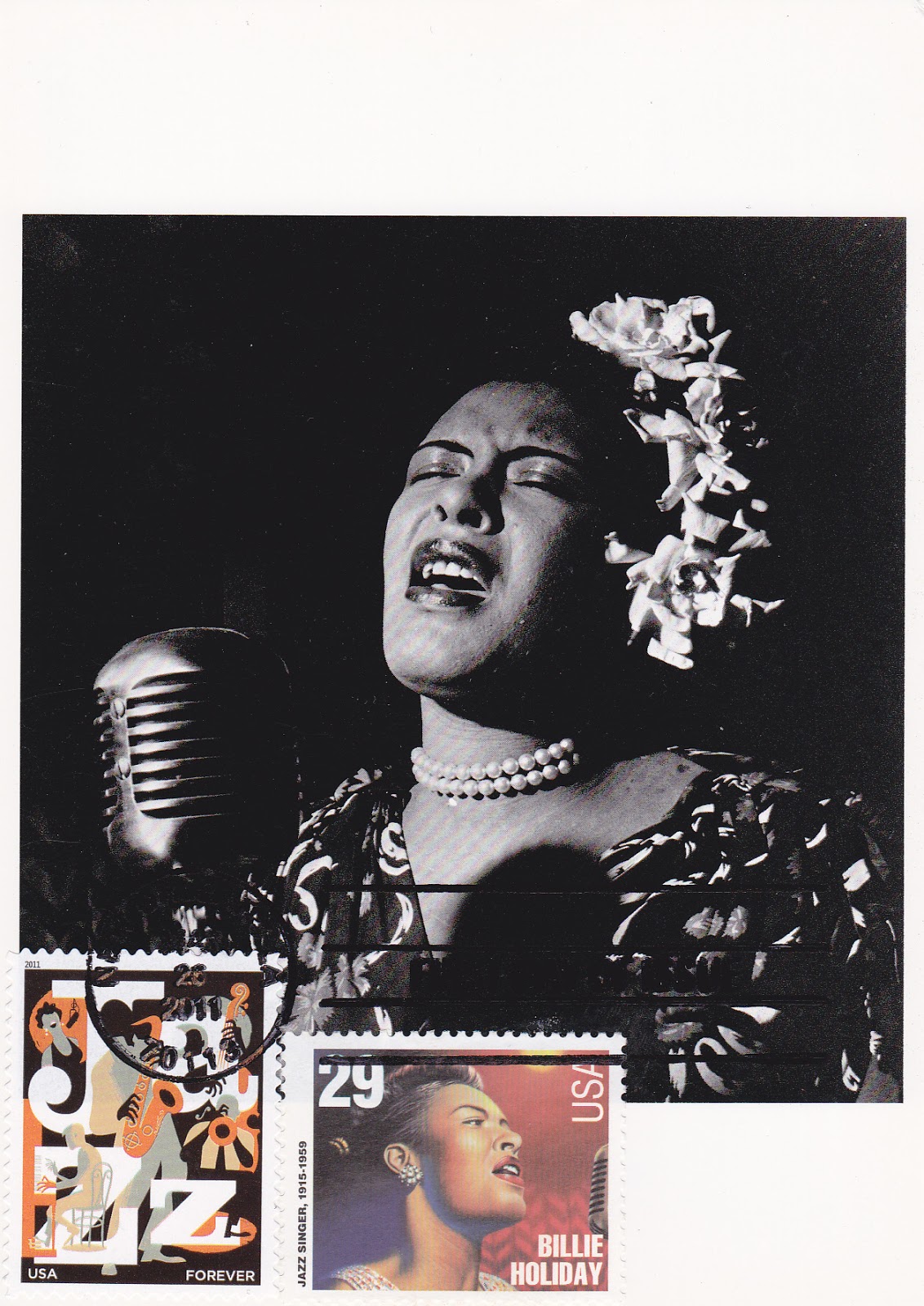
New articles, some recent and others previously in limbo but now finished:  ET and the joy of bike riding; 2001 and my first encounter with art; Billie Holiday and my love of classic singers + King Kong, Toy Story, James Bond, and the Sight & Sound poll.  Plus, more maximum cards, bad postmarks, the yearly wrap-up, a birthday greeting to my niece, and of course, Oscar season is under way.

Holiday


Given that he’s made nothing but crappy movies for the last 15 years or so, it’s easy to forget that Steve Martin used to be a small, cinematic treasure.  And revisiting The Jerk (C.Reiner, 1979) again, with its goofy unevenness, brought back to me a scene I had completely forgotten about: Navin and Marie (Bernadette Peters) singing the tender, poignant "Tonight You Belong to Me" on the beach, by firelight.

I’ve been told more than once that when it comes to music, I was born too late.  I don’t mind modern music, but the truth is that since I left college two decades ago, I’m exposed to it very little so don’t indulge in it much.  My heart truly belongs to the Great American Songbook and the great jazz singers of a bygone era.

But there’s something very curious about those songs that I love by Cole Porter and the Gershwins, Walter Donaldson and Rodgers & Hart.  I adore listening to them (and do so constantly), but never feel compelled to sing along to them.  My favorite sing-along album is We Shall Overcome, Bruce Springsteen’s covers of Pete Seeger songs, and if I ever do provide vocal accompaniment in my car, it’s usually to Johnny Cash or Marty Robbins. So the domain of classic folk and country are fertile territory for my (limited) vocal range.  But those jazz standards occupy a special place where I don’t feel entitled to tread.  

The USPS just announced that Cash will be getting his own postal issue this year.  And while many singing legends (Ella, Dinah, Frank, Patsy) got their own stamps years ago, it’s a tribute to his longevity that Cash was only recently eligible for the honor.  And while there are some legends of that time whom I’ve seen in concert (Blossom Dearie, Tony Bennett, Willie Nelson), I’ve always regretted never going to see him perform live.

We all, in our own ways, find connection and belonging through music, though most of what I listen to was made long before I was born.  Maybe that’s why one of my favorite musicals is Pennies from Heaven (Ross, 1981), also with Martin and Peters, because its entire soundtrack is full of these vintage beauties.  But as far as great musicals go, the film is still unusual because it inhabits the gulf between the fantasy life which music provides and the real life we actually face.  Throughout the film, nobody sings; rather, they all lip synch to those classics from the 20s and 30s.  But they never do these mimes as performers in the story.  What they do is lip synch in their own fantasy dreamscapes, psychologically allowing the songs to fill the ache, the emotional void that we feel every day but keep hidden.

As a result, I know of no other musical which is as heart-breaking, not because of the tragic things that happen in the plot, but because the movie reminds us how fundamental music can be to buoy our spirits and provide an escape valve for the darker truths that our choices and damaged lives represent.  I guess that’s why I never sing to those songs.  Because I’m too busy listening, inhabiting, breathing them in.  

But I love hearing them and have a sense of awe for people, professional or otherwise, who can sing them with such affection.  Singing in front of people solo is something I’ve never done (never even privately, one-on-one).  I always find safety in large numbers.  Church?  Fine.  Karaoke?  I’ve been tempted, but have never summoned up the courage.  Even the thought of such a simple duet as the one in The Jerk unnerves me—not  because I’m a bad singer (I’m not), but because it means opening up to something vulnerable (be it raw or playful) in myself.  That's something I rarely do.  Public speaking in front of large crowds scares some people but it’s never bothered me one bit.  But to sing is something different.  More naked.  Exposed.  Which is also why I admire people who can do it with joy and fearlessness.


But while solo singing might fill me with deep trepidation, there is something else that fills me with actual fear—and that’s the dentist.  I won’t go into the childhood trauma I had that’s resonated with me since I was very young.  My dentist at the time was not a sadist (unlike the musical Steve Martin from Little Shop of Horrors), but what happened still had an effect on me like few other moments in my life.  Even now, the closest I’ve ever had to a full-scale emotional meltdown as an adult was because of that chair.

But that fear has been tempered by one simple thing, and this, again, is where music sustains me.  For of all the singers I love, there’s one I never actually listen to for fun.  And that’s Billie Holiday.  I own her CDs, and while a jazz compilation may bring up a song of hers periodically, I never sit down for an hour of her music like I can do effortlessly with, say, Nina Simone.  And that’s because whenever I go to the dentist, it’s a Billie CD I listen to.  I discovered quickly that Ella’s warmth, Blossom’s flirtations, Nina’s soulfulness aren’t what work for me at that moment of dread.  Maybe that’s because they represent my own aural dreamscape of what I long to be and feel.

But Billie’s sadness, even in the face of love and redemption, have always spoken to me in a special way—not in how I long to feel, but how I usually do every day already.  And so that’s why I cherish her and secrete that voice away in my heart and head.  Because like anything that sweet and precious, I only bring her out at those times when I need to be so fortified and comforted.  So in that chair is when I need her the baddest, and treasure her the most.  Her blues are my solace and in her voice, my fear doesn't just take leave, but evaporates altogether.  Without fail.  There may be singers I love more, but none whom I rely on so fervently.  Fine and Mellow indeed.

The Billie Holiday stamp is Scott # 2856, Nat King Cole # 2852, Ella Fitzgerald # 4120.  The Jazz stamp is Scott # 4503.

If I had to list 10 songs from that school of songwriting which I revisit most regularly, I suppose I might pick these:

* "Ain't Nobody Here But Us Chickens" (Kramer/Whitney) - Louis Jordan
* "Do You Know What It Means to Miss New Orleans?" (DeLange/Alter) - Billie Holiday
* "I Loves You, Porgy" (Gershwin/Gershwin) - Nina Simone
* "If I Had a Ribbon Bow" (Prince/Singer) - Maxine Sullivan
* "Mr. Meadowlark" (Donaldson/Mercer) - Bing Crosby & Johnny Mercer
* "Shine On Harvest Moon" (Bayes/Norwoth) - Betty Carter
* "St. James Infirmary Blues" (Primrose) - Cab Calloway
* "Stardust" (Carmichael) - Nat King Cole
* "They Say It's Spring" (Clark/Haymes) - Blossom Dearie
* "What'll I Do?" (Berlin) - Johnny Mathis


Wednesday, January 30, 2013

2012 Yearly Wrap


 The Film Directors issue, including John Huston, Scott # 4671


The Pixar issue, including Finding Nemo, Scott # 4679.  Aquarium stamp is # 2866.


Jose Ferrer, Scott # 4666, here with Humphrey Bogart, Scott # 3152


 Choreographers issue, including Bob Fosse, Scott # 4701


Edgar Rice Burroughs, Scott # 4702


Earthscapes issue, including Highway Interchange, Scott # 4710o


Baseball All-Stars issue, including Joe Dimaggio, Scott # 4697, here with Marilyn Monroe, # 2967

Sunday, January 20, 2013

My Oscar Ballot

Picture: Amour
Actor: Joaquin Phoenix, The Master
Actress: Naomi Watts, The Impossible
Supporting Actor: Robert De Niro, Silver Linings Playbook
Supporting Actress: Amy Adams, The Master
Director: Michael Haneke, Amour
Original Screenplay: Moonrise Kingdom
Adapted Screenplay: Lincoln
Cinematography: Skyfall
Art Direction: Life of Pi
Editing: Life of Pi
Costume Design: Mirror Mirror
Score: Life of Pi
Song: “Skyfall”, Skyfall
Sound Mixing: Life of Pi
Sound Editing: Life of Pi
Visual Effects: Life of Pi
Make-Up: Hitchcock
Foreign Language Film: Amour
Documentary Feature: Searching for Sugar Man
Documentary Short: Inocente
Animated Feature: Frankenweenie
Animated Short: Head Over Heels
Live Action Short: Asad