One of my most favorite people in the world—in my lifetime, in fact—is getting married today. And to the lucky couple, I wish nothing but good health and happiness, bliss and adventure, joy and security for the rest of their lives. It is a beautiful thing, this union, and a special, sacred day. One worth celebrating.
Bride of Frankenstein (Whale, 1935) is one of my favorite films. It has rich humor and genuine pathos. It has fantastic production values and a magnificent score (by Franz Waxman). It has tremendous acting and memorable, iconic setpieces. It has its own sly streak of perversity and boundless quantities of creativity and inspiration. And while never really scary, it has plenty of creepy and tension-filled moments, too.
It is a cinematic marvel and joy.
But it is also a meditation on connection, and on the almost primal impulse to find a mate, a match, a kindred spirit. Things don’t quite work out in the end for the couple pictured here. But the film delves deep into the idea that finding someone else to pair up with is a defining trait of the human condition. The Monster (tenderly played by Boris Karloff) knows that. In a world of estrangement, he simply seeks to belong, to be accepted for what he is, even if it’s just by one other in the whole world. And it is this yearning that makes him the most relatable and sympathetic figure in the film, far more so than any of the “real” people.
Of course, the most memorable scene is between our “hero” and the blind man he encounters, isolated in his cottage in the woods. Oblivious to the monster’s appearance, he embraces him as a visitor and takes him into his home—the first sign of any kindness the creature has ever experienced and a simple, selfless act, free of judgment, which resonates with him (and us) for the rest of the movie.
And so it is sometimes—two lonely people who meet only for a moment, but who greatly impact each other’s life. A different kind of bond, but one with its own value and legacy.
And so on this wonderful day, my thoughts and prayers go to those who found that special someone—for a moment or a lifetime. Each of those encounters is a blessing beyond measure.
Alone Bad. Friend Good.
Saturday, September 15, 2012
Saturday, September 1, 2012
A Long Time Ago...
So much has happened since then, it feels like a different life almost, but it's been a year since I left my job at Lucasfilm (something I only obliquely referenced in the past on this blog). I'm sure I'll periodically post more about my experience there in the future, but this post serves as a tribute to over a decade commuting to Skywalker Ranch in Marin County. Below are postcards you can buy on the property (which has a gift store).
The top building is the Main House, where pre- and post-production occur. It's a beautiful facility, particularly the research library which supports productions across a myriad of studios, in both film and television.
The bottom postcard is known as the Tech Building and is home to Skywalker Sound, including a variety of recording and mixing stages and a wonderful theater. When I joined the company, Skywalker Ranch was overflowing with employees and the expansion to other complexes, including eventually the Letterman Digital Arts Center (LDAC) in the Presidio in San Francisco, all occurred during my time there (though my office never left the Ranch). The Yoda statue is on the Presidio grounds and visible to the general public.
I came on between the releases of Episode I and II, and my job often meant a deep immersion into the history of the studio and the Star Wars productions in particular (though certainly not limited to that). So the release of the Star Wars stamps by the USPS also occurred during my time there. Below is just a small selection of the many hundreds of First-Day-of-Issue postmarks on postcards I have that are Star Wars related. Maybe one day I'll see fit to part with a handful (I have quite a few duplicates) but for now, here's a sample that evoke different things about my memorable time working there.
The Star Wars stamp Scott #s are all 4143, with a letter denoting the different illustrations: Darth Vader (a), Millennium Falcon (b), Anakin vs Obi-Wan (d), Luke (e), Leia & R2 (f), C-3PO (g), Queen Amidala (h), Ben Kenobi (i), Boba Fett (j), Darth Maul (k), X-wing (m), Yoda (n) and Stormtroopers (o). The other Yoda stamp (note the different postmark and date) is a re-release based on balloting of the fan favorites from all the original stamps. That Scott # is 4205.
The stamp joined with Vader on the Main House card is the oldest movie stamp ever, Scott #926. The two stamps other stamps on the Tech building card are the centennial of sound recording and the 50th anniversary of talking motion pictures (Scott #1705 & 1727 respectively). The latter was actually released in 1977 (50 years after The Jazz Singer), which was also the year the original Star Wars rocked the world.
The top building is the Main House, where pre- and post-production occur. It's a beautiful facility, particularly the research library which supports productions across a myriad of studios, in both film and television.
The bottom postcard is known as the Tech Building and is home to Skywalker Sound, including a variety of recording and mixing stages and a wonderful theater. When I joined the company, Skywalker Ranch was overflowing with employees and the expansion to other complexes, including eventually the Letterman Digital Arts Center (LDAC) in the Presidio in San Francisco, all occurred during my time there (though my office never left the Ranch). The Yoda statue is on the Presidio grounds and visible to the general public.
I came on between the releases of Episode I and II, and my job often meant a deep immersion into the history of the studio and the Star Wars productions in particular (though certainly not limited to that). So the release of the Star Wars stamps by the USPS also occurred during my time there. Below is just a small selection of the many hundreds of First-Day-of-Issue postmarks on postcards I have that are Star Wars related. Maybe one day I'll see fit to part with a handful (I have quite a few duplicates) but for now, here's a sample that evoke different things about my memorable time working there.
The Star Wars stamp Scott #s are all 4143, with a letter denoting the different illustrations: Darth Vader (a), Millennium Falcon (b), Anakin vs Obi-Wan (d), Luke (e), Leia & R2 (f), C-3PO (g), Queen Amidala (h), Ben Kenobi (i), Boba Fett (j), Darth Maul (k), X-wing (m), Yoda (n) and Stormtroopers (o). The other Yoda stamp (note the different postmark and date) is a re-release based on balloting of the fan favorites from all the original stamps. That Scott # is 4205.
The stamp joined with Vader on the Main House card is the oldest movie stamp ever, Scott #926. The two stamps other stamps on the Tech building card are the centennial of sound recording and the 50th anniversary of talking motion pictures (Scott #1705 & 1727 respectively). The latter was actually released in 1977 (50 years after The Jazz Singer), which was also the year the original Star Wars rocked the world.
Sunday, August 5, 2012
The Beginning of a Beautiful Friendship
For practically as long as I can remember movies, I have known and adored Claude Rains.
Probably the first movie I really fell in love with was Casablanca (Curtiz, 1942), and in a movie teeming with wonderful characterizations, Rains’s Renault stood out as enormously appealing and inscrutable, perhaps the best thing in an irresistibly fine film. While the rest of the characters seemed designed to fulfill their specific destiny, all the real crucial choices in the film are Louis’, and it’s his arc of redemption that sells the film, making Rick’s sacrifice satisfying because with nobility comes camaraderie. The term "bromance" didn’t exist when I was in elementary school, but this was the perfect balance of admiration, acceptance, and loyalty—two cynics who are up to the challenge when their self-interest is superseded by something greater.
Casablanca is rich with broad strokes of romance, nationalism, and honor, so it’s up to Rains to provide any real complexity. Even after multiple viewings, his motives are never obvious, his allegiances seemingly open and yet always suspect. While Rick revels in mystery, throwing out opaque answers and assertions of indifference, Renault is always plain-spoken—about his affections, his corruption, and his obvious delight in straddling every fence he can. He plays both ends against the middle down to the very last scene and Rains makes his character so amused by his own self-awareness that the character is instantly likeable even when far from respectable.
But that was classic Rains. In The Adventures of Robin Hood (Curtiz/Keighley, 1938), Basil Rathbone’s (wonderfully portrayed) villain is so miserable in his seriousness, while Rains’s Prince John relishes every syllable that he utters. In Mr. Smith Goes to Washington (Capra, 1939), his Senator Paine is a realist, and while he’s positioned as the antagonist, he’s not a one-dimensional bad guy. In fact, he’s a model of networking and backroom compromise, and with our current political landscape of brinksmanship and line-in-the-sand thinking, is his type any less palatable than a Jefferson Smith?
But he could be enormously touching, too. Witness his psychiatrist in Now, Voyager (Rapper, 1942) or the loving husband in Mr. Skeffington (Sherman, 1944), turning in incredibly compassionate performances that ground these “chick flicks” in a generous emotional authenticity that’s never maudlin. In Hitchcock’s Notorious (1946), he may be the villain, but compared to mercenary Cary Grant and compromised Ingrid Bergman, he comes across as surprisingly sympathetic…for a Nazi. Just because he was short doesn’t mean he couldn’t control the room (Exhibit A: They Won’t Forget—LeRoy, 1937), but Rains could also use his size to convey a weakness or moral temerity, and his Alexander Sebastian is a man clearly in over-his-head, terribly pliable by the forces of love and fear that control, and eventually doom, him. His last scene is as shattering as anything he ever did.
In short, he was usually the best thing in the movies he worked on, and given his filmography, that’s high praise indeed. Even late in his career, he steals every scene he’s in in Lawrence of Arabia (Lean, 1962). It isn’t until the desert that O’Toole really blooms, so Rains’s world-weary diplomat Dryden is the one character who has the big picture in mind, standing on the outside looking in, with bemused skepticism at the posturing from all sides.
I hope he gets a stamp one day, perhaps part of a 20-pane sheet devoted to cinema’s great character actors (joining Agnes Moorehead, Walter Brennan, Thelma Ritter and many more). The closest he ever came was missing the cut with the Universal Monsters release, since his first film was The Invisible Man (Whale, 1933). But even then, he wouldn’t have really been depicted (we never see his features in the film; his voice does all the acting)--just a bandaged head and mask, the ultimate chameleon who could blend into any situation and a memorable introduction to a tremendous career.
The Bogart, Hitchcock and Grant stamps are part of the Legends of Hollywood series (Scott #’s 3152, 3226, & 3692 respectively). Erich Wolfgang Korngold was part of the film composers series (Scott #3344) while Green Arrow (Scott #4084d) was part of the DC Comics release. The American filmmaking series provided the Film Editing stamp (Scott #3772h).
This post is part of the TCM Summer Under the Stars blogathon. Be sure to check out all the stellar entries.
Probably the first movie I really fell in love with was Casablanca (Curtiz, 1942), and in a movie teeming with wonderful characterizations, Rains’s Renault stood out as enormously appealing and inscrutable, perhaps the best thing in an irresistibly fine film. While the rest of the characters seemed designed to fulfill their specific destiny, all the real crucial choices in the film are Louis’, and it’s his arc of redemption that sells the film, making Rick’s sacrifice satisfying because with nobility comes camaraderie. The term "bromance" didn’t exist when I was in elementary school, but this was the perfect balance of admiration, acceptance, and loyalty—two cynics who are up to the challenge when their self-interest is superseded by something greater.
Casablanca is rich with broad strokes of romance, nationalism, and honor, so it’s up to Rains to provide any real complexity. Even after multiple viewings, his motives are never obvious, his allegiances seemingly open and yet always suspect. While Rick revels in mystery, throwing out opaque answers and assertions of indifference, Renault is always plain-spoken—about his affections, his corruption, and his obvious delight in straddling every fence he can. He plays both ends against the middle down to the very last scene and Rains makes his character so amused by his own self-awareness that the character is instantly likeable even when far from respectable.
But that was classic Rains. In The Adventures of Robin Hood (Curtiz/Keighley, 1938), Basil Rathbone’s (wonderfully portrayed) villain is so miserable in his seriousness, while Rains’s Prince John relishes every syllable that he utters. In Mr. Smith Goes to Washington (Capra, 1939), his Senator Paine is a realist, and while he’s positioned as the antagonist, he’s not a one-dimensional bad guy. In fact, he’s a model of networking and backroom compromise, and with our current political landscape of brinksmanship and line-in-the-sand thinking, is his type any less palatable than a Jefferson Smith?
But he could be enormously touching, too. Witness his psychiatrist in Now, Voyager (Rapper, 1942) or the loving husband in Mr. Skeffington (Sherman, 1944), turning in incredibly compassionate performances that ground these “chick flicks” in a generous emotional authenticity that’s never maudlin. In Hitchcock’s Notorious (1946), he may be the villain, but compared to mercenary Cary Grant and compromised Ingrid Bergman, he comes across as surprisingly sympathetic…for a Nazi. Just because he was short doesn’t mean he couldn’t control the room (Exhibit A: They Won’t Forget—LeRoy, 1937), but Rains could also use his size to convey a weakness or moral temerity, and his Alexander Sebastian is a man clearly in over-his-head, terribly pliable by the forces of love and fear that control, and eventually doom, him. His last scene is as shattering as anything he ever did.
In short, he was usually the best thing in the movies he worked on, and given his filmography, that’s high praise indeed. Even late in his career, he steals every scene he’s in in Lawrence of Arabia (Lean, 1962). It isn’t until the desert that O’Toole really blooms, so Rains’s world-weary diplomat Dryden is the one character who has the big picture in mind, standing on the outside looking in, with bemused skepticism at the posturing from all sides.
I hope he gets a stamp one day, perhaps part of a 20-pane sheet devoted to cinema’s great character actors (joining Agnes Moorehead, Walter Brennan, Thelma Ritter and many more). The closest he ever came was missing the cut with the Universal Monsters release, since his first film was The Invisible Man (Whale, 1933). But even then, he wouldn’t have really been depicted (we never see his features in the film; his voice does all the acting)--just a bandaged head and mask, the ultimate chameleon who could blend into any situation and a memorable introduction to a tremendous career.
The Bogart, Hitchcock and Grant stamps are part of the Legends of Hollywood series (Scott #’s 3152, 3226, & 3692 respectively). Erich Wolfgang Korngold was part of the film composers series (Scott #3344) while Green Arrow (Scott #4084d) was part of the DC Comics release. The American filmmaking series provided the Film Editing stamp (Scott #3772h).
This post is part of the TCM Summer Under the Stars blogathon. Be sure to check out all the stellar entries.
Wednesday, July 18, 2012
Robinson Crusoe
Later this month, Sight & Sound releases their international poll of the Greatest Films of All Time, probably the most anticipated of such lists since they've been conducting it every 10 years since 1952.
Like most film lovers, I tend to treat any such list with curiosity and skepticism, taking issue with some choices, other omissions, and seeing how the canon has (or hasn't) shifted over time. For the last 5 polls (or half-a-century), Citizen Kane has been at the top of the S&S polling, though I'm suspecting that this is the year it will be unseated.
By what? A few candidates are possible, including two that would be on my own list, and which I've discussed in this blog already: Vertigo (Hitchcock, 1958) and 2001: A Space Odyssey (Kubrick, 1968)
For me, however, I never presume to be an arbiter of "Best"; I simply go with the films I would miss the most. A Desert Island tally, one that inevitably would have some painful absences but the balance I know I'd need if I could only rely on 10 films to get me through the rest of my life.
So, the other eight? Top of the list would be The General (Keaton/Bruckman, 1926), quite possibly my favorite film ever, Buster Keaton's meticulously constructed Civil War epic that combines his exquisite comic timing with sweep, spectacle, some curious romance, and glorious visual compositions. It has a little bit of everything, and while some of his other films may be just as funny (Sherlock Jr., Steamboat Bill Jr.,), I would unquestionably miss this one the most.
For sound comedies, The Marx Brothers and Some Like It Hot would be serious contenders, but the emotional themes that run through Preston Sturges' divine and hilarious The Lady Eve (Sturges, 1941) make it the one I'd want in close company. It also has perhaps the sexiest seduction scene ever, and Barbara Stanwyck may be my favorite actress, too.
When it comes to my favorite Italian and Japanese directors, I'd probably say Antonioni and Ozu, and films like L'Eclisse and An Autumn Afternoon are undeniable masterpieces among a body of incredible work. But in truth, I would probably have greater regret if I didn't include the emotional roller-coaster and spirited energy of La Dolce Vita (Fellini, 1960) and The Seven Samurai (Kurosawa, 1954) in my sandy oasis. Marcello Mastroianni's first scene and Toshiro Mifune's last remain unforgettable.
Both Black Narcissus (Powell/Pressburger, 1947) and Cleo from 5 to 7 (Varda, 1962) ostensibly deal with women at a crossroads of personal crisis and commitment, but while the former takes an operatic approach to the cultural and sexual discord among a group of nuns in the Himalayas, the latter is like a soulful jazz standard, full of bright Parisian energy and experimental riffs, but grounded in a need for love and connection in the shadow of our mortality.
I suppose I should choose one film made in my own lifetime, so I'll pick The Spirit of the Beehive (Erice, 1973), a beautiful, tranquil, tremendously poignant meditation on family, politics, and the power of the movies, as the imagery of the original Frankenstein informs the way a small Spanish girl sees the world around her.
That's 9. So what gap do I fill? A western? A french film? Hawks or Rohmer, perhaps? But what I notice I'm missing the most is Jazz. And so I pick Norman McLaren's miraculous Begone Dull Care (McLaren, 1949), maybe the 10 most perfectly abstract and delightful minutes ever committed to film. McLaren's animation style was to paint and scratch the film stock and emulsion itself--essentially, a camera-less process. With lines and patterns dancing to Oscar Peterson's wonderful music, it is a feast for the eyes and ears. When I die, it's the film I'd want to have played at my wake. Enjoy.
Buster Keaton was part of the Stars of the Silent Screen, Scott # 2828. In the American Filmmaking series, the stamps for Directing and MakeUp are # 3772b and -e, respectively. The San Marino stamp for La Dolce Vita was released in 1988 and for The General, in 1995.
Wednesday, July 4, 2012
Freedom
"Then last week, as it must to all men, death came to Charles Foster Kane."
It was over 10 years ago now, but I still remember the phone call vividly. Catching up with mom like I always did, the content of the conversation wasn’t any different than usual—she was fine and Dad (an invalid, bedridden, and suffering from dementia for years) was no better or worse.
But there was something about the tone in her voice that was unusual, though impossible to pin down. And even though I couldn’t put my finger on it (and didn’t even know if she realized she had sounded different), I knew what I had to do.
So within a few hours, I was on the road, driving the 500 miles overnight to head back to the house I grew up in, surprising her that following morning at the door. I spent an hour just holding his hand, and then took a quick nap. After waking up, I joined her again in his room, and with each of us by his side, clasped hands again, we watched him peacefully pass. He was 93.
The end was simple. No profound last words, like Kane’s “Rosebud”. No frogs from the sky (though Jason Robards’s incredibly moving portrayal in Magnolia often reminded me of Dad’s last moments of lucidity, before his mind disappeared beyond our grasp). It was death at its most quiet and solemn. And for my Mom, who was his caretaker for years, and for him, a shell of his former self, it was a freedom for which I had long prayed for. He had had a good run, but that day was painfully overdue.
I got my blue eyes from him. My love for tennis (watching and playing) and travel (he visited 60 countries over 40 years working in the U.S. state department). We went to the same alma mater, graduating 63 years apart. Most of the life he lead before my Mom he kept close to his vest. But I do know that when he was my age, his first marriage hadn’t failed yet (mom was his second, and last). So a belief in second chances is something I might slowly learn to embrace from his example, too. We had few things in common, but a need for redemption from past failures is one of them.
He was born on the 4th of July, just like the song's Yankee Doodle Dandy (Walter Huston’s final scene w/Cagney’s George M. Cohan, in the film of the same name, is another beautiful cinematic deathbed moment, father and son saying goodbye). So when I celebrated Independence Day, it really was more about my Father than our Founding ones. The fireworks were always for him in our eyes. And when he died, my interest in the holiday largely died with him. It was nice and musical and colorful, but just wasn’t the same. And never will be.
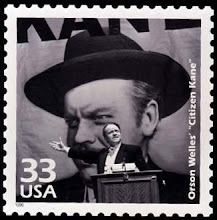
The 3 American flag stamps joining Captain America (Scott #4159e ) date back to 1957: Scott #’s 1094, 1132, and 1320. The US Citizen Kane stamp (Scott #3186o) I paired with one from Guyana. Bernard Herrmann’s first film score was for Kane, as was Orson Welles’s only Oscar (but for screenwriting, not directing). The Scott #’s are 3341 & 3772b, respectively.
Friday, June 22, 2012
Queer Notions
It’s hard to imagine two films as different from each other
as Beautiful Thing (Macdonald, 1996) and Happy Together (Wong, 1997). One traces the beginning of a romance while
the other chronicles the slow death of one.
One is heavily stylized, with saturated colors, handheld intimacy, and
grainy black & white, while the other has TV movie production values. One story is very linear, while the other is
more elliptical. One is sexually coy,
with a cast of unknowns, while the other decidedly isn’t on either count. They take place on the other side of the
globe from each other, with family and community playing a big part in one,
while the other is a tale of cultural alienation, with the two main characters
virtually the only ones with speaking parts.
Even the respective approach each film has to its title is polar
opposite, for while Beautiful Thing is puppy-dog sincere, the men in Happy
Together are anything but.
But if there’s one thing they have
in common (besides their gay protagonists), it’s about how the laws of attraction
can transcend all sorts of barriers and obstacles, for better and for
worse. As The Turtles song (which makes
a late appearance in the Wong Kar-Wai film) goes:
Me and you and you and me
No matter how they toss the dice,
it has to be
The only one for me is you, and
you for me
And these lyrics hold true, in
different ways, for both films.
Beautiful Thing starts off as a
British working class drama in the classic kitchen sink tradition. Gritty, urban, and racially diverse, we
eventually learn that this, external trappings aside, is no world of a Loach or
Leigh or Richardson. For while the film
starts with its feet on the ground, it ends with its head in the clouds. Forged from common feelings of loneliness, the
chemistry between Jamie and his mate Ste is sweet, tentative, believable. But while trenchant topics like schoolyard
bullying and domestic abuse start front and center, the film, perhaps a little
too easily, sheds itself of these issues to lose itself, head over heels, in
its romance.
What would be the cultural fallout
to two lads being out and proud in such a closeknit but economically
disadvantaged environment? There would
be pockets of acceptance, but the film skirts the larger backlash from peers
that would likely result. Is the film
itself a metaphor for how those other problems dissolve away in the mind’s eye
(but not the real world) when you fall in love?
Or is it a victim of its own soft center and good intentions? The rooftop finale ends up being extremely
touching but also a bit naïve, but perhaps that’s only if we project our
expectations on the film to ground itself in fact. But Love often represents its own Truth that
ignores fact. That’s where the risk of
Love lies, and one’s sense of the larger film as emotionally authentic fantasy
or well-meaning empowerment exercise directly relates to how, for this couple,
you choose to embrace this Truth.
That this kind of Love-as-Truth
can fly in the face of all demonstrable evidence is also at the core of Happy
Together, a film that finds in the extraordinary visual palette of
cinematographer Christopher Doyle, a corrosive melancholy in the depiction of a
relationship in its downward spiral. For
there is love there, but buried under the frustration, imbalance, and resentment
of a romance on the rails. There are
lots of petty arguments and needling efforts to taunt and torture the other,
but no huge turning point in the course of the couple, just a festering
complacency that is spiritually toxic. A
slow death by a thousand ruts.
But that doesn’t mean there isn’t
beauty, intimacy, and longing—even if it’s longing for something that once was
but is no longer. The fulfillment of a
personal dream, only to understand its hollowness when that person to share it
with is absent. The memory of a
closeness that’s faded, when it’s mirrored in the kindness of a stranger. The cherry-picking of experiences, the
fixation on little moments that echo in your consciousness that serve as a
reminder of why you’re drawn to them in the first place. The heart wants what it wants, even if it
doesn’t always know best. Like moths to
that flame until one inevitably burns out, director Wong captures those
feelings that go beyond narrow conceptions of sex and gender. It’s a film that’s erotic not in the
particulars of the bodily exchanges, but in the language of cinema itself—the rhythms
and music, the cutting and compositions that infuse every frame with sensuality…and
sadness.
Tony Leung and Leslie Cheung were
as big as any actors alive in Chinese cinema at the time, but their portrayal
of two gay lovers has no real equivalence in American cinema when it comes to
stars of that magnitude in our industry.
And a film like this makes you wonder what a Scorsese or Eastwood or
Spike Lee would do with similar material, where the queer element is both
central and incidental. Maybe one day we’ll
know.
Like the previous Quilts of Gee’sBend posting, these two one-sheets were selected because the patterns and color
schemes of the poster design matched nicely with the stamps themselves (Scott # 4094 & 4091).
For more entries in the Queer Film Blogathon
Sunday, May 27, 2012
Horse Feathers

The immense outpouring of affection recently at the loss of
Maurice Sendak filled me with joy and sadness—joy at the abiding legacy he left
with so many people, and sadness because I was not one of them. I never grew up with Where the Wild Things Are,
or any of his other books. I was
probably in high school before I was even aware of who he was, and while that
wasn’t too old to appreciate his genius, the opportunity his books had to tap
into my childhood impulses of defiance, giving tacit approval to less decorous
desires, was past.
Mine was a childhood of “Children should be seen and not
heard”, of bedtime Bible stories and Little Golden Books. Maurice Sendak, Judy Blume, were simply not
on my radar at all. The only element of
subversive role modeling in my life, embracing anarchy and reveling in chaos,
were the Marx Brothers.
To my parents, they were silly. Cartoonish.
With cute musical numbers. In
short—harmless.
But while other classic comedians I was allowed to watch
might fall into that characterization—Bob Hope or Danny Kaye, say—I knew the
Marxes were different. For they weren’t
cowards. They weren’t clowns. They were jesters, fearless in the face of
authority. They were brazen with women,
insulting toward tough guys, and irreverent towards anyone who told them what
to do. They were one-of-a-kind and hilarious.
And I loved them. For they were a balm in a landscape of suburban propriety I had around
me. And the fact that my parents didn’t
seem to get it—the satire, the innuendo (much of which went over my head, too),
the blatant disrespect they represented—made them that much richer to me. In a still water world, they were my din and
tonic.
A Day at the Races (Wood, 1937) may be their last largely satisfying
movie. Once they moved to MGM, they
began to gradually lose their fizz, but this was only their second film at the
studio and their energy was still suitably manic and unrestrained, though some
telltale warning signs (overly produced musical numbers, an increased
sentimentality) are there, too.
While the Marxes would usually run rampant in the corridors
of the elite (opera circles, ivory tower universities, luxury cruise liners),
Races is unusual in that it straddles itself between a highly formal
environment (the Shelton sanitarium) and the racetrack, where shysters, con
men, and rascals like Groucho, Chico & Harpo are right at home.
The horse in Races is High Hat, the final hope for the
financially strapped hospital that has just recently acquired Hugo Z.
Hackenbush (Groucho) as its chief-of-staff, at dowager Margaret Dumont’s insistence
(though no one knows he’s actually a horse doctor). That the racetrack adjoins the sanitarium
means the action can move back and forth, with jockey Harpo and co-conspirator Chico
prepping the horse for the big race. The
less said about Allan Jones, colorless love interest to sanitarium owner
Maureen O’Sullivan, the better.
There are some memorable comedic setpieces. The legendary
Tootsie-Frootsie ice cream negotiation between Chico & Groucho is still
fantastic, and Chico & Harpo’s game of charades is fun, as are the boys’
examination of Dumont & foiled seduction of floozy Esther Muir. And the climactic race is in the boisterous
spirit of the football game in Horse Feathers, which takes a lot of the
conventions of the sport and turns them on their head (and unlike most horse
racing films, this is a steeplechase, which is fundamental in a final twist).
But the film really belongs to Groucho. His phone conversation with Leonard Ceeley is
a miniature masterpiece, and his rumba number alternating between Dumont &
Muir has its own perverse grace. None of
the other Marx boys could hold the screen on their own, for Chico perpetually
needs a partner and Harpo risks becoming too precious left to his devices
alone. But give Groucho a dance floor or
an empty hotel room and he’s master of the house.
And speaking of dance numbers, Races is unique in Marx
Brothers history as being the only one of their films nominated for an Oscar—Best
Dance Direction for the genuinely bizarre “All God’s Children Got Rhythm”,
which manages to combine terrific jitterbugging with unfortunate blackface in a
bizarre tangent that has nothing to do with anything in the story (though the
number is still a step up from another turgid Jones ballad).
The Marxes did end up getting an Oscar—an Honorary Achievement
one in the early 1970s, when only Groucho was left alive. One can only imagine the chaos they would’ve
caused at a ceremony, worthy of Races’ gala or the climax of A Night at the
Opera (still my favorite of their flicks).
But they had to become elder statesmen of comedy to finally get their
due.
Which still, curiously, has not happened with the USPS
yet. For while Laurel & Hardy,
Abbott & Costello, and W.C. Fields have gotten their stamp, the only
mention they’ve gotten has been Groucho in the You Bet Your Life stamp (seen
here as part of the Early TV Memories series, Scott #4414; coupled with horse
racing, Scott #1528). But their real
impact as a group, making them still quite contemporary while the other artists
I listed have dated some over the years, continues to go unrecognized. Having a slate of stamps, with the mirror
scene from Duck Soup, the stateroom scene from Opera, and the barrels in Monkey
Business (to throw Zeppo a bone) would be perfect. And throw Tootsie-Frootsie
in there, too. For the Coconut in all of
us.
For more entries in the Classic Movie Horse Blogathon
Subscribe to:
Posts (Atom)