Showing posts with label Art/Architecture. Show all posts

Friday, June 9, 2017

All the World Is Waiting for You


Despite the remarkable ascendancy, critically and commercially, of the Marvel Comics cinematic Universe in the last decade, there is no denying that it has largely been one big sausage party.  Growing up as a Marvel comics fan, this was also true of the publisher itself.  Women heroes, when represented, were usually part of a team (Sue Richards, Scarlet Witch, Jean Grey) and there weren’t any female icons with the heft to carry their own title in any significant way.  When the USPS released a set of Marvel stamps ten years ago, the interests of gender parity meant including marginal characters like Elektra and Spider-Woman over far more famous heroes like Thor and Daredevil.  This was because Marvel simply didn’t have any females as big as their counterparts at DC, Wonder Woman or Supergirl.
And so the films have followed-suit, with Scarlett Johansson’s Black Widow (incredible ass-kicker but essentially power-free) doing most of the heavy lifting across five appearances to date.  Even when staffed with Oscar-winners like Halle Berry, Jennifer Lawrence and Anna Paquin, the Marvel films have rarely known what to do with them.  In fact, the only female-driven Marvel film so far has been Elektra, Jennifer Garner’s incarnation who got her own movie after first being introduced as a secondary character in a film where Ben Affleck played an urban vigilante.  Sound familiar?
So Patty Jenkins’s Wonder Woman is far overdue, especially when you consider that her DC colleagues Superman and Batman have had a combined total of 16 appearances in films since Christopher Reeve first began the modern era of superhero movies almost 40 years ago.  That’s one every 2.5 years.  And that’s not even counting The LEGO Batman Movie (2017’s fifth highest money-maker currently).
They say to never let the perfect be the enemy of the good, and Wonder Woman is good.  The business on Exposition Island is clunky (most origin stories are) but rich with Amazon badassery.  There’s not enough of Etta Candy (Lucy Davis) or Antiope (Robin Wright), though there is something delicious about having Princess Buttercup unleash her inner warrior.  The third act reveal of Ares is smart and well-thought out, but what it means is that through most of the film, there really isn’t a truly menacing villain as counterpoint to Gal Gadot’s imposing presence.  Danny Huston was a bigger threat in the Wolverine offshoot movie as a mere mortal, and is definitely no Red Skull.
For of course, Captain America: The First Avenger (2011) is the obvious analogue to Wonder Woman, a pair of noble neophytes waging war in the German (or Belgian) woods via historical flashback.  But the film that Wonder Woman more closely resembles, and a comparison I haven’t seen anywhere yet, is Luc Besson’s The Fifth Element, celebrating its 20th anniversary this year.  For like Diana, Milla Jovovich’s Leeloo is fierce but gentle, naïve but strong-willed, and doesn’t need anyone’s help to take out a room full of assailants.
But more importantly, their arcs are similar because they are their own McGuffin.  Diana thinks she’s carrying the God-Killer (her sword), but she actually *is* the God Killer, just like Leeloo is herself the Fifth Element.  Both have, late in the game, serious bouts of disillusionment with mankind and its propensity for war and violence.  But both overcome this despondency and very explicitly choose to manifest Love—not merely Eros (the stock & trade of comic book fantasy), but Agape, a higher spiritual extension of compassion, generosity and self-sacrifice.
In this sense, I think it resembles Man of Steel (Snyder, 2013), a film I’ll still argue is--while also flawed--underrated and misunderstood.  Both heroes are not mere saviors, but also a means to inspire those around them.  But while that film is cloaked in a brooding melancholy, Wonder Woman has clear-eyed optimism, even in the face of man-made horrors.  After Chris Nolan’s excellent but dark Batman trilogy set the tone for DC’s moody temperament, WW is exactly the shot-in-the-arm this comic series needs.  Which is why I worry about the upcoming Justice League movie, which will depict Diana a hundred years later.  Will she be more jaded and cynical?  She was the best thing about the bad Batman v Superman because she brought warmth and sass and energy.  But as the new movie demonstrates, her real heroic power is Love.  How much of that will survive when she joins this Super Boys Club with a different director at the helm?
The same weekend I saw Wonder Woman, I attended the SF Silent Film Festival.  And it was a welcome reminder of how the movies weren’t afraid of strong women back then, even if the times were far more conservative.  In Filibus (Roncoroni, 1915), the title role is a female mastermind—exceptional thief, daring impostor, and the head of a motley crew of outlaws with gadgets that would make James Bond green with envy.  In Outside the Law (Browning, 1920), Lon Chaney may have two roles (one heroic, one villainous) but it’s Priscilla Dean who calls the shots when she inherits a criminal empire from her father.  She balances being a reformist and a resourceful crook with equal aplomb.
But the real eye-opener for me was The Dumb Girl of Portici (1916), a remarkable collaboration between famous Russian dancer Anna Pavlova and pioneering director Lois Weber.  The first American woman to direct a feature-length film, Weber had dozen of titles under her belt by this time, but she was still known for contemporary dramas and social issue pictures.  This was a film on a completely different level—an epic period piece with a higher budget and bigger scale than she’d ever worked with before.  It reminded me of the talk of giving Patty Jenkins such an expensive tentpole picture after just one feature (the Oscar-winning Monster) and some TV work.
The final result?  Portici is a glorious achievement, with incredible tableaus, jaw-dropping camera movement, and a wonderful sense of drama amidst the herculean (or perhaps, Amazonian?) task of managing so many moving parts within a single frame.  The film isn’t perfect (it still suffers from some stiff dramaturgy typical of the time), but the achievement is impressive: a gorgeous restoration of a film that deserves to be better-known.
Which got me thinking: Why isn’t there a US postage stamp of Weber?  Or of any woman filmmaker for that matter?  Body and Soul (1925) was also featured at the festival, and both Oscar Micheaux and Paul Robeson, the film’s director and star respectively, have well-deserved US postage stamps.  In fact, there’s a wonderful series of stamps commemorating Black Cinema and a handful of film directors have been honored on stamps starting with D.W. Griffith.
 
But the only women who have been honored from the American film industry have been actresses—amazing, powerful, influential actresses, but still ones who never really worked outside the confines of that craft.  No directors or producers, no screenwriters or below-the-line artists.  Douglas Fairbanks has a US stamp, but not his wife Mary Pickford, one of the biggest stars of the silent era and a co-founder of United Artists.
No Lois Weber or Mabel Normand or June Mathis.  No Maya Deren or Dorothy Arzner or Ida Lupino (as important a director as an actress).  Not yet, at least. 

But I’ll keep hoping that one day, I can add a Frances Marion stamp to my Anna Christie card (part of her prolific writing career) or an Edith Head stamp to my Roman Holiday card (one of over 400 films to her credit as costume designer).  Or any number of women who were essential in making the movies magic.  History was often not kind to their placement in the industry or the opportunities afforded them.  Which makes their achievements that much more worth celebrating.  Wonder Women all.
These are the Scott #s for the stamps pictured:  
The Wonder Woman stamp from the DC Comics issue (lower right on Lynda Carter card) is #4084c.  The three stamps from the Wonder Woman issue a decade later are #5149, 5150, & 5151.  The other stamps pictured from the DC Comics issue are Superman (#4084k), Green Lantern (#4084b), the Flash (#4084p), Green Arrow (#4084d) and Hawkman (#4084j).  The Batman stamp was from the issue for that character (#4934).  On the Justice League card, you can see all 3 different types of postmarks.
The two stamps pictured from the Marvel Comics issue are Captain America (#4159o) and Elektra (#4159i).  The movie stars pictured are Paul Robeson (#3834), Greta Garbo (#3943), Audrey Hepburn (#3786) and Gregory Peck (#4526).  Oscar Micheaux is #4464.  Mary Pickford's Canadian stamp was issued in 2006.
The stamp for Charles Demuth's painting "I Saw the Figure 5 in Gold" is #4748a.  The textile worker (#4801k) is from the Building America series.  The Field Day stamp (#5182) is part of the brand new WPA posters series.


Monday, February 6, 2017

For E, Four-Oh


Awash with mutual affection, we walked up Filmore St. and had dinner at Florio, where we talked and ate pasta off each other's plates.  Then on the way back, she sang Thelonious Monk and Kurt Weill to me in that beautiful voice of hers.  And when I said good night to her, looking in her eyes there on the corner of Eddy & Steiner, I knew I had never loved anyone so much as I did her.

And still do.  If I could relive one hour of my life again over and over, forever, it would be that hour with her. 

She turns 40 today, and this card is for Her.

Starting at the top, Georgia O'Keefe (Scott #4748e) is one of four stamps on this card that were part of the Modern Art in America issue--the others being Arthur Dove (#4748l), Marsden Hartley (#4748d), and Marcel Duchamp (#4748k).  The first-day-of-issue postmark is for those stamps.

Moving on from there, the other stamps I featured are: Neysa McCain (#3502m), William M. Harnett (#1386), Folk Art tea caddy (#1776), Frida Kahlo (#3509), Love letter (#3551), Isamu Noguchi (#3859), Grandma Moses (#1370), Winslow Homer (#1207), John Sloan (#1433), Hawaii (#C84), Mary Cassatt (#1322), Fine Arts (#1259), guitar (#1613), Yosemite National Park (#740), Seattle (#1196), orchid (#2079), art glass (#3328), Edward Hopper (#3184n), and Louise Nevelson (#3383).


Thursday, June 30, 2016

She Certainly Can Cannes-Cannes


When people (quickly) discover what a big cinephile I am, the question I get the most often (besides “What’s your favorite movie?”) is “Have you been to Sundance?”  And they’re invariably surprised when I tell them No.  After all, isn’t that what cinephiles do?  Isn’t Cannes our Mecca?  But honestly, I’m not interested in going and never really have been.  The newest incarnation of this query is the Turner Classic Movies Festival every spring.  I’m a regular on #TCMParty, have met dozens of fabulous film fans from around the US on that hashtag, and even am lucky enough to have TCM follow me on Twitter.  But I’m guessing I’ll probably never go to that, either.

This year will be my seventh working for the Mill Valley Film Festival.  But long before that, I’ve been going to local film festivals, most notably The San Francisco International Film Festival.  So I love the energy film fans bring to a screening.  I'm excited by the marathon days, the triangulation of schedules across multiple venues, the bustling from one show to the next.  In particular, I love that festivals are usually the only place you can see short films projected, which I consumed voraciously long before it became my job to program them.

But destination film festivals have held little appeal to me.  As much as I love travel and movies, they’ve very rarely overlapped in my life.  When I’m somewhere new, foreign, different, I want to explore the landscape, not hole up in a theater.  I’ve seen movies in England and Ecuador when I was living there, and once in Thailand because the humidity was so oppressive, it was the easiest way to cool off (it was one of the Bourne films), but otherwise, my travels meant seeing parks and museums and centers of culture and history, never movies.  And that’s what it’d be like if I was in the south of France or Park City, too.


Some of it is also the cost.  Festivals can be expensive on their own, let alone the additional price tag of planes, hotels, food, etc.  The one festival I have been to outside the Bay Area was SXSW, and that was because I’d visited Austin already and my all-access badge was paid for.  But everything else on that trip still made a huge dent on my wallet.  It was undeniably fun, but not something I had any wish to make a habit of.  And that’s why I can’t see myself spending money to stay in LA for a week for TCM, no matter how great the crowd, the guest list or the program schedule might be.

There are lots of different types of festival patrons, too.  Some love to see the big stars, the legends or masters or household names.  Some people are drawn to the First Look appeal—the chance to see a film weeks or months before anyone else.  Festivals count on that kind of star-power draw and name recognition, and I totally get that.  But that’s not what draws me.  I love festivals for the chance to see films I’ll never see anywhere else, arthouse or otherwise.  Guests are great and Q&As can often be illuminating and memorable, but that’s not the reason I go.

And that’s why, given a choice, I’d always prefer SFIFF over TCM (whose schedules overlap annually).  Because I live in the Bay Area, there’s no shortage of classic films available on the big screen here.  Here’s a list of all the films that screened in June in a theater within 40 minutes of me that were made at least 40 years ago:

The Gold Rush (Chaplin, 25)
Behind the Front (Sutherland, 26)
Nell Gwyn (Wilcox, 26)
The Scarlet Letter (Sjostrom, 26)
The Big Broadcast (Tuttle, 32)
White Zombie (Halperin, 32)
Duck Soup (McCarey, 33)
The Crime of Doctor Crespi (Auer, 35)
The Great Garrick (Whale, 37)
Four’s a Crowd (Curtiz, 38)
The Private Lives of Elizabeth and Essex (Curtiz, 39)
The Long Voyage Home (Ford, 40)
Santa Fe Trail (Curtiz, 40)
Hold Back the Dawn (Leisen, 41)
They Died with Their Boots On (Walsh, 41)
Double Indemnity (Wilder, 44)
The Dark Mirror (Siodmak, 46)
His Sister’s Secret (Ulmer, 46)
La Otra (Gavaldon, 46)
To Each His Own (Leisen, 46)
The First Legion (Sirk, 51)
The Forbidden Christ (Malaparte, 51)
Strangers on a Train (Hitchcock, 51)
The Lusty Men (Ray, 52)
The Devil’s Money (Galindo, 53)
Roman Holiday (Wyler, 53)
Giant (Stevens, 56)
Cat on a Hot Tin Roof (Brooks, 58)
Suddenly, Last Summer (Mankiewicz, 59)
Butterfield 8 (Mann, 60)
La Dolce Vita (Fellini, 60)
The Great Race (Edwards, 65)
Tokyo Drifter (Suzuki, 66)
Who’s Afraid of Virginia Woolf? (Nichols, 66)
Spring Night, Summer Night (Anderson, 67)
The Chronicle of Anna Magdalena Bach (Straub/Huillet, 68)
Dillinger is Dead (Ferreri, 69)
The Wild Bunch (Peckinpah, 69)
Two-Lane Blacktop (Hellman, 71)
Fat City (Huston, 72)
Bring Me the Head of Alfredo Garcia (Peckinpah, 74)
The Sugerland Express (Spielberg, 74)
Kings of the Road (Wenders, 76)

And that's not even including the SF Silent Film Festival, which featured 16 features--including films by Ozu, Clair, Lang, Lubitsch, Fleming, Micheaux, and Wellman's Beggars of Life, starring Louise Brooks--and even more shorts. 


TCM fans are drawn to their festival by the opportunity to see those classic films on the big screen (many of which I already have), by the stars, the interviews, and the camaraderie.  And I don't doubt for a second that I would have a lot of fun in their company.

But there are far more things I would feel I missed out on by not attending SFIFF--new foreign treasures, innovative docs, experimental shorts I'll never see anywhere else.  Every month is like a TCM festival living here in the Bay Area anyway--beautiful Art Deco houses, or film archive theaters, or dungeon-like screening rooms specializing in 16mm arcana--so I save my pennies (or rather, maximize their cinematic heft) by staying put.  There are still a lot of places in the world I want to visit.  But movies have very little to do with any of them.  Which suits me fine.

The Ingrid Bergman stamp is Scott # 5012 .  The stamp of Aaron Douglas's painting The Prodigal Son (Scott # 4748g) is part of the "Modern Art in America" series.


Thursday, March 10, 2016

Desert Island 100

The challenge: Pick my favorite feature film each year from 1924-2015.  Add 8 more shorts spread out over that period to make an even 100.  Here's what I picked.  Links are to other blog entries on those films.  What would your list look like?

1924 Greed (von Stroheim)
1925 The Gold Rush (Chaplin)
1926 The General (Keaton/Bruckman)


1927 The Italian Straw Hat (Clair)
1928 The Wind (Sjostrom)
1929 Man with a Movie Camera (Vertov)
1930 The Blue Angel (Sternberg)
1931 M (Lang)
1932 I Was Born, But... (Ozu)
1933 Footlight Parade (Bacon)
1934 The Thin Man (Van Dyke)
1935 Bride of Frankenstein (Whale)

1936 The Crime of M. Lange (Renoir)
1937 Shall We Dance (Sandrich)
1938 Bringing Up Baby (Hawks)
1939 Only Angels Have Wings (Hawks)
1940 Pinocchio (Sharpsteen)
1941 The Lady Eve (Sturges)
1942 Casablanca (Curtiz)
1943 The Life and Death of Colonel Blimp (Powell/Pressburger)
1944 Meet Me in St. Louis (Minnelli)
1945 Children of Paradise (Carne)

1946 Belle et la Bete (Cocteau)
1947 Black Narcissus (Powell/Pressburger)
1948 Germany, Year Zero (Rossellini)
1949 Kind Hearts and Coronets (Hamer)
1950 Winchester '73 (A. Mann)

1951 On Dangerous Ground (N. Ray)
1952 Singin' in the Rain (Donen/Kelly)
1953 The Earrings of Madame de... (Ophuls)
1954 The Seven Samurai (Kurosawa)
1955 Night of the Hunter (Laughton)
1956 Forbidden Planet (Wilcox)
1957 Sweet Smell of Success (Mackendrick)
1958 Vertigo (Hitchcock)
1959 Some Like It Hot (Wilder)
1960 La Dolce Vita (Fellini)
1961 Last Year at Marienbad (Resnais)
1962 Cleo from 5 to 7 (Varda)
1963 The Leopard (Visconti)
1964 Dr. Strangelove, or How I Learned to Stop Worrying and Love the Bomb (Kubrick)
1965 Chimes at Midnight (Welles)
1966 The Battle of Algiers (Pontecorvo)
1967 Point Blank (Boorman)
1968 2001: A Space Odyssey (Kubrick)
1969 The Wild Bunch (Peckinpah)

1970 Days and Nights in the Forest (S. Ray)
1971 Walkabout (Roeg)
1972 The Bitter Tears of Petra van Kant (Fassbinder)
1973 The Spirit of the Beehive (Erice)
1974 Chinatown (Polanski)

1975 Monty Python and the Holy Grail (Gilliam/Jones)
1976 The Marquise of O (Rohmer)
1977 Close Encounters of the Third Kind (Spielberg)

1978 The Last Waltz (Scorsese)
1979 The Black Stallion (Ballard)
1980 The Empire Strikes Back (Kershner)
1981 Pennies from Heaven (Ross)
1982 Burden of Dreams (Blank)
1983 Zelig (Allen)
1984 The Terminator (Cameron)
1985 Come and See (Klimov)
1986 The Sacrifice (Tarkovsky)
1987 Wings of Desire (Wenders)

1988 Bull Durham (Shelton)
1989 Do the Right Thing (Lee)
1990 Miller's Crossing (Coen)
1991 The Double Life of Veronique (Kieslowski)
1992 The Last of the Mohicans (M. Mann)
1993 Groundhog Day (Ramis)
1994 Ed Wood (Burton)
1995 Underground (Kusturica)
1996 Lone Star (Sayles)
1997 A Taste of Cherry (Kiarostami)
1998 Out of Sight (Soderbergh)
1999 Topsy-Turvy (Leigh)
2000 In the Mood for Love (Wong)
2001 Mulholland Dr. (Lynch)
2002 Gerry (Van Sant)
2003 Master and Commander: The Far Side of the World (Weir)
2004 Eternal Sunshine of the Spotless Mind (Gondry)
2005 L'Enfant (Dardenne/Dardenne)
2006 Children of Men (Cuaron)
2007 Once (Carney)
2008 Man on Wire (Marsh)

2009 The White Ribbon (Haneke)
2010 Winter's Bone (Granick)
2011 The Tree of Life (Malick)
2012 Moonrise Kingdom (Anderson)
2013 Upstream Color (Carruth)
2014 Timbuktu (Sissako)
2015 Mustang (Erguven)

Shorts
1929 Un Chien Andalou (Bunuel)
1933 Snow White (Fleischer)
1949 Begone Dull Care (McLaren/Lambert)
1962 Cosmic Ray (Conner)
1968 Windy Day (Hubley/Hubley)
1993 The Wrong Trousers (Park)
2000 The Heart of the World (Maddin)
2013 Just Before Losing Everything (Legrand)

Here are the Scott #s for the stamps pictured:

Devil's Tower - 1084
Water conservation - 1150
Talking Pictures - 1727
Hudson's General - 2843
Frankenstein - 3170
Cinematography - 3772g
Luke Skywalker - 4143e
James Stewart - 4197
Wedding cake - 4398
William S. Hart - 4448
John Huston - 4671
Iron worker - 4801h
Circus clown - 4905
Martin Ramirez train - 4970


Friday, January 8, 2016

2015 Yearly Wrap


Martin Ramirez set, Scott # 4968


Medal of Honor set, Scott # 4822b


Coastal Birds set, Scott # 4994.  California condor stamp (1971), Scott # 1430


Penguins issue, Scott # 4989


Summer Harvest set, Scott # 5007


Elvis Presley, music icon series, Scott # 5009


Ingrid Bergman, Scott # 5012


Paul Newman, Scott # 5020


A Charlie Brown Christmas set, Scott # 5025

Saturday, November 19, 2011

Maximum Review


It’s been a while since I discussed maximum cards, and while they don’t pop up often in my collecting, the recent X-men post reminded me that I should highlight a few that I’ve created since I last wrote about them.

I don’t typically collect art postcards, but when the abstract expressionist issue came out, I went to one of the few remaining postcard stores I know and found this painting of Robert Motherwell’s "Elegy to the Spanish Republic #34" (Scot #4444g).  This is a maximum card in its most traditional sense.

I will admit to never having seen a single episode of The Honeymooners (Scott #4414t), but I found a few postcards for the show on E-Bay, including this one, which has Jackie Gleason’s face virtually identical in both stamp and card.  If you look carefully, though, you can see Art Carney’s face is slightly different in the two photos.  Still, pretty darn close. 


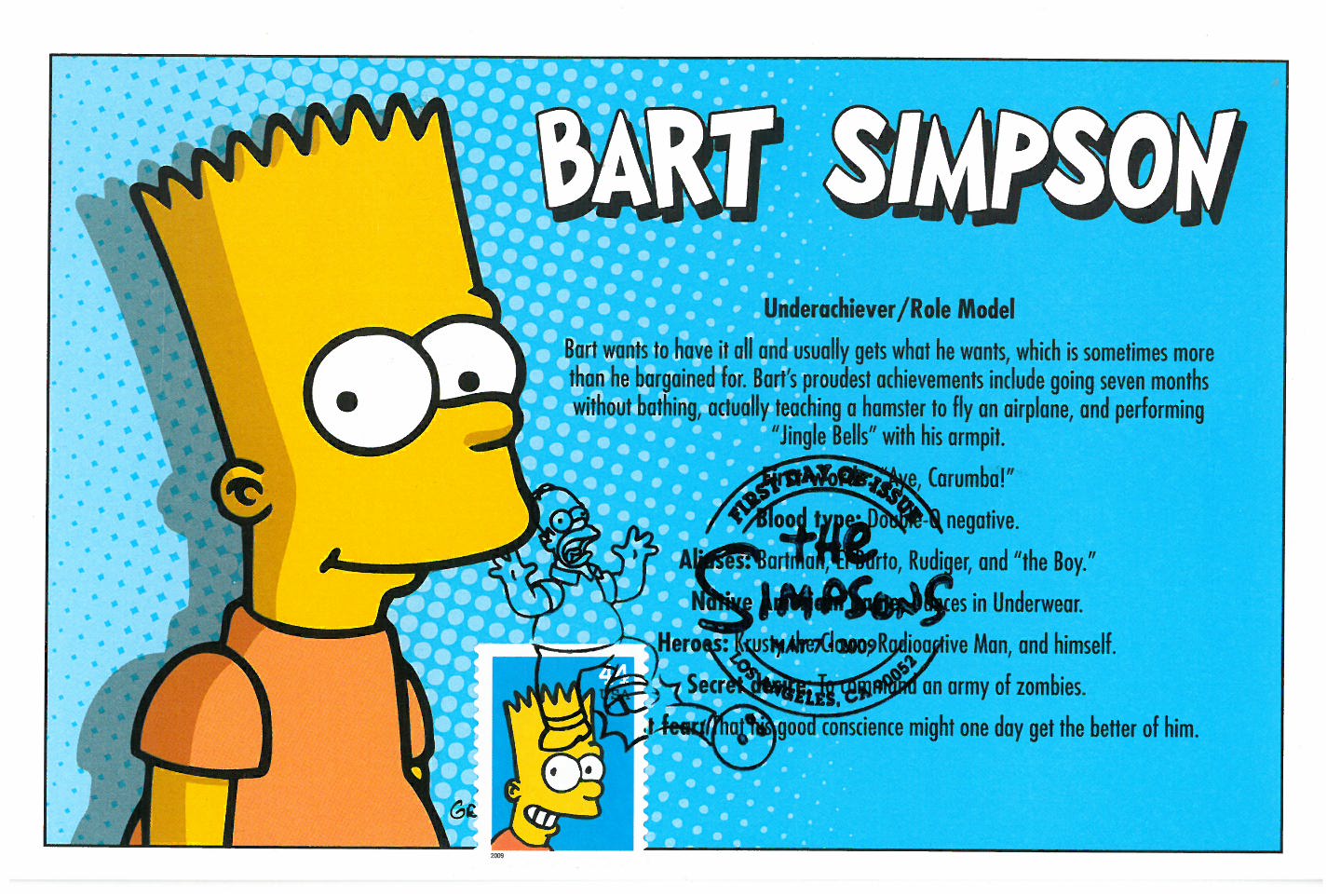
This profile of Bart Simpson (Scott #4401) also has a slightly different facial expression but given the matching background color, also comes very close as well.

And of all 20 different Disney stamps issued between 2004 and 2008, this stamp from Lady and the Tramp (Scott #4028) most closely resembles any of the postcards I used for the First-Day-of-Issue postmark.


Sunday, February 6, 2011

Inspiration


I am not a particularly creative person. My writing has always leaned toward analysis and academia-based essays, but never fiction. I have a musical sensibility, vocally and instrumentally, without the skill to match. My attempts at photography, juggling and magic are notable for their failure to go anywhere. Unless you count intentionally bad poetry (especially limericks), you might say the most creative thing I do is this blog and these postcards--which may not be saying much (whatever gifts I have lie elsewhere). But my tastes over the years have allowed me the opportunity to hang around dancers, musicians, photographers, filmmakers, all of whom have amazed me with their talent, but in an art form that I still found somewhat accessible, either from first-hand experience or long-term exposure.

But artists--painters, sculptors, mixed media--have always impressed me in a different way. Because I honestly don't know how they do it. Examining brush strokes up close in a museum never fails to leave me in awe, for every little dib and dab seems so arbitrary, random on its own. But the whole is greater than the sum of its parts, and seeing a canvas breathe life and force and intensity in its static frame is a thing of singular beauty that I don't feel in a position to scrutinize. With the other arts, I think I can provide some sort of critical perspective, because I understand the mechanisms behind creating harmony or dissonance, light or shadow, fluidity or gravity.

Of course, all these qualities apply to painting, too, and I've seen enough art (across four continents) to know that I like some things much more than others. But while I am personally discerning, I guess I feel less qualified to be judgmental. Because every achievement that works or connects with me, I see as a small miracle. And the ones that don't are miraculous in their own way, too. That's why I've never had an issue with "modern" art--for while it can be superficially assessed as simplistic or naive or lazy, it still was inspired by something powerful and elusive, yet rendered in front of me whole and concrete and fearless. I respect that a lot, and while I've known my share of artists over the years, I've never seen them at work, so the process is still couched in mystery to me.

Which is why a movie like Pollock (Harris, 2000), or any artist biopic, can be challenging. Because inspiration is rarely a simple throughline of cause-and-effect. The epic expanse of white that is a blank canvas would be terrifying to me, that first stroke too great a level of commitment. And while Pollock's process may involve more sheer physicality than a Da Vinci or Monet, conveying that window into his artistic mind can still be a difficult thing to dramatize. Very few movies have done it successfully, leaving the artist we love (no matter how well-acted) still an enigma, chronicling the events and external demons of a life but never harnassing the soulfulness that makes that art great.

I wouldn't know what makes a painting "great" anyway. Back in college, my friend in UC Santa Cruz had a Pollock-y painting on her dorm room wall that I thought was marvelous. Learning her 6-year old niece made it didn't change that opinion one bit. I have a painting hanging now at home, from a friend. It reminds me of Van Gogh, but with a pallette that's more verdant than I'm used to him. Is it any good? All I know is that I love it.

My favorite films about art are The Mystery of Picasso (Clouzot, 1956) and The Quince Tree Sun (Erice, 1992). Neither are biographies, but simple films about trying to capture that process, and depicting how the making of a piece (be it masterful or not) is itself a journey that's singular, with the rest of the world only seeing the final destination. They are both magical films, and ones that I never hesitate to recommend to my artist friends--though I never know if they've sought them out. For process itself can be sacred and private, and while other artists perform in front of audiences, a painter or sculptor rarely does. And it feels almost intrusive to ask about how those seeds are planted.
The Phladlephia Museum of Art. The Tate Modern. The Uffizi. So many I've seen and adored visiting, and so many more I'd like to some day. In a private gallery or a public square, I never tire of being left in awe. The stamps for Pollock and De Kooning (played by Ed Harris and Val Kilmer, respectively) were part of an Abstract Expressionist issue by the USPS (Scott #4444d & b), while the other Pollock stamp (nicly mirroring the poster itself) was part of the Celebrate the Century series (Scott #3186h)

Thursday, January 20, 2011

2010 Yearly Wrap

 Katharine Hepburn, Scott #  4461


Cowboys of the Silver Screen issue, including Roy Rogers, Scott # 4446


Abstract Expressionsists issue, including Mark Rothko, Scott # 4444c

Sunday Funnies issue, including Archie, Scott # 4469


Sunday, March 1, 2009

Vertigo Redux

I just received back from the USPS one of my Vertigo postcards with a new FDC, so I thought I’d post it because it’s unique for a couple of reasons. I’ve already discussed my great love for the film, and while the one-sheet is the same as the previous post, the cancellations and stamp combinations are different.


First of all, this postcard has six different First-Day-of-Issue postmarks on a single card, as many as exist in my collection (in chronological order):

Alfred Hitchcock (Legends of Hollywood series; Scott #3226)
Bernard Herrmann (Film Composers issue; Scott #3341)
Film Directing (American Filmmaking issue; Scott #3772b)
The Coast Redwoods (Wonders of America issue; Scott #4063)
Jimmy Stewart (Legends of Hollywood series; Scott #4197)
And now, the Redwood Forest priority mail stamp (Scott #4378)

You can see by the dates that this spans 12 years from the first postmark to this most recent one.

This card also has the most stamps of any non-Disney postcard I have, for in addition to those listed, I also used four other stamps. The Golden Gate Bridge and Palace of Fine Arts stamps were featured in the previous Vertigo blog post, to which I’ve added the two oldest stamps on the postcard: Forest Conservation (1959; Scott #1122) and the bicentennial of the California settlement (1969; Scott #1373)


I used so many of the redwood tree stamps because of the visit Scottie and “Madeline” make to the redwood groves in the film. As big a movie buff as I am, I never quote movies in my everyday life, but if I’m ever in a museum or national park and encounter a large tree cross-section, I will always say, “Here I was born, and there I died. It was only a moment for you. You took no notice”. It’s a haunting moment in a haunting film.

As for the California stamp, nothing could be more perfect for the film than its depiction of a mission belltower, which, sadly, doesn’t really exist if you visit San Juan Bautista in real life. The mission is there but the tower in the film is a matte painting.

The dollar value of all the stamps is also by far the most of any in my collection, because this most recent postmark was for a priority mail stamp, putting the total face value of the card at $7.37.

I think this card is also ready for retirement. There’s very little real estate left to fit any other stamps, and I’m hard-pressed to think of anyone else associated with the production who will be recognized by the Postal Service. The film features Kim Novak’s best performance (Stewart’s too, incidentally), but I don’t see her ever getting a stamp. The brilliant Herrmann thankfully has already been acknowledged, and while Saul Bass (title credits), Robert Burks (cinematography) and George Tomasini (editing) also make invaluable contributions to this masterpiece, it seems likely that this will be about it--unless the film itself gets its own stamp one day. Who knows?

But I’m really happy how this one turned out—a real prize in my collection commemorating an even more special movie.