Showing posts with label Historic Figures. Show all posts

Monday, February 6, 2017

For E, Four-Oh


Awash with mutual affection, we walked up Filmore St. and had dinner at Florio, where we talked and ate pasta off each other's plates.  Then on the way back, she sang Thelonious Monk and Kurt Weill to me in that beautiful voice of hers.  And when I said good night to her, looking in her eyes there on the corner of Eddy & Steiner, I knew I had never loved anyone so much as I did her.

And still do.  If I could relive one hour of my life again over and over, forever, it would be that hour with her. 

She turns 40 today, and this card is for Her.

Starting at the top, Georgia O'Keefe (Scott #4748e) is one of four stamps on this card that were part of the Modern Art in America issue--the others being Arthur Dove (#4748l), Marsden Hartley (#4748d), and Marcel Duchamp (#4748k).  The first-day-of-issue postmark is for those stamps.

Moving on from there, the other stamps I featured are: Neysa McCain (#3502m), William M. Harnett (#1386), Folk Art tea caddy (#1776), Frida Kahlo (#3509), Love letter (#3551), Isamu Noguchi (#3859), Grandma Moses (#1370), Winslow Homer (#1207), John Sloan (#1433), Hawaii (#C84), Mary Cassatt (#1322), Fine Arts (#1259), guitar (#1613), Yosemite National Park (#740), Seattle (#1196), orchid (#2079), art glass (#3328), Edward Hopper (#3184n), and Louise Nevelson (#3383).


Wednesday, August 3, 2016

Good as Gold

-->
I’ll admit it: Despite the waste and corruption that often go hand-and-hand with their undertaking, I am easily seduced by the Olympics.  Given that coverage (live or tape delayed) often occurs round-the-clock, the looming Summer Games in Rio de Janiero will prove to be an extraordinary temptation over the next 2 weeks, especially for this perpetual early riser.  Although I love watching the relatively obscure sports that are often broadcast in those pre-dawn hours, I’ll inevitably watch some track & field, too—races that often get front-and-center attention in the TV coverage, not only because the US always does very well in them, but because of the natural mythology around naming “The World’s Fastest Human” in the 100-meter dash.
Certainly, Track & Field has played a more prominent part in movies about the Summer Olympics than any other sport—most recently with the historical drama Race (Hopkins, 2016) about Jesse Owens in the 1936 games.  While not the first black athlete to medal in the 100m, his victory that year (exactly 80 years ago today) carried enormous symbolic weight because the games were held in Berlin under the shadow of Hitler and orchestrated by Joseph Goebbels and the propaganda arm of the Third Reich.  In defiance of the host country’s insistence that no Jewish or “Negro” athletes compete, Owens’ 4 gold medals struck a powerful blow against the dogma of racial superiority that was a driving engine of the Nazi Party.
The movie isn’t bad.  Stephan James is good in the lead role, and the story is an important one.  Predictably, the double meaning of the title is a prominent theme, since not only did Owens face systemic prejudice at Ohio State (where the movie begins), but he felt enormous pressure from the NAACP not to compete in Berlin as a gesture of protest against how African-Americans were still being oppressed in the US.  Although the horrific explicitness of that racism isn’t depicted as vividly as it was in 42, the movie follows many of the same beats as that recent (superior) Jackie Robinson film.  There’s even a scene where German runner Luz Long befriends Jesse in front of the entire stadium of Germans (and the Fuhrer) that echoes what southerner Pee Wee Reese would do with teammate Jackie in Cincinnati decades later.  Long’s scene with Owens in private after their race is perhaps the best in the film—two athletes with deep mutual respect acknowledging the role they’re each playing as propaganda tools of their governments.  But like many movies dedicated to recreating real events, the other characterizations are cookie-cutter and the final result is more of a history lesson than an emotionally engaging drama.
What’s interesting about the film, though, is that its story directly links to the two most celebrated films about the Summer Olympics: Leni Riefenstahl’s Olympia (1938) and Hugh Hudson’s Chariots of Fire (1981).  The connection with the former is obvious.  Riefenstahl (played by Black Book’s Carice van Houten) was perhaps the most prominent female film director in the world at the time and is an important character in the movie.  While commissioned by Goebbels as a tribute to the wonders of a modern Germany (we see the two of them watch rushes of her coverage), Riefenstahl went beyond that short-sighted mandate and redefined cinematic language when it came to form and athletics in ways that are now commonplace on ESPN and advertising today.  It’s still a problematic film, with the ever-present swastikas and the specter of the Holocaust around the corner, but it’s not a paean to National Socialism the way the country’s leaders might have hoped for.  Her eye transcends the politics of the piece, even if it can't divorce itself from it completely.  And she doesn’t give short shrift to Owens’ accomplishments either.  In a scene in Race where Riefenstahl asks Owens to help her shoot some pick-ups for his Gold medal Long Jump that would later be inserted into her film, they have this exchange:
Jesse: Isn’t that cheating?
Leni: Cheating?
Jesse: Yeah.  I’m just saying it’s not the actual jump I made.
Leni: You did make that jump.  We all saw it.  You made history out there.  All I’m doing is making sure years from now, those people who weren’t there can see it too.  ‘Cause they’ll never forget what you did.
And she did.  And we haven’t.  Riefenstahl is one of the most complex figures in movie history, and one of my favorite documentaries is about her: The Wonderful, Horrible Life of Leni Riefenstahl (Muller, 1993).  In it, the film doesn’t blink at the insidious contribution she made to the Nazis’ ascendancy through her notorious film The Triumph of the Will.  But it also shows in the many decades after WWII that she was smart, resourceful, innovative, gutsy, and supremely talented.  Perhaps the best you can say about her is that she was a fervid aesthetician who lived in denial about how her gifts were exploited for evil.  Other judgments, far harsher, would be equally fair.  But this exchange in the film also brings the conversation about myth-making in an ironic full circle, because Owens’ legacy is also helped immeasurably by her film.
The connective tissue between Race and Chariots of Fire is interesting, too.  Larry Snyder (SNL’s Jason Sudekis) was Owens’ coach at Ohio State, and also on the US Track & Field team that competed against Brits Harold Abrahams and Eric Liddell in the 1924 Paris games.  We even see a picture of Snyder with Charlie Paddock (played by Dennis Christopher In Chariots).  Sadly, Snyder was in a plane crash weeks before the games and never competed.  But he did go on to coach the US team in Helsinki (1952) and Rome (1960).
Abrahams, like Owens 12 years later, won the 100m (his time was 10.6 seconds; Owens, 10.3).  The film shows that he dedicated his athletic pursuits to fight the antisemitism he faced in the English establishment.  This resonates in Race because on the eve of the 100x4 relay in Berlin, the US benched its two Jewish runners out of deference to the Germans.  Owens ended up subbing in that race and there is a powerful scene where his teammates talk to him about what a victory would mean to them, watching from the sidelines.  They won, of course.  Although Chariots doesn’t depict it, Abrahams also won a medal in the 4x100 (a silver) in Paris.
I think Chariots often gets a bad rap.  It does have a bit of Masterpiece Theater stuffiness about it, but it also does address religion (Abraham’s Judaism and Liddell’s Christianity) in ways that you rarely see in mainstream movies anymore—with thoughtfulness, sincerity, and lack of piety.  Vangelis’ iconic synthesizer score manages to be anachronistic but still mines emotional depths.  It’s the only Oscar nomination Ian Holm has ever received (an oversight bordering on the criminal).  Its period details are meticulous (lacking starting blocks, the runners use small trowels to dig in footholds before the race, something we see Owens do in Race, too).  And with the recent Star Trek reboots, there’s a perverse delight in seeing Spock’s father (Ben Cross) and the Borg Queen (Alice Krige) fall in love.  Plus it was my first introduction, at 11 years old, to Scotland, and I’ll admit to thinking of Liddell training across the lush countryside when 20 years later, I hiked up to Arthur’s Seat, the mountain peak overlooking Edinburgh.  
There are also a couple of postage stamp references worth noting in Chariots.  When Abrahams is enrolled in Cambridge (somewhere I’ve also visited), we see him and future Olympian teammate Aubrey Montague signing up for various extra-curricular activities.

Harold (to Aubrey): “Rugby club, golfing society, tennis, squash club, flora and fauna!, philately—is that all?  You’re idle, man.  Idle!”

So stamp collecting was a viable academic pastime back then.  A few seconds later, we see a sign for another club: The Cinematic Club.  Given that the date is 1919, it strikes me as perhaps a little early for such a club, especially for a medium that was still associated with the lower classes at the time, not the halls of privilege.  Plus, even the most hardcore cinephile would be hard-pressed to name a notable British silent film up to that time (unlike other parts of Europe).
  
The second stamp reference comes a little later.  The film has already used Aubrey’s letters to his mother as a narrative framing device for the film.  Now, in Scotland, Sandy—a friend to the Liddells—makes a toast to the family, most of whom are returning to their missionary work in China, where Eric (Ian Charleson) was born.
Mrs. Liddell: I’m relying on you now to keep them all out of mischief.
Sandy: Oh, that I will, Mrs. L.  And if they do transgress, I’ll pop the details on a postcard and you can read all about it before you can say "Marco Polo".
Eric: Cost you a fortune in postage stamps.
Tragically, Ian Charleson and Brad Davis, who plays American Olympian Jackson Scholz, would be dead within a decade, both from AIDS.   
The Jesse Owens Olympic stamp is Scott # 2496.  He never competed in the hurdles in the Olympics, but the stamp commemorating his records set in the US, part of the Celebrate the Century series, is Scott # 3185j. 

Saturday, March 14, 2015

Zero Recall


Happy Birthday to Albert Einstein, who was born on this date 136 years ago.  So why not discuss the action film where his postage stamps played a critical part of the story?  For I’ll be honest: I’m a sucker for time travel movies, so I have a weak spot for John Woo’s Paycheck (2003), flaws notwithstanding.
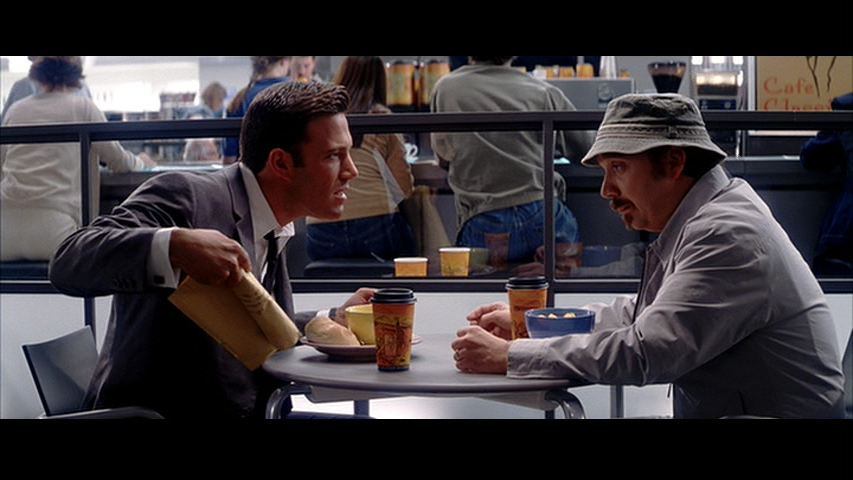
Now Paycheck is not a typical time travel movie because nobody actually travels through time.  Ben Affleck is an engineer-for-hire who builds a machine for billionaire Aaron Eckhart that can see into the future and right before getting his memory of the job erased (a scifi conceit that’s part of his employment contract), he leaves himself an envelope full of innocuous items—each of which his “future self” knows will (by virtue of using the machine) help him, since he can see that Eckhart plans to betray him.  From there, he is forced to go on the lam from both the law and a team contracted to kill him as he tries to unravel a past he doesn't remember.

What first arouses his suspicion is that despite expecting a nine-digit payday for his years of service, he discovers that he had mysteriously declined his salary (one of many things he can't recall after this amnesia procedure) and this envelope of random junk he left for himself is the only thing he’s left with.   He first receives the envelope (with cancelled postage) from the registrar at the company:
Registrar: Your personal items.  You only needed four stamps.
Ben: Oh, well, I guess I can afford the extra 50 cents.

This is before he learns from her that he gave up the paycheck he had earned, something he can hardly believe he would’ve done voluntarily.  But very quickly, he realizes (after a narrow escape using a couple of the items in the envelope) that giving up his salary was his way of telling himself that these items held enormous value while still getting that message past his employer who would’ve checked the envelope for anything unusual.
The rest of the movie is essentially one big chase film after that, so we see this envelope with the Einstein stamps over and over again, surviving shootouts and high-speed pursuits, since the contents of the envelope remain his only clues as to why he has been put in such peril.  Certainly, no philatelic items in film history are exposed to as much high-octane action as this set.


Eventually, he learns that he had a girlfriend (Uma Thurman) during his time at the company and despite not remembering anything about their relationship, he recruits her to his cause--she does remember him, after all--and she gets in on the action, too (although his assignment was top secret, so she doesn’t know exactly what he was working on either).
By this time in his career, Woo was on the verge of self-parody.  Face/Off (1997) was an irresistible acting tour de force as John Travolta and Nicolas Cage swap faces and personas, but all the incessant slow motion and flying doves and heavy-handed symbolism were getting to be predictable, silly stylistic flourishes.  The second Mission: Impossible film was completely undistinguished and the less said about the WWII Windtalkers the better.  So Paycheck is nice because the action is well-executed but isn’t as overly-orchestrated as we’re used to seeing from him.  And because Affleck is always problem-solving his way out of situations using the envelope’s items, it’s a movie that highlights the character’s brains over his brawn.
Ultimately, the stamps serve their most important purpose by explaining his situation.  He intuits that the excess postage itself was a clue and when inspecting the stamps closely, he sees that’s he embedded in Einstein's eye a set of microscopic pictures, “screen shots” from what he saw in the future-vision machine.   
They are a series of newspaper headlines from the future showing that rampant abuse of the machine would destroy the economy, aggravate international tensions, and ultimately lead to global war.  Up to this point, he was able to stay one step ahead of Eckhart because he had put (pre-amnesia) a poison pill in the programming of the machine, temporarily sabotaging it so it couldn't be used.  But now, he knows he has to go back and destroy the machine for good with his dwindling supply of envelope “assists”.
It’s important to point out that Albert Einstein does indeed have two different US stamps, an 8 cent and 15 cent issued in 1965 and 1979 respectively (Scott #s 1285 & 1774).  The stamp in the movie is neither of them.  So why manufacture a fake stamp?  One guess is that they needed a high denomination but still specifically wanted to use Einstein.  After all, Affleck does have this conversation with his one other close confidant, Paul Giamatti.
Giamatti: Look, if we know anything, we know that time travel’s not possible.  Einstein proved that, right?
Affleck: Time travel, yes.  But Einstein was very clear that he believed time viewing theoretically could be accomplished.
It’s from this conversation that they speculate how he was somehow able to anticipate these items being critically useful to him and, by extension, guess what he had been building in this mystery job assignment.  So the Einstein stamps not only see a ton of action, but they act as a thematic reference, too.
Paycheck isn’t a great film—Ben and Uma have zero chemistry and there are a few too many explosions by the climax—but I like the puzzle aspect of decoding the usefulness of each individual item, and the envelope itself and the persistent inventorying of its contents hearkens back to that other (far better) stamp movie, Charade.
This was the last film Woo made in the states, returning to a very different Hong Kong from when he made the legendary The Killer, Hard Boiled and A Better Tomorrow.  Here's hoping one day he makes his way back across the Pacific; it'd be interesting what the intervening years have taught him.

Sunday, December 1, 2013

When we play our Charade

Charade (Donen, 1963) celebrates its 50th Anniversary this week, and over the years, it has earned a reputation, oft-repeated, as “the best Hitchcock film Hitchcock never made.”  Now, I love Charade, and not just because it’s the best postage stamp film ever.  It’s an irresistibly entertaining comedy-thriller, with wonderful Paris locations, great lines of dialogue, and a fizzy, playful tone, all fueled by incredible chemistry between Cary Grant & Audrey Hepburn (their only film together). 

But I’ve always hated that Hitchcock meme because it shows a fundamental failure to understand what the great Sir Alfred was all about.  For while Charade is enormous fun, it really isn’t about anything except thrills and laughs and clever reversals.  And while Hitch certainly employed all those things, he was far more reflective, and far more subversive.  His is the cinema of sex and psychology, of paranoia and pursuit, of fever dreams and salient nightmares.  His humor was darker, his action laced with malevolence.  He showed a real fear of institutions and a suspicion of normalcy, with his characters regularly haunted and hounded out of their routines.


Hitch lived with the moniker “The Master of Suspense”, which often served as a back-handed compliment, since it appreciated his technical craft while also relegating him to a genre hack, a niche and unserious talent.  He certainly made worse films than Charade, but I’m hard-pressed to think of many that were as lightweight.  Charade is a delicious soufflé.  But Hitch was filet mignon.  So “the best Hitchcock film Hitchcock never made” should reflect his artistry and pathology, not just his deceptive smoke & mirrors.  Something by Chabrol, perhaps.  Or Polanski or Suzuki.

But we’re here about stamps, and the statute of limitations on spoilers is why I can call this marvelous confection the greatest postage stamp movie in history—because the big twist of the film is the fact that postage stamps play an important role at all.  Throughout the film, the key characters, good and bad, are looking for a missing $250,000 and the only clues to its whereabouts are the contents of a travel bag, which are itemized several times in the film

Police inspector: “One wallet, containing four thousand francs; one agenda...; one ticket of passage to South America; one letter, stamped but unsealed...; one key, to your apartment; one comb; one fountain pen; one toothbrush; one tin of tooth powder.  That is all.”
Of course, we eventually learn that the envelope actually contains three incredibly rare and valuable stamps, a discreet and portable way to move the fortune.  I won’t discuss the specifics around the stamps in question (which were conceived especially for the movie), primarily because I couldn’t do it any better than this detailed and illuminating blog post about philatelic values and the real-life counterparts to this narrative McGuffin.  Definitely check it out.
But the movie is very clever about disguising what is ultimately a preposterous resolution.  Early in the film, our damsel in distress Reggie (Hepburn) has the following chat with Jean-Louis, the young son of her friend Sylvie:
JL: When you get your divorce, are you going back to America?
R: Well, don’t you want me to stay?
JL: Yes, of course, but if you went back and then wrote me a letter...
R: ...You could have the stamps!  I’ll get you some here, ok?
JL: OK
 
This is before she learns her husband is dead or about the money and the bag, and it’s a throwaway exchange but a nice way to seed the idea of stamps being important later on when Jean-Louis goes to the stamp mart (which is obliquely mentioned in the agenda).
Similarly, the film is coy about how it shows the envelope, mixing it in among the other assorted items and, when more closely inventoried by Reggie and her mysterious ally (Cary Grant), dismissed quickly out of hand.  More emphasis is placed on the contents of the envelope, an innocuous letter to her, than the envelope itself—a sly little head fake by screenwriter Peter Stone.   We only get two brief looks at the stamps before the big reveal, one when baddies James Coburn & Ned Glass examine the bag's contents, and another when Audrey & Cary revisit the clues.

"Everybody and his Aunt Lillian’s been through that bag, including me...I’ve been into it at least once a day.  Somebody would have seen it."
"It’s there, Reggie.  We’re looking at it right now.  Something on that bed is worth a quarter of a million dollars."
Of course, it defies credulity that the French police, a member of the US treasury department, and 3 criminals (not to mention our heroine) would not notice that something was unusual about 3 stamps on a single envelope for a domestic mailing, or that none of the stamps are French and all are from different countries!  But that’s the genius of a McGuffin, which is simply a vehicle to keep the plot moving.  And one of the beauties of Charade is that it has terrific pacing while also allowing lots of room to let the romance breathe.  It’s also a very funny movie without ever losing its sense of genuine menace, and Cary’s allegiances are always jumping back and forth (hero or villain?) believably.  And of course, the stamps are a great 11th-hour twist, but not the only one.

So approaching the climax, the final entry in her husband’s agenda brings Cary & Audrey to the Jardin des Champs Elysees.  They don’t know what they’re looking for so they split up and Cary tails the last remaining heavy, Tex (Coburn) as he wanders among a cluster of vending stalls.  Suddenly, both he and Tex have a wordless epiphany, punctuated by lots of quick close-ups of stamps.  


As they both return to grab the stamps from the travel bag, we return to Audrey still at the garden, who runs into Sylvie.
R: Sylvie! What are you doing here?
S: I’m waiting for Jean-Louis. 
R: Oh, what’s he up to?
S: He was so excited when he got the stamps you gave him this morning.  He said he’d never seen any like them.
R: I’m glad.  What’s all this?
S: The stamp market.  It’s there every Thursday afternoon.  That’s where Jean-Louis trades his stamps.
R: Good Lord, where is he?
S: What’s the matter, Cherie?
R: The stamps!  They’re worth a fortune!
Having gone to quite a number of philatelic conventions in my time, all the production design and displays in this sequence are very convincing, so I suspect the stamp mart is a real thing (though one I've never sought out in the 3 times I've traveled to Paris).


 When they finally find Jean-Louis, it’s too late:


R: (taking a bag of stamps from him): What’s this?
JL: A man gave me all those for only three.
The vendor has closed his stall, so they find him in what appears to be his home (with philatelic items scattered everywhere)


Stamp Vendor: I was expecting you.  I know you would come.  Look at them, madame.  Have you ever in your entire life seen anything so beautiful?
Reggie: I’m sorry, I don’t know anything about stamps.
SV: I know them as one knows his own face, though I had never seen them.  This one, a Swedish four shilling called Da Gula Fyraskillingen, printed in 1854.
R: What is it worth?
SV: Oh, the money is unimportant. 
R: I’m afraid it’s very important.
SV: Well, in your money, perhaps $85,000.
R: And the blue one?
SV: Oh, it’s called the Hawaiian Blue.  In 1894, the owner was murdered by a rival collector who was obsessed to own it.
R: And what is its value today?
SV: $65,000.

SV: Ah, the best for last.  Le chef d’oeuvre de la collection.  The masterpiece.  The most valuable stamp in the world.  It’s called the Gazette Maldave.  It was printed by hand on colored paper and marked with the initials of the printer.  Today, it has a value of $100,000.  I’m not a thief, madame.  I knew there was some mistake.
R:  You gave the boy a great many stamps in return.  Are they for sale now?
SV: Let me see, 350 European, 200 Asian, 175 American, 100 African and 12 Princess Grace commemorative.  Which comes to 10 Francs.  And don’t forget these. (hands her the stamps from the envelope)
R: Thank you.  I’m sorry.
SV: Oh, no.  For a few minutes they were mine.  That is enough.

I’ve always loved this exchange for a number of reasons.  It shows a stamp enthusiast who is passionate and learned, but also has enormous integrity.  It views stamp collecting as a portal into history, intrigue, and craftsmanship.  And the cheap bag of stamps is a very familiar fixture at stamp stores, showing that it’s a hobby that’s accessible to even the most modest amateur and not just a pastime for the effete and elite.  

One other thing about the value of the stamps (beyond what the link above breaks down): Nothing is said about how sticking the stamps on the envelope potentially devalued them.  $250K may be the cumulative sales price, but would the US be able to recoup the money now that the stamps are affixed to something?  Or will some intern have to soak the envelope in water to slide the stamps off and allow them to carefully dry separately again?


Some other details: The stamp vendor mentions a Princess Grace commemorative stamp, and in the stamp montage, you can actually see one (from Monaco).  Other stamps on display include pictures of Lincoln & FDR, Charles De Gaulle & Louis XIV, and the 1960 Winter Olympics (in Squaw Valley, CA).  No US stamps are depicted, but there are ones from France, the Congo, Madagascar, French West Africa and French Equatorial Africa.  Incredibly, on display is even one stamp I’ve used in my own hobbying, an Eiffel Tower stamp from 1939, which I used to supplement this one-sheet for The Lavender Hill Mob (which is also one of Audrey Hepburn’s earliest film appearances).


Another thing I love about Charade is that it’s a film that loves the City of Lights without indulging in the stereotypical Paris porn like so many American movies do (Exhibit A: Donen & Hepburn’s previous collaboration, the musical Funny Face).  There's some wonderful Parisian street scenes and plenty of atmosphere without relying on the cliche locations.  Even when it does feature a tourist spot like Notre Dame (also visible in that stamp screen shot), it’s as a self-referential joke.

Donen is one of my favorite directors and has always had a wonderful eye for movement in his legendary musicals, and that skillset serves him well here, in a thrilling rooftop fight between Cary and a hook-handed George Kennedy, and also in the climax under the stage of the Comédie-Française, a masterclass sequence of using sound and movement to enhance suspense.  All before that final surprise happy ending, and Cary's last line of the film: "Well, before we start that, may I have the stamps?"


Donen doesn’t have a stamp (yet), but Cary & Audrey both do.  They are Scott # 3692 and 3786 respectively.  The flavorful score is by Henry Mancini, whose stamp is Scott # 3839 (Charade is even mentioned on the stamp itself).  All 3 postmarks are on the reverse side of my one-sheet postcard that opened this article.  The Hitchcock stamp from the Legends of Hollywood series Is # 3226 and the one from the Golden Age of Television is # 4414o .  Obi-Wan Kenobi is Scott # 4143i from the Star Wars issue.