Showing posts with label Christmas. Show all posts

Friday, January 8, 2016

2015 Yearly Wrap


Martin Ramirez set, Scott # 4968


Medal of Honor set, Scott # 4822b


Coastal Birds set, Scott # 4994.  California condor stamp (1971), Scott # 1430


Penguins issue, Scott # 4989


Summer Harvest set, Scott # 5007


Elvis Presley, music icon series, Scott # 5009


Ingrid Bergman, Scott # 5012


Paul Newman, Scott # 5020


A Charlie Brown Christmas set, Scott # 5025

Sunday, December 20, 2015

Kringle All the Way

-->
My first associations with Fred Astaire were with Christmas.  One of the first films I remember him starring in was the family-friendly TV movie The Man in the Santa Claus Suit (1979), where he is an ever-present holiday sprite in NYC as three different men find unlikely solutions to their respective problems through a Santa suit they rent from Fred.  Of course, there was the ubiquitous Holiday Inn (Sandrich/1942), which first introduced the song "White Christmas" (sung by co-star Bing Crosby).  But the earliest thing I remember was the Rankin-Bass Christmas special Santa Claus Is Coming to Town, narrated by Fred, which first aired in 1970, the year I was born.

Rankin-Bass, of course, were the producing pair (Arthur Rankin Jr. & Jules Bass) who created a series of animation specials, mostly Yuletide but other holidays too, that were prevalent when I was growing up.  Quite a few used puppets and stop-motion, including the first, 1964’s Rudolph, the Red-Nosed Reindeer, which received a postage stamp issue last year.  That’s an origin story for Rudolph, with Santa an established character and Burl Ives (as a North Pole snowman) acting as singing narrator.  SCIC2T follows the same template, with Fred a mailman who uses the letters from Santa he encounters as a springboard to explain Kris Kringle’s backstory.  He makes a terrific storyteller and even sings the title tune, a bonus pleasure.

Like Gene Kelly, the other legendary male dancer from Hollywood’s Golden Age, Fred Astaire doesn’t have a US postage stamp yet.  It’s always curious how the decision-making process is conducted for which film stars get memorialized by the USPS, either in the Legends of Hollywood series or an offshoot issue.  Certainly, he’s a profoundly influential figure in popular culture, both as singer & dancer, and while Bing has a stamp, as do Fred’s co-stars of the classic musicals Easter Parade (Judy Garland) and Funny Face (Audrey Hepburn), he's still waiting for one.  Fred’s only Oscar nomination was for the very unmusical The Towering Inferno (Guillerman/1974) and his co-star there, Paul Newman, also has a stamp.
In fact, the closest thing to a postage stamp in the US that Fred has is actually in his Rankin-Bass Xmas special, where all the credits are formatted as postal letters, with the characters depicted as stamps.

Though no longer mainstays on network TV, these specials still get rotation in December on other cable channels, like ABC Family.  Perhaps their best facet were the songs, which had nice memorable little hooks.  But revisiting Santa with my mom recently, I noticed something unusual: they cut one of the tunes, and a rather central one, since it’s the musical motif for Santa himself (whose theme recurs throughout the show).  The internet being what it is, it was easy enough to find the missing song, which has the following lyric, sung by Kris: 

If you sit on my lap today,
A kiss, a toy is the price you pay.
When you sit on my left knee, don’t be stingy.
Be prepared to pay.

While the song itself is innocently karmic (the love you give comes back to you), the quid pro quo aspect of coercing affection with the promise of gifts sends a very different message these days.

It’s also interesting that Kris and the future Mrs. Claus (the gorgeous redheaded school marm, naturally) are also essentially a common law union, never getting legally married, but finding  their vows to each other sufficient in a ceremony that’s spiritual but not “religious”.  It’s a curiously progressive stance that’s perfectly in sync with Jessica’s surprisingly adult torch song of non-conformity and sensory awakening “My World Is Beginning Today” (which also indulges in some heavy abstract animation, very unusual for these kiddie specials).  Her voice was done by Robie Lester, who only has a handful of credits but, curiously enough, did provide the singing voice for both of Eva Gabor’s Disney flicks: The Aristocats (1970/Reitherman) and The Rescuers (1977).
I’ll admit that I liked the rudimentary but charming animation style as a kid, and it served as my first introduction to quite a few classic film stars: Jose Ferrer and Greer Garson (The Little Drummer Boy, 1968), Shirley Booth and Dick Shawn (the latter as the hilarious Snow Miser in The Year Without a Santa Claus, 1974), and Jimmy Durante (the cel animated Frosty the Snowman, 1969).  Mickey Rooney--another legend one suspects has a stamp in his future--played Santa in both SCIC2T and Year Without...

But even memories of some of the more obscure specials linger.  Nestor, the Long-Eared Donkey (essentially, a Biblical Rudolph from 1977) had a four-legged parental death that moved me far more than Bambi’s mom did.  Jack Frost (1979) was a primer in how a girl can say she loves you but not, you know, love-loves you (leaving the title character in a bittersweet frozen friendzone).  And the awkward, skeptical, bespectacled kid mouse in Twas the Night Before Christmas (1974) was easily relatable given what I saw in the mirror every day.
Perhaps the best loved holiday special is the one that got a stamp this year: A Charlie Brown Christmas (1965/Melendez), which is celebrating its 50th Anniversary.  The Charles Schulz museum in Santa Rosa, CA, isn't far from where I live and well worth the visit.  It always has wonderfully-curated collections that show how savvy he was in observing human behavior through these kids who always had childish impulses and very adult sensibilities.  The TV special is no different in its critique of commercialism at the expense of more simple and compassionate priorities (and all with a terrific Vince Guaraldi score).

Personally, my favorite remains How the Grinch Stole Christmas (1966 and my first exposure to Boris Karloff) so if these TV specials are a trend with the USPS, I hope it gets an issue next--though as you can see, Dr. Seuss has gotten a few stamps from them already.


Santa from the Rudolph issue is Scott #4948.  The original Peanuts stamp is #3507 while Charlie Brown w/his tree is #5021.  Dr. Seuss is #3585, "The Cat in the Hat" #3187h and "Fox in Socks" #3989.  Paul Newman is Scott #5020 and the skyskraper stamp (#4710n) is from the Earthscapes issue. 101 Dalmatians and Lady and the Tramp are #4342 and #4028 respectively.  And Elvis is Scott #5009.


My 10 Favorite Fred Astaire films

1. Shall We Dance (Sandrich, 1937)
2. Swing Time (Stevens, 1936)
3. You Were Never Lovelier (Seiter, 1942)
4. Top Hat (Sandrich, 1935)
5. The Band Wagon (Minnelli, 1953)
6. Easter Parade (Walters, 1948)
7. Follow the Fleet (Sandrich, 1936)
8. Royal Wedding (Donen, 1951)
9. Silk Stockings (Mamoulian, 1957)
10. Funny Face (Donen, 1957)


Saturday, December 24, 2011

A View from the Bridge

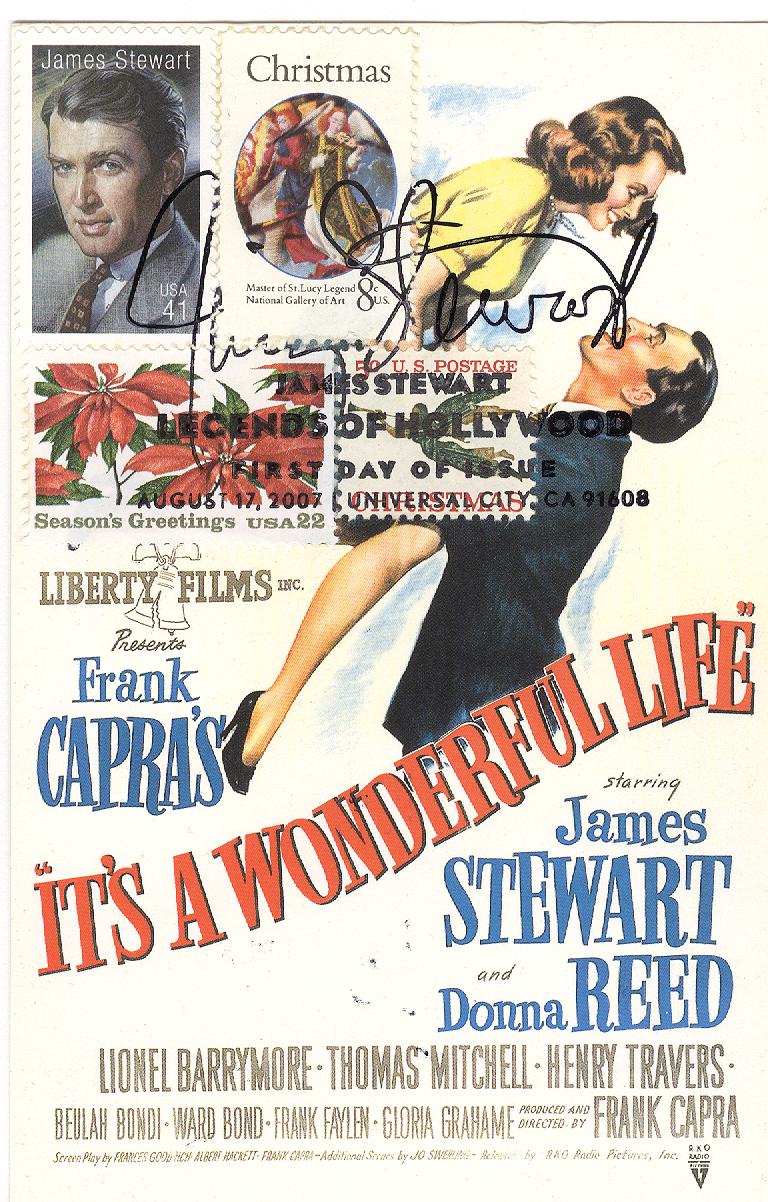
A holiday standard now, Frank Capra’s It’s a Wonderful Life (1946) is a film that’s easy to take for granted and even easier to underestimate. The idyllic small town life of Bedford Falls, the overly-cutesy courtship of George and Mary, the knee-jerk sentimentalism about human nature are what we’d come to expect from Capra. And while there are charming moments or marvelous little grace notes, it’s undeniable that he lays it on a bit thick, especially with Clarence’s running commentary.

But Jimmy Stewart may be America’s greatest actor, and Life is a film on the cusp of his career, since it revels in his effortless folksy charm, often parodied but never less-than-believable, but it also anticipates the darker Stewart who’d flourish in the 1950’s—the Stewart with disturbing pathologies (the Hitchcock films) or with the raw nerves of obsessive behavior (the brilliant Anthony Mann westerns). For it’s in the last half hour that Life really takes wing, with a fantasy element that submerges itself into unadulterated nightmare.


Much of Pottersville might seem pretty tame to us now. And I’ve known more than my fair share of librarians who laugh at Mary’s horrible fate without George (though it’s hard to imagine Donna Reed not ever landing another beau). But to have your world turned upside down in an instant, to have every memory and place and association called into question, to have your entire reality thoroughly upended (especially those things that you'd grown to love and cherish)—I can only imagine how horrible it must be. And Stewart sells it thoroughly. It's not a film I revisit often, but when I do, I am still surprised by the darkness at its center.

There are no shortage of Christmas stamps available, so when the Stewart release came out (Scott #4197), I tried to select some that had a very traditional feel to them and which matched the color scheme of the one-sheet pictured.

Angel (1965 – Scott #1276)
Virgin Mother (1972 – Scott #1471)
Poinsettia (1985 – Scott #2166)


As for the reverse side, I figured throwing some more Christmas stamps in would be fun, since I needed to add the Barrymores (Scott #2012; Lionel plays Mr. Potter) anyway.

Sleigh (1983 - Scott #1900)
Ornament (1987 – Scott #2368)
American Holly (1997 – Scott #3177)

This is in addition to the Tiomkin stamp (Scott #3340) that I piggybacked onto the First Day Cover of the American Filmmaking series (Screenwriting – Scott #3772a) back in 2003. Total face value of all the stamps pictured: $2.66 (and 2/10).

A film like Life invites one to examine the impact you’ve had on others’ lives—inadvertent or otherwise. How your actions cause ripples in the pond, ones that reverberate beyond your own awareness. George never made a name for himself outside of his town, never conquered the world. But his decency was profound, and so was his impact. He sometimes may feel trapped in his life, but he still has choices. He never embezzles money from the Building and Loan. He never cheats on Mary. He lives on his word, his integrity, and the community responds in kind when he needs them.

George could easily appear a plaster saint, a glib archetype of the Everyman Stewart is often best remembered for. But there are far worse things in this world than to be staid and boring and decent. Sometimes, the ripples you set off aren’t ripples, but waves that capsize the boats of others—not just in an alternate life, but in a real world nightmare of your own creation. To have a legacy where you know you’ve made someone’s life worse, not better—it’s a heavy, heavy thing.

Clarence tells George “No man is a failure who has friends.” I wish that were true. But like Zuzu’s petals, I have a buckeye in my pocket—one I’ve kept there for 15 years, reminding me often of those who mattered, but more recently of those I’ve damaged. Perhaps irreparably. For it was a wonderful life. But I’m no George Bailey. And while the future remains uncertain, it will be quite a while before those waves stop crashing.

Saturday, December 25, 2010

Merry Christmas


Like last year, a Christmas one sheet of a Disney short, this time with Mickey and Pluto in Mickey’s Good Deed (Gillett, 1932). The holiday wreaths (Scott #3245-7) are part of the same set and match up with the wreath in the window. Depression era B&W Disney are far better in both humor and nuance, with lots of nice detailing in the animation and a greater gift for character design without being afraid of surrealistic elements. And there are still emotional touches that are charming.

May your Yuletide be full of food, fun, and fellowship.

Friday, December 25, 2009

Merry Christmas


This is a good example of how, once I got the first year’s Disney issue FDC on a postcard, I decided to get the subsequent ones’ too, completing the set. In this case, these are all the Mickey stamps—chronologically, Scott #3865 w/Donald, followed by 3912, 4025, 4192, and 4343). The Christmas tree on the front dates back to 1973 (Scott #1508).

Toy Tinkers (Hannah, 1949) has probably been seen more than most Chip ‘n’ Dale shorts since it gets a lot of play this time of year, with Donald undertaking a military campaign against the rodents. I’ve never been a huge fan of this era of Disney shorts—colorful, polished, and utterly bland. Oscar nomination aside, this one is no exception.

Merry Christmas everyone. May your holiday season be a safe and happy one.

Thursday, December 25, 2008

The Hero of 34th Street


Miracle on 34th Street (Seaton, 1947) remains one of the best-loved Christmas films, and with good reason: it has a terrific cast (led by Oscar-winner Edmund Gwenn as Kris Kringle), a story that deftly balances seasonal uplift with modern skepticism, and a tone that never takes itself too seriously.  It's one of the few films I try to catch around this time each year.

But the film also stands out as probably the finest cinematic moment for the United States Postal Service.  As you remember, late in the film, the trial over Kris's sanity isn't going well, so Susan (Natalie Wood) decides to write him a letter, which her mother (Maureen O'Hara) mails to the county courthouse, via those vertical mail chutes you'd find in high-rise buildings from that era.


Note that the total postage is 16 cents--significant overkill since first class postage back then was only 3 cents! In fact, there wasn't a 13-cent US stamp issued in the entire 1940s and I can't find any evidence (based on the image) that this stamp we see ever existed at all.  Was it created by the production department specifically for this shot?  Very curious.  The 3-cent stamp looks like the Thomas Jefferson issue of the Presidential series (Scott #807).

We then cut to one of the New York City mail sorting centers, where a post office worker (we never learn his name) calls to his co-worker Lou to observe that of all the Santa letter's he's seen, none has been addressed like this one.  Lou has a newspaper and shows his friend the story of the court case, and this anonymous worker gets an epiphany:

“Hey Lou, how many Santy Claus letters we got down at the dead letter office?”
“I don’t know, there must be about 50,000 of ‘em—bags and bags all over the joint and there’s more comin’ in every day.”
“Yeah.  Hey, uh…Hey Lou…it’d be kinda nice to get rid of ‘em, wouldn’t it, huh?”


I've always enjoyed this sequence because of one particular detail--the incredibly casual way the workers would throw mail up in the air and over their shoulders, to have them caught in overhead circulation paths that route the various letters to their specific destinations.  It's such a great old school detail.

So, as we know, this brainchild proves to be the deciding factor in Kris's exoneration.  But before we get the familiar image of the contents of the mail bags--21 in total--being thrown on the bench of Judge Harper (Gene Lockhart)--the USPS also gets its own little public relations boost, as orated by lawyer/leading man John Payne:

“The Post Office department was created by the second Continental Congress on July 26, 1776.  The first Postmaster General was Benjamin Franklin.  The Post Office department is one of the largest business concerns in the world.  Last year under Robert Hannigan, it did a gross business of $1,112,877,174....Your honor, the figures I’ve just quoted indicate an efficiently run organization.  Furthermore, the United States postal laws and regulations make it a criminal offense to willfully misdirect mail or intentionally deliver it to the wrong party.”

And so with that combination of kismet and lawyerly quick-thinking, Kris is off the hook and Christmas is saved--all thanks to the USPS and its official recognition of Kris as the one-and-only Santa Claus!


This shot comes from the pile on the judge's desk (we soon see him clear them out of frame to make his ruling).  Note the Jefferson stamp again, as well as the (insufficient postage) 1-cent Washington stamp (Scott #804) from the same series.  I like that there are different 1946 postmarks, too--though if you look closely, one of the postmarks is from Indianapolis!.  If there's no other address besides "Santa Claus", how did a letter from Indiana end up in a dead letter office 700 miles away?  Maybe they're not quite so efficiently run after all...


Monday, February 11, 2008

Ask the Filmatelist - Part I

For our first installment of a (hopefully) recurring feature, Ask The Filmatelist, we go to my friend Brian, who’s the host of, IMHO, the Best Bay Area Movie Blog around:

One question from a stamp ignoramus: why did you use three stamps for the "Fargo" postcard, instead of all four, or just one?
A good question, though I should address the “ignoramus” comment first—Believe me, I may be The Filmatelist, but my hobbying is truly Amateur Hour. I attend Westpex every year (more on that in a future post), and as much as I enjoy assembling this material, it is really just dabbling compared to what the old school philatelists commit themselves to. So I can’t speak as anything other than a stamp collecting fan, as opposed to a hardline purist in the field.
The conventional wisdom suggests that you’re probably right—it certainly seems to make more sense, particularly from an investment standpoint, to include all four stamps of the holiday issue together. There are a couple different reasons why I chose not to.
From an aesthetic standpoint, I didn’t want to include the fourth stamp (a knit snowman), because not only did the color of the stamp not quite balance with the colors of the postcard and the other three stamps, but also because I thought having stamps four-across would end up looking a little cluttered. As you’ll see in future posts, sometimes the sheer volume of stamps appropriate for a postcard trumps appearance or compositional concerns, but in this case, I thought it would look better without the fourth.
Another consideration, though, was that I had another use for that snowman stamp:


This is a postcard still from the Pixar short Knick-Knack (Lasseter, 1989), about a snowman trying to escape the snowglobe in which he’s encased. It’s probably my favorite of all the Pixar shorts, with a charming a cappella score by Bobby McFerrin, and I thought the snowman stamp would work better here. Although my emphasis has always been collecting the one-sheet movie advert postcards, I also occasionally will seek out other film-related postcards if I know I’ll be able to use them with an upcoming issue.
Similarly, if there’s a multi-stamp release that has some stamps I know I want to use, then I’ll make a concerted effort to find enough different postcards so I can use all the stamps from that issue—even ones that might not seem as obvious a candidate. Since my last post introduced both the Muppet and Marvel Comic stamp releases, here are two more one-sheets that use other stamps from those same issues:

Probably the most frustrating part of this hobby is knowing the perfect movie to match with a stamp, but not having the postcard for that film. That’s why having National Lampoon’s Animal House (Landis, 1978) was a particularly happy accident, Animal being my second favorite muppet as it is (just ahead of Beaker and behind the Swedish Chef).
Spider Woman’s inclusion in the Marvel Comics issue reeked of quota pandering (Spider Woman? over Thor? Daredevil?) But there was one unlikely film that she was perfect for: Kiss of the Spider Woman (Babenco, 1985). This postcard is actually a German one-sheet for the film. I would estimate maybe 10-15% of the postcards I have for American films are movie adverts from foreign countries, quite a few purchased in my international travels, though a majority still from American postcard companies licensing the images for domestic sale.

Hope that clarified things, and thanks for the question, Brian! To Ask The Filmatelist, you can e-mail me (Filmatelist@gmail.com) or just post your question in the comments field. See you soon…

Thursday, January 31, 2008

What's a Filmatelist?

phi·lat·e·list [fi-lat-l-ist]: one who collects stamps and other postal matter as a hobby or an investment

Since for as long as I can remember my passion has been movies, so it seemed quite natural to allow my interest in film to dovetail with my ongoing fascination with stamp collecting. For a while, this manifested itself in a broad, rather random variety of items I collected, but eventually, I found it easiest to narrow my emphasis to one specific area I enjoyed the most.


One Sheet: A 27"x41" poster, usually printed on paper stock and usually folded.
First Day Cover (FDC): An envelope with a new stamp and cancellation showing the date the stamp was issued.


Though I love movies, I've never really gotten into collecting memorabilia (though this had as much to do with the logistics and economics of maintaining such a collection as anything else). But I do have two vices: Original scores (on CD) and One Sheet film advertisements reproduced onto postcards. Whereas a single one sheet could put me back $20 or more (sometimes much, much more), a postcard would only cost me a buck. So I've managed to collect a few thousand of them over the years.

Independent of this, I started idly (even haphazardly) collecting movie stamps. Anything that related to movies or the film industry, domestic or international, was fair game. And this was fine for a while, but quickly became ungainly (more on that in a future post). So I decided to limit myself to FDCs. But while First Day Cover postmarks usually are found only on envelopes (usually with some pre-printed, mass-produced design element and called a cachet), I decided to utilize my postcard collection instead, creating a unique, and rather addictive, hybrid of the two pasttimes.

Probably the best way to illustrate this, however, is to simply show you. Here's a postcard I prepared and sent to the appropriate USPS postmaster last month, and just recently got back
  As you can see, the film is Fargo (Coen, 1996) and the stamps are 3 of the four Holiday stamps released October 25, 2007 (note the postmark). While sometimes I'll use a stamp that has a direct relationship to the movie I'm using, there are other times when I'll pick a postcard simply because of a thematic or visual relationship between the stamp and the film in question. This is a good example of the latter (though sticklers might argue that the poster is actually an example of cross-stitching, I'm not about to Knitpick the issue). The winter theme and the color schemes on both also complement each other, and it doesn't hurt that the movie itself is darkly humorous and the stamps, I think, reinforce the playfully ironic tone of the poster art itself.

Fargo is also notable because it has one of the best philatelic scenes committed to film (though we never see the actual stamp). In the final scene, Marge Gunderson (Frances McDormand) and her husband Norm (John Carroll Lynch) are in bed. The film has previously referred to a painting he's been working on for submission somewhere, and that arc neatly closes here:

Norm: They announced it.
Marge: They announced it?
Norm: Yeah.
Marge: So?
Norm: Three-cent stamp.
Marge: Your mallard?
Norm: Yeah.
Marge: Oh, that's terrific.
Norm: It's just a three-cent.
Marge: It's terrific.
Norm: Hautman's blue-winged teal got the 29-cent. People don't much use the three-cent.
Marge: Oh, for Pete's…. Of course they do. Whenever they raise the postage, people need the little stamps.
Norm: Yeah?
Marge: When they're stuck with a bunch of the old ones.
Norm: Yeah. I guess.
Marge: That's terrific. I'm so proud of you, Norm.


It's a lovely little moment, and Marge's law enforcement officer acts as an interesting contrast to Tommy Lee Jones' sheriff in the Coens' recent film No Country for Old Men. While both are able and compassionate, serving as the moral centers of their respective stories, Marge is resiliently optimistic, even when facing the malignancy of some men's casual indifference to anything beyond self-interest. But Ed Bell is worn down by the world, by the pervasiveness of evil and the ubiquity of violence that he sees around him. His resignation (both vocational and spiritual) is a poignant one, for it's a worldview that doesn't come easily for him. But he knows enough about himself to appreciate his limits—that his capacity to confront the banality of cruelty has eroded over time, and the more he observes, the more he yearns for some kind of moral stability or reason that he can no longer find. It's an unusually bitter ending for the Coens, but to these eyes, a perfectly calibrated one.


To this end, a lot of credit goes to Roger Deakins, who perfectly captured the bleakness of both the Minnesota snowscapes and the Texas desert in the two films. He's up for a Cinematography Oscar this year, not only for the Coens' film, but also for The Assassination of Jesse James by the Coward Robert Ford (which would get my vote). The last film by the Coens to get an Oscar was, of course, Fargo (for their screenwriting and for McDormand as lead actress), and it appears that the brothers are likely to pick up another set this year, with another actor (supporting nominee Javier Bardem) in tow. 

So, in short, that's what this blog will be about--posting various fun, film-related FDCs that I've created myself, as well as provide some general ruminations on movies I see throughout the year. Thanks for reading, feel free to ask me any questions (about movies, stamps, or movie stamps), and talk to you soon.

The Filmatelist