Tuesday, February 14, 2012

Happy Valentine's Day

In the spirit of the season, here's a one-sheet with Mickey & Minnie and their corresponding stamp from the Disney Art of Romance series. Ye Olden Days (Gillett, 1933) is a charming little short, unusual in that it pits prince Goofy as minstrel Mickey's romantic rival for princess Minnie's affections. A comical jousting duel is the inevitable climax.


Whomever you adore and hold dear, many blessings to you today and far beyond, for Love is precious and worth celebrating always.

Monday, February 6, 2012

What Dreams May Come

In this Delicatessen (Jeunet/Caro, 1991) one-sheet, we find another example of a foreign film whose poster imagery on the one-sheet inspired me to create a FDC--or in this particular case, three. Miss Piggy (Scott #3944d) is part of the Muppets 2005 release, while Wilbur from Charlotte’s Web (Scott #3988) was part of a children’s storybook issue a year later. The first stamp represents the Year of the Boar (Scott #3895k) in the Chinese Calendar USPS release, and all the postmarks are clear and distinct without obscuring the artistry of the poster itself.


Laying claim to his own special territory in French cinema, Jean-Pierre Jeunet (who often collaborated with co-director Marc Caro) is responsible for films that are tricky to assess, and Delicatessen, their first feature, typifies much of what I find frustrating in his work. The personalities are often built on mannerisms and physical distinctiveness without ever delving into true characterization. The hyper-active editing and extreme stylization in photography and set design rarely contribute to any larger thematic intent, making the end result appear self-consciously showboaty. And all these layers of bells and whistles prevent it from having a larger emotional payoff, insulating it from greater feeling by being such a slave to design. An assault on the senses, the film is an exercise in exhaustion, which most of his films are guilty of to one degree or another.

Only...the attention to detail, rhythm, composition, causality can be so intricate, so meticulous, that there remains something resolutely visionary and unique in his films--with some persuasive throughlines of feeling often at risk of getting lost in the din. For all its quirky kineticism and whimsy that's borderline-overbearing, Amelie is grounded in a very real melancholy. A Very Long Engagement has a dull main love story, but remains stark and visceral about its World War I setting and details without ever wallowing into the pathos of, say, Spielberg’s recent War Horse. Micmacs dissolves into silliness, but it’s still a sweet paean to the familial and forgotten.

Vital to his films post-Delicatessen is Jeunet’s generous and expansive view of the world, with the smallest of actions having the most profound of consequences, for good and ill. The way we are all connected, tied together by invisible threads that quiver with each choice or action, is something he loves to literalize through Rube Goldbergian sequences of cause-and-effect. But these are no mere contrivances, for Life, he shows, is one long series of happy (and unhappy) accidents—-filled with love and loss, layered with optimism but leavened with acceptance. Redemption is possible, and happiness need not be elusive, through an alchemic combination of patience, rigor, and blind luck. While sometimes the visual cacophony threatens to overwhelm his pictures, these sentiments still are often captured in miniature, with small throwaway gags adding richness and texture when it feels like the larger arc is treading water. A symphony of small grace notes, if you will.

Essentially, perhaps even ironically, it is his most fantastical that’s also the most emotionally resonant, for The City of Lost Children (1995) is a masterpiece, and one of my favorite films from the past 20 years. It is a tragedy and an adventure, an unconventional love story and a futuristic horror flick—all beautifully balanced while still staying decidedly off-center. But most of all, it’s about dreams, and how they are critical for living. Dreams keep us young. Keep us sane. And while pursuit, ambition are what we focus on and work for consciously, we cannot control our dreams. But we are still servants to them. They may ground us, inspire us, comfort us. They may be follies, impractical, unobtainable. But they still remain in our lifeblood.


Ultimately, City is about dreams, but is also its own dreamscape, actualized. And in it is terror, longing, and relentless hope. Just like each of our Futures. For what lies before us is equally unknowable—full of promise and wonder, hurt and very scary possibilities. The ending of the film is the most opaque of all of Jeunet’s works, which for me makes it the most satisfying. There are no easy answers or resolutions, and there’s much that haunts you afterwards. But it’s a triumph of the imagination like few recent films I know, and a reminder of the power that even a single, small teardrop can have on the world.

Monday, January 9, 2012

The Curious Case of "Bringing Up Baby"

Thanks to Hell On Frisco Bay for letting me guest blog on the upcoming PFA Howard Hawks retrospective and on the wonderful Bringing Up Baby (Hawks, 1938) in particular.


Here are a couple different Baby posters, both with the Hepburn FDC (Scott #4461) along with the Grant stamp (Scott #3692) and each with a different international stamp--a snow leopard from Afghanistan (c.1985) and a Zanzibar leopard from Tanzania (c.1984).

It's interesting that Grant looks like Clark Kent--though in a female's robe--in one of the poster's illustration, but in the opposite one, he's rendered like his more debonair self and nothing like how he appears in the film.


The back of the cards have Grant's FDC on one, and the FDC of the screenwriting stamp of the American Filmmaking series (Scott #3772a) on the other, with Grant piggybacking on that postmark. There's also an FDC of the Connecticut stamp (Scott #3702) from the Greetings from America series, the oldest of all the FDCs depicted here. Note also that the home Post Office for the Hepburn stamp is in Old Saybrook, CT, where Hepburn was raised and the state where the film takes place.

Sunday, January 1, 2012

The Man in the Moon

While I may be a film archivist by trade and by training, I was a film lover far earlier, so I'm torn by Martin Scorsese's new labor of love Hugo (2011). For while I appreciate the passion for film it engenders, its embracing of the medium in its earliest days, and its position on resurrecting and preserving the past for future generations to admire and adore, it finds its way to this magical reenactment by way of high tedium. For Hugo the orphan waif is the least interesting thing about Hugo the movie, and the mystery that unfolds about his past and the way his fate intersects with Georges Melies is not nearly as enchanting or engrossing as it needs to be to justify the wait. Call him Oliver Listless.

I think Scorsese has always had this problem with period films. The Age of Innocence goes beyond conveying oppressive social mores and is itself suffocating amidst unimpeachable production values. Gangs of New York is all posturing until the point when the feuding tribes get overwhelmed by the larger sweep of history, a tantalizing promise of something grander that goes largely unfulfilled (compare this with Ron Shelton's lean, underappreciated Dark Blue ). New York New York is insufferable because we're on a journey with a protagonist who constantly offends but never intrigues.

In each, the tone is just slightly off enough that the experience is never full immersive the way his best films are. Scorsese's style is never invisible, for Taxi Driver or Raging Bull are special because of his unique perspective and directorial flourishes. But it always feels organic to the temperament of the narrative, setting or characters. No one will argue that GoodFellas is a short or economical film, but it's got blood in its veins and a pulse that propels you forward on pure energy, style, and a perverse combination of warmth and anxiety. But like the gadgets and gears that Hugo obssesses over, Hugo is a clockwork orange--hopelessly trying to resemble something sweet and fleshy, but all empty (and poorly-calibrated) mechanics inside.

I will admit, though, that if the film does ignite renewed interest in early (pre-Griffith) cinema, that's always a good thing. Georges Melies understood the magical quality of cinema that had less to do with storytelling and more with showmanship. Camera movement, continuity, all the things we associate with cinematic "language" may have developed later, but he was never afraid to be as whimsical and fantastical as his imagination (and resources) allowed. And these moments of the artist at play are the best of the film, infusing real magic into the proceedings, because it's only at this point do we finally believe in what Scorsese is selling--not all the phoney-baloney 3D city-of-light trappings that proceed it (again, for a more luminous demonstration of the magic of Paris, just revisit Woody Allen's latest achievement, which finds that elusive balance of a grounded flight-of-fancy that such an amazing city deserves).

This French first day cover I own also represents the first filmmaker to ever get a postage stamp anywhere in the world (I'm not counting Edison or Will Rogers, who did get USPS issues pre-1961). The stamp itself depicts not only the legendary pioneer, but footage of the cannon that our intrepid lunar explorers use to reach their destination in the seminal Le Voyage dans la Lune (1902). But what everyone best remembers from the film is The Man in the Moon, irritated by the capsule that blinds one eye. Even a century later, it's still the most iconic cinematic image of that celestial body. The first time I remember hearing about the Man in the Moon was the nursery rhyme

"The man in the moon came down too soon,
and asked his way to Norwich.
He went by the south and burnt his mouth
By supping on cold plum porridge."

Little did I know that decades later, my love of film and the need to preserve it would take me to Norwich, but the image of the man irritated at his encounter with earthlings still lingered. In Scorsese's film, Melies (played by Ben Kingsley, the film's best performance) benefits by reconnecting with the real world. A new lease on life is possible once he lets other people in, and allows the past that haunts him to find its proper place, moving forward with his life instead of being crippled by grief or self-pity at past failures. And his legacy is reaffirmed as a result.

But this New Year's, I envy that Man in the Moon, so distant from human contact. For my failures are present and immediate, and my legacy far more dubious. And while the Man is usually perceived as observing remotely, separate and isolated, he still is the Moon and his orbital pull still affects the tides, despite his best efforts. The 1st is often a time for resolutions and the promise of renewal, and as far as new beginnings go, I've never faced so many or of such gravity as I do now. For me, 2012 will be about looking back (with nostalgia and regret) but still trying to move forward, step by step. Even if the destination feels as far away as the moon. And as lonely.

Saturday, December 24, 2011

A View from the Bridge

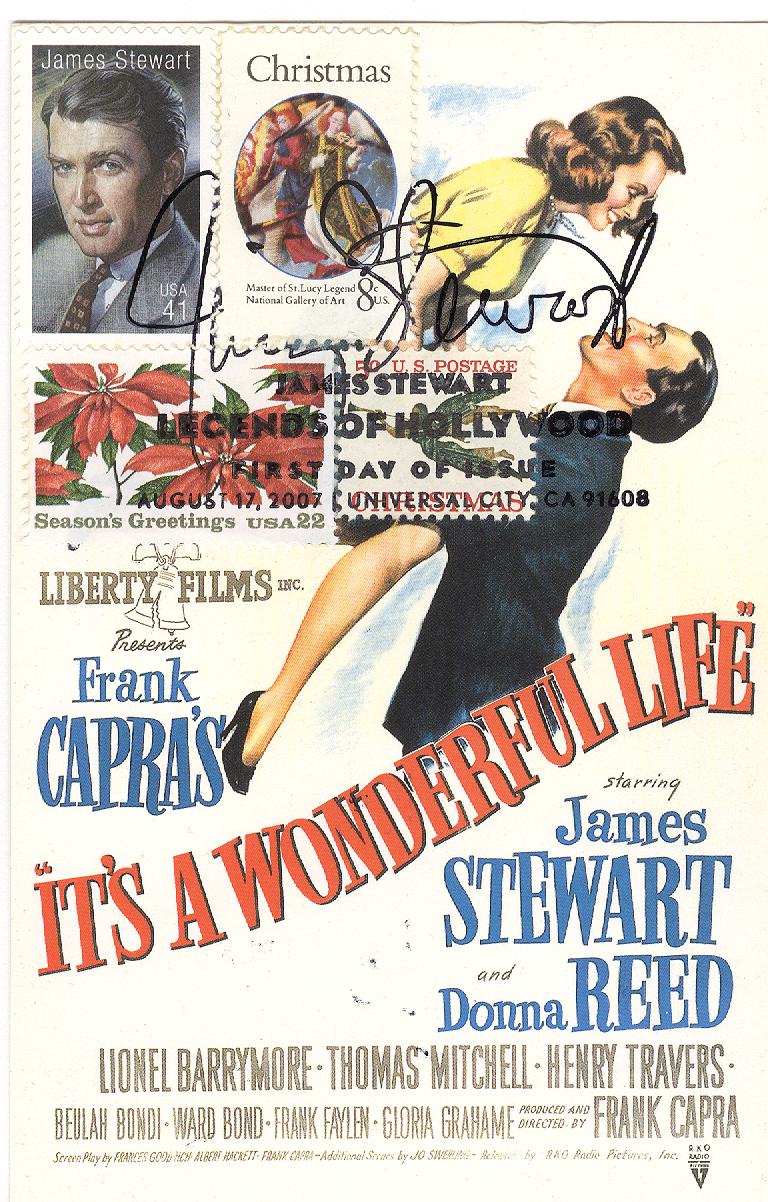
A holiday standard now, Frank Capra’s It’s a Wonderful Life (1946) is a film that’s easy to take for granted and even easier to underestimate. The idyllic small town life of Bedford Falls, the overly-cutesy courtship of George and Mary, the knee-jerk sentimentalism about human nature are what we’d come to expect from Capra. And while there are charming moments or marvelous little grace notes, it’s undeniable that he lays it on a bit thick, especially with Clarence’s running commentary.

But Jimmy Stewart may be America’s greatest actor, and Life is a film on the cusp of his career, since it revels in his effortless folksy charm, often parodied but never less-than-believable, but it also anticipates the darker Stewart who’d flourish in the 1950’s—the Stewart with disturbing pathologies (the Hitchcock films) or with the raw nerves of obsessive behavior (the brilliant Anthony Mann westerns). For it’s in the last half hour that Life really takes wing, with a fantasy element that submerges itself into unadulterated nightmare.


Much of Pottersville might seem pretty tame to us now. And I’ve known more than my fair share of librarians who laugh at Mary’s horrible fate without George (though it’s hard to imagine Donna Reed not ever landing another beau). But to have your world turned upside down in an instant, to have every memory and place and association called into question, to have your entire reality thoroughly upended (especially those things that you'd grown to love and cherish)—I can only imagine how horrible it must be. And Stewart sells it thoroughly. It's not a film I revisit often, but when I do, I am still surprised by the darkness at its center.

There are no shortage of Christmas stamps available, so when the Stewart release came out (Scott #4197), I tried to select some that had a very traditional feel to them and which matched the color scheme of the one-sheet pictured.

Angel (1965 – Scott #1276)
Virgin Mother (1972 – Scott #1471)
Poinsettia (1985 – Scott #2166)


As for the reverse side, I figured throwing some more Christmas stamps in would be fun, since I needed to add the Barrymores (Scott #2012; Lionel plays Mr. Potter) anyway.

Sleigh (1983 - Scott #1900)
Ornament (1987 – Scott #2368)
American Holly (1997 – Scott #3177)

This is in addition to the Tiomkin stamp (Scott #3340) that I piggybacked onto the First Day Cover of the American Filmmaking series (Screenwriting – Scott #3772a) back in 2003. Total face value of all the stamps pictured: $2.66 (and 2/10).

A film like Life invites one to examine the impact you’ve had on others’ lives—inadvertent or otherwise. How your actions cause ripples in the pond, ones that reverberate beyond your own awareness. George never made a name for himself outside of his town, never conquered the world. But his decency was profound, and so was his impact. He sometimes may feel trapped in his life, but he still has choices. He never embezzles money from the Building and Loan. He never cheats on Mary. He lives on his word, his integrity, and the community responds in kind when he needs them.

George could easily appear a plaster saint, a glib archetype of the Everyman Stewart is often best remembered for. But there are far worse things in this world than to be staid and boring and decent. Sometimes, the ripples you set off aren’t ripples, but waves that capsize the boats of others—not just in an alternate life, but in a real world nightmare of your own creation. To have a legacy where you know you’ve made someone’s life worse, not better—it’s a heavy, heavy thing.

Clarence tells George “No man is a failure who has friends.” I wish that were true. But like Zuzu’s petals, I have a buckeye in my pocket—one I’ve kept there for 15 years, reminding me often of those who mattered, but more recently of those I’ve damaged. Perhaps irreparably. For it was a wonderful life. But I’m no George Bailey. And while the future remains uncertain, it will be quite a while before those waves stop crashing.

Saturday, November 19, 2011

Maximum Review


It’s been a while since I discussed maximum cards, and while they don’t pop up often in my collecting, the recent X-men post reminded me that I should highlight a few that I’ve created since I last wrote about them.

I don’t typically collect art postcards, but when the abstract expressionist issue came out, I went to one of the few remaining postcard stores I know and found this painting of Robert Motherwell’s "Elegy to the Spanish Republic #34" (Scot #4444g).  This is a maximum card in its most traditional sense.

I will admit to never having seen a single episode of The Honeymooners (Scott #4414t), but I found a few postcards for the show on E-Bay, including this one, which has Jackie Gleason’s face virtually identical in both stamp and card.  If you look carefully, though, you can see Art Carney’s face is slightly different in the two photos.  Still, pretty darn close. 


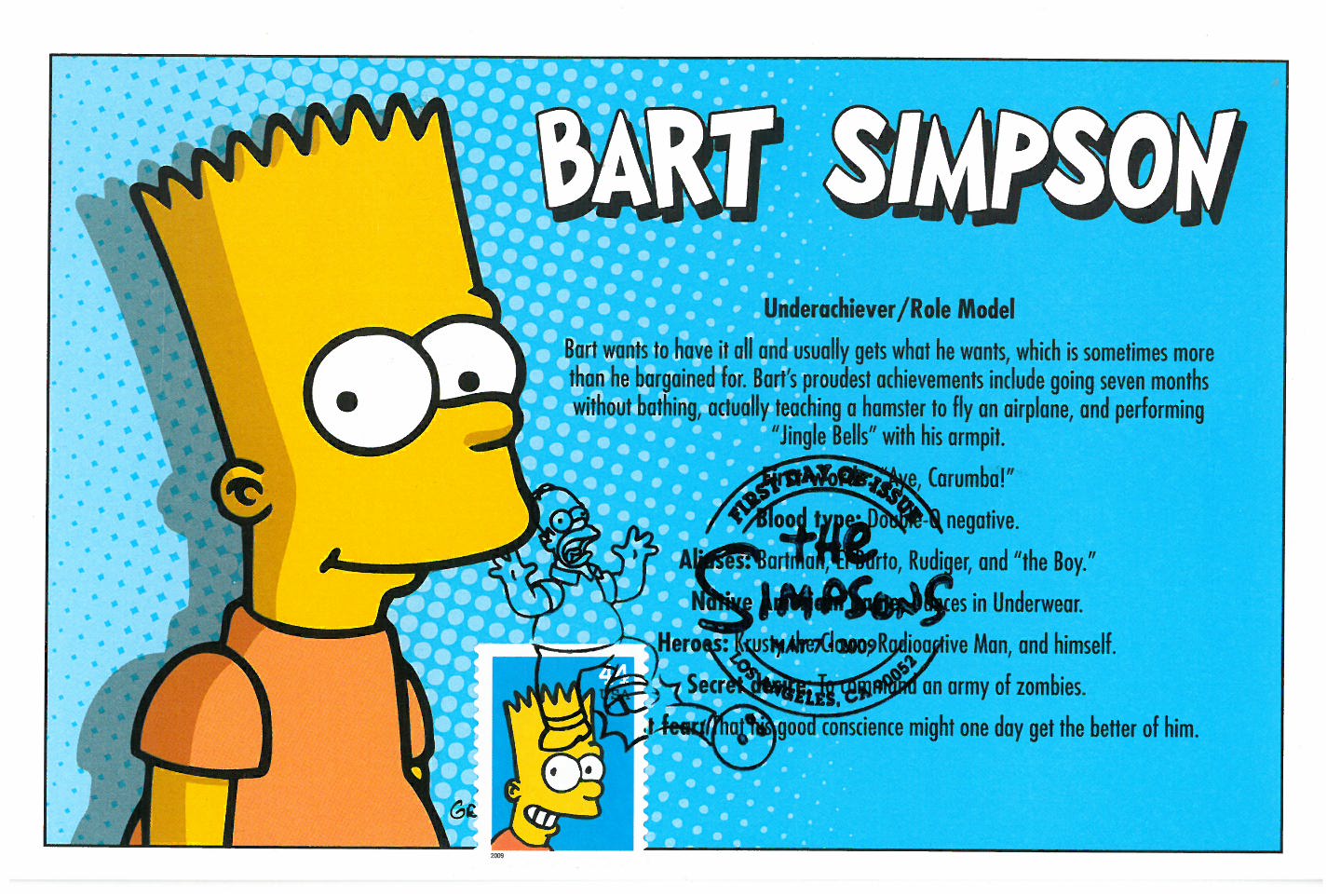
This profile of Bart Simpson (Scott #4401) also has a slightly different facial expression but given the matching background color, also comes very close as well.

And of all 20 different Disney stamps issued between 2004 and 2008, this stamp from Lady and the Tramp (Scott #4028) most closely resembles any of the postcards I used for the First-Day-of-Issue postmark.


Thursday, September 22, 2011

We Don't Need Another Hero


Four big budget comic book movies this past summer, and while none were overtly bad, none was particularly good, either. The period playfulness of Captain America’s production values and Michael Fassbinder’s commitment to Magneto stood out, but it was mostly silly and disappointing, though not the last we’ll see of any of them I suspect (except perhaps Green Lantern - Scott #4084l).

The DC and Marvel comic postage issues yielded few opportunities for movie-related FDC’s (at least based on my collection), but I had other postcards at my disposal. The X-Men one (Scott #4159t) was the best because it’s a true Maximum Card, with the stamp and the postcard being exactly identical. As for poor Thor, he didn’t even merit his own stamp, though you can see him way in the background of Cap’s stamp (Scott #4159o). For his comic, I settled for the Spider-Woman cover stamp (Scott #4159q), since it also features Nick Fury, who will be wrangling the Avengers for next year.