Wednesday, April 3, 2013

Bedtime Story


Happy Birthday to Doris Day, who turns 91 today.  My first exposure to her, alas, was the swath of 60s comedies taking on sex and domesticity with such prudish timidity.  There was no doubt that she had genuine chemistry with her leading men, especially Rock Hudson, but the films so often tried to have it both ways, playing naughty but really neutered.  And for someone with such a fantastic set of pipes, it always seemed weird that we rarely saw her sing in those immensely popular films.

I’d soon learn that the 50s held far more interesting fare from her (Love Me or Leave Me, Teacher's Pet), though it took me a while to eventually discover my favorite film of hers, and one that’s almost criminally unknown by movie fans (I don’t remember ever seeing it broadcast, even on TCM): The Pajama Game (1957).  Of the two films co-directed by Stanley Donen and George Abbott, it’s not as well known as the following year’s Damn Yankees!, itself a work that’s fading from the canon of movie musicals, but it's a gem nonetheless.

I love this film for a lot of reasons: A great assembly of songs with addictive melodies; terrific choreography by Bob Fosse, a decade before he directed his first film; a story that’s unapologetically pro-labor unions; and my favorite Day performance, where she’s virtuous but not virginal, romantic but not sappy, and fun-loving but still a fierce woman of conviction.  Plus, it’s the movie musical that most prominently features postage stamps!

Babe Williams (Day), a major player in the labor union at the pajama factory where she works, has finally succumbed to the charms of Sid Sorokin (John Raitt), the new up-and-coming middle manager at the company.  Hanging out at her home, her single dad (Franklyn Fox) approaches his daughter’s new beau with his beloved stamp album:
Pop: “Say, Sid, do you like stamps?”
Babe: “Oh, Pop!”
Pop: “Well, even If he don’t, that’s something that’d interest anyone: Two sets of mint Columbians. Plate blocks on every issue since 1919.”
And then after he leaves, Sid scans through the album.
Sid: “Say, he has got a whole set of mint Columbians”
Babe: “Sure he has. That’s why I work at Sleeptime.”
This leads to the duet “Small Talk”, where Sid croons, “I don’t wanna talk small talk, now that I’m alone with you”, as Babe counters with a series of efforts to change the subject, including the refrain
"Who would you vote for next election? How do you like the stamp collection?”
“Small Talk!”
Eventually, Sid’s argument, “I’ve got something better for your lips to do, and that takes no talk at all” wins out.

But after some work-related conflict about a raise and a threatened strike puts them at romantic odds, Sid visits her home to reconcile, only to run into Pops again with his stamps and magnifying glass.
Babe: “What you got there, Pop, your stamp album?”
Pop: “Now don’t get excited—if Sid don’t want to look at it, why he doesn’t have to.  There’s no law against my looking at it, is there?”
Babe: “Sid likes stamps.  He told me so.  But me, I’m just plain bushed so if you don’t mind I think I’ll slide off to bed.”
Pop: “Run along, honey.  Good night, dear.”
Sid: “Good night.  Sleep well.”
Babe: “Thanks.”
Pop: “Sid, suppose we start with the Pan-American Exposition issue of nineteen-hundred-and-one”
Sid: “I guess that’s good a place to start off as any.”
This issue is a real philatelic release, commemorating the 1901 Pan-American Exhibition in Buffalo, an event which is now most famous as the site where President McKinley was assassinated in September of that year.  Here’s a website that discusses those stamps in more detail, though I’d be inclined to guess that if Pop had a favorite stamp from that set, it would be Scott #295, since his blue-collar job is as a train engineer.  Today, the value of that set of six stamps, unused, would be over $800.

So what about the Columbians that Pop talked about earlier?  There was an issue known as The Columbians in 1893, commemorating the World’s Columbian Exhibition in Chicago, itself celebrating the 400th anniversary of Columbus landing on the New World.   Here’s a website that goes into detail about all 16 stamps in that set, ranging in denomination from 1 cent to 5 dollars.  This last figure is quite extraordinary because it would be analogous to having a postage stamp with a $150 face value today.  Another fun trivia note is the Columbian issue features the first US postage stamps to depict a woman--in this case, Queen Isabella.  Needless to say, a complete set of this issue in good quality would be worth close to $20,000 today.

Pop also talks about plate blocks, which are blocks of stamps straight off the production line and which include the additional perforations off the edge of the block which gives the information of the cylinder from which those stamps were printed.  This is obviously something much harder to get hold of and not available at your local post office.  They are also something which some collectors treasure highly.

I only own one plate block, of Scott #926, the first stamp about movies ever issued anywhere (which I discuss more here).  Note the cylinder number in the bottom left-hand corner.

The original Broadway production of The Pajama Game (represented by the postcard at the top) was in 1954, so plate blocks for every issue since 1919 meant over 500 US stamps across those 35 years.  That makes Pop an avid collector, a hobby which Babe implies she helps to subsidize.  So she really does need that "Seven-and-a-half Cents" raise (quite possibly my favorite song in the film).

The movie is readily available on DVD for cheap.  It has gorgeous production values but the quality of the print used for the transfer is dodgy and could use a loving TLC restoration.  But the film itself is marvelous--great fun but also genuinely progressive without compromising the political passions of the heroes.  It's also the only major film role for theater legend Raitt (Bonnie’s father) and features the only cinematic speaking part for Carol Haney, a frequent collaborator of Gene Kelly’s (she’s one of the dancers in the On the Town fantasia) and a legend in her own right who died a very sad, early death.  “Steam Heat”, “Hey There”, “Hernando’s Hideaway”, “Once-a-Year Day” are all staged by Donen with peerless energy and great verve.  It’s one of his best films—high praise for perhaps the greatest director of movie musicals the world has ever known.


My 10 favorite Stanley Donen films

1. Singin' in the Rain (1952, w/Gene Kelly)
2. On the Town (1949, w/Kelly)
3. The Pajama Game (1957, w/George Abbott)
4. Seven Brides for Seven Brothers (1954)
5. Charade (1963)
6. It's Always Fair Weather (1955, w/Kelly)
7. Bedazzled (1967)
8. Royal Wedding (1951)
9. Funny Face (1957)
10. Two for the Road (1967)


Last year's Bob Fosse stamp is Scott #4701 and Audrey Hepburn is #3786.  Johnny Mercer (composer for Seven Brides for Seven Brothers) is #3101, while George Gershwin is #1484 and George w/brother Ira (the team behind the Funny Face song score) is #3345.  The wedding rings are #4397, the Oregon stamp is #3732, and the Costume Design stamp is Scott #3772c. 


Wednesday, February 6, 2013

Updates Galore

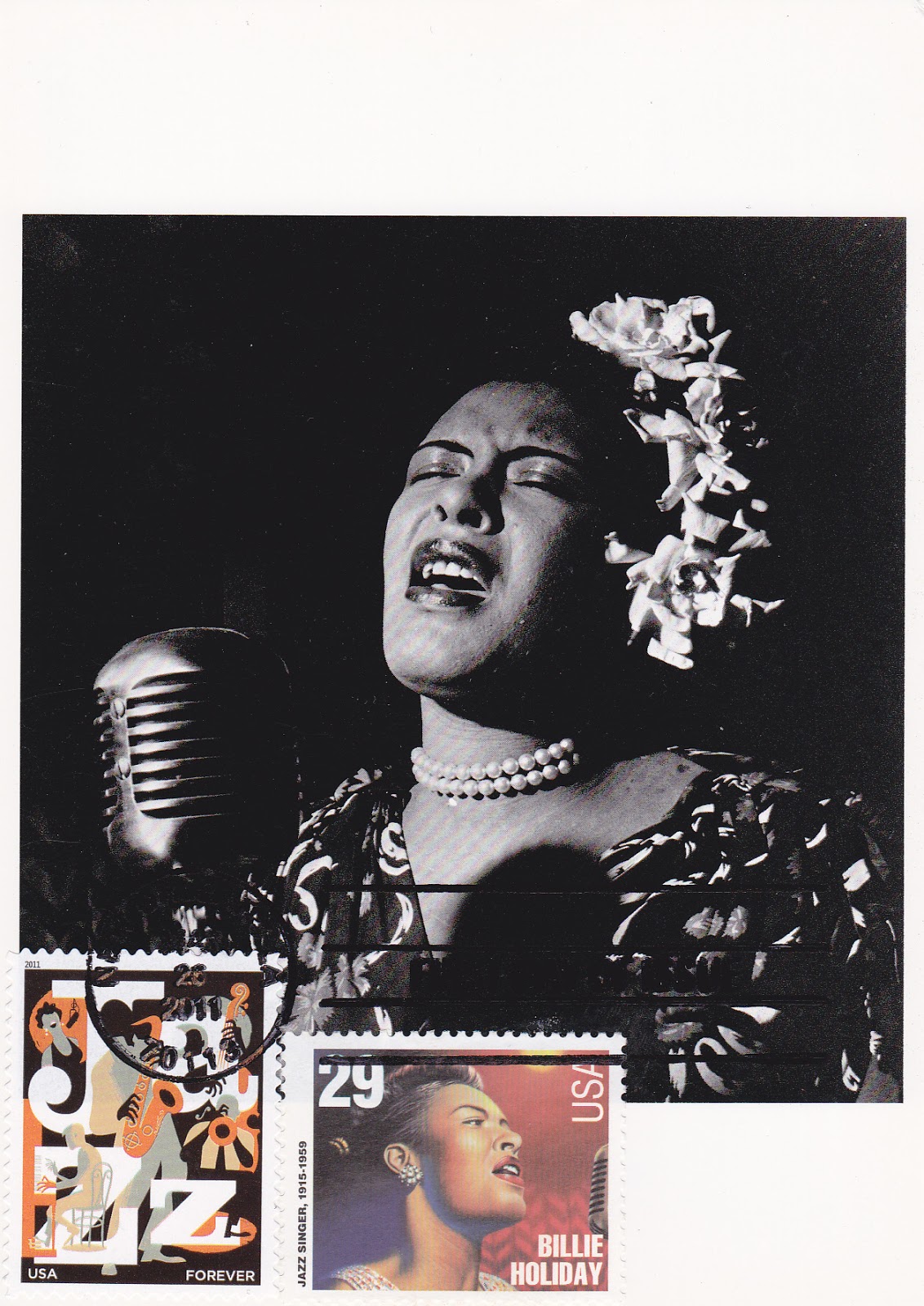
New articles, some recent and others previously in limbo but now finished:  ET and the joy of bike riding; 2001 and my first encounter with art; Billie Holiday and my love of classic singers + King Kong, Toy Story, James Bond, and the Sight & Sound poll.  Plus, more maximum cards, bad postmarks, the yearly wrap-up, a birthday greeting to my niece, and of course, Oscar season is under way.

Holiday


Given that he’s made nothing but crappy movies for the last 15 years or so, it’s easy to forget that Steve Martin used to be a small, cinematic treasure.  And revisiting The Jerk (C.Reiner, 1979) again, with its goofy unevenness, brought back to me a scene I had completely forgotten about: Navin and Marie (Bernadette Peters) singing the tender, poignant "Tonight You Belong to Me" on the beach, by firelight.

I’ve been told more than once that when it comes to music, I was born too late.  I don’t mind modern music, but the truth is that since I left college two decades ago, I’m exposed to it very little so don’t indulge in it much.  My heart truly belongs to the Great American Songbook and the great jazz singers of a bygone era.

But there’s something very curious about those songs that I love by Cole Porter and the Gershwins, Walter Donaldson and Rodgers & Hart.  I adore listening to them (and do so constantly), but never feel compelled to sing along to them.  My favorite sing-along album is We Shall Overcome, Bruce Springsteen’s covers of Pete Seeger songs, and if I ever do provide vocal accompaniment in my car, it’s usually to Johnny Cash or Marty Robbins. So the domain of classic folk and country are fertile territory for my (limited) vocal range.  But those jazz standards occupy a special place where I don’t feel entitled to tread.  

The USPS just announced that Cash will be getting his own postal issue this year.  And while many singing legends (Ella, Dinah, Frank, Patsy) got their own stamps years ago, it’s a tribute to his longevity that Cash was only recently eligible for the honor.  And while there are some legends of that time whom I’ve seen in concert (Blossom Dearie, Tony Bennett, Willie Nelson), I’ve always regretted never going to see him perform live.

We all, in our own ways, find connection and belonging through music, though most of what I listen to was made long before I was born.  Maybe that’s why one of my favorite musicals is Pennies from Heaven (Ross, 1981), also with Martin and Peters, because its entire soundtrack is full of these vintage beauties.  But as far as great musicals go, the film is still unusual because it inhabits the gulf between the fantasy life which music provides and the real life we actually face.  Throughout the film, nobody sings; rather, they all lip synch to those classics from the 20s and 30s.  But they never do these mimes as performers in the story.  What they do is lip synch in their own fantasy dreamscapes, psychologically allowing the songs to fill the ache, the emotional void that we feel every day but keep hidden.

As a result, I know of no other musical which is as heart-breaking, not because of the tragic things that happen in the plot, but because the movie reminds us how fundamental music can be to buoy our spirits and provide an escape valve for the darker truths that our choices and damaged lives represent.  I guess that’s why I never sing to those songs.  Because I’m too busy listening, inhabiting, breathing them in.  

But I love hearing them and have a sense of awe for people, professional or otherwise, who can sing them with such affection.  Singing in front of people solo is something I’ve never done (never even privately, one-on-one).  I always find safety in large numbers.  Church?  Fine.  Karaoke?  I’ve been tempted, but have never summoned up the courage.  Even the thought of such a simple duet as the one in The Jerk unnerves me—not  because I’m a bad singer (I’m not), but because it means opening up to something vulnerable (be it raw or playful) in myself.  That's something I rarely do.  Public speaking in front of large crowds scares some people but it’s never bothered me one bit.  But to sing is something different.  More naked.  Exposed.  Which is also why I admire people who can do it with joy and fearlessness.


But while solo singing might fill me with deep trepidation, there is something else that fills me with actual fear—and that’s the dentist.  I won’t go into the childhood trauma I had that’s resonated with me since I was very young.  My dentist at the time was not a sadist (unlike the musical Steve Martin from Little Shop of Horrors), but what happened still had an effect on me like few other moments in my life.  Even now, the closest I’ve ever had to a full-scale emotional meltdown as an adult was because of that chair.

But that fear has been tempered by one simple thing, and this, again, is where music sustains me.  For of all the singers I love, there’s one I never actually listen to for fun.  And that’s Billie Holiday.  I own her CDs, and while a jazz compilation may bring up a song of hers periodically, I never sit down for an hour of her music like I can do effortlessly with, say, Nina Simone.  And that’s because whenever I go to the dentist, it’s a Billie CD I listen to.  I discovered quickly that Ella’s warmth, Blossom’s flirtations, Nina’s soulfulness aren’t what work for me at that moment of dread.  Maybe that’s because they represent my own aural dreamscape of what I long to be and feel.

But Billie’s sadness, even in the face of love and redemption, have always spoken to me in a special way—not in how I long to feel, but how I usually do every day already.  And so that’s why I cherish her and secrete that voice away in my heart and head.  Because like anything that sweet and precious, I only bring her out at those times when I need to be so fortified and comforted.  So in that chair is when I need her the baddest, and treasure her the most.  Her blues are my solace and in her voice, my fear doesn't just take leave, but evaporates altogether.  Without fail.  There may be singers I love more, but none whom I rely on so fervently.  Fine and Mellow indeed.

The Billie Holiday stamp is Scott # 2856, Nat King Cole # 2852, Ella Fitzgerald # 4120.  The Jazz stamp is Scott # 4503.

If I had to list 10 songs from that school of songwriting which I revisit most regularly, I suppose I might pick these:

* "Ain't Nobody Here But Us Chickens" (Kramer/Whitney) - Louis Jordan
* "Do You Know What It Means to Miss New Orleans?" (DeLange/Alter) - Billie Holiday
* "I Loves You, Porgy" (Gershwin/Gershwin) - Nina Simone
* "If I Had a Ribbon Bow" (Prince/Singer) - Maxine Sullivan
* "Mr. Meadowlark" (Donaldson/Mercer) - Bing Crosby & Johnny Mercer
* "Shine On Harvest Moon" (Bayes/Norwoth) - Betty Carter
* "St. James Infirmary Blues" (Primrose) - Cab Calloway
* "Stardust" (Carmichael) - Nat King Cole
* "They Say It's Spring" (Clark/Haymes) - Blossom Dearie
* "What'll I Do?" (Berlin) - Johnny Mathis


Wednesday, January 30, 2013

2012 Yearly Wrap


 The Film Directors issue, including John Huston, Scott # 4671


The Pixar issue, including Finding Nemo, Scott # 4679.  Aquarium stamp is # 2866.


Jose Ferrer, Scott # 4666, here with Humphrey Bogart, Scott # 3152


 Choreographers issue, including Bob Fosse, Scott # 4701


Edgar Rice Burroughs, Scott # 4702


Earthscapes issue, including Highway Interchange, Scott # 4710o


Baseball All-Stars issue, including Joe Dimaggio, Scott # 4697, here with Marilyn Monroe, # 2967

Sunday, January 20, 2013

My Oscar Ballot

Picture: Amour
Actor: Joaquin Phoenix, The Master
Actress: Naomi Watts, The Impossible
Supporting Actor: Robert De Niro, Silver Linings Playbook
Supporting Actress: Amy Adams, The Master
Director: Michael Haneke, Amour
Original Screenplay: Moonrise Kingdom
Adapted Screenplay: Lincoln
Cinematography: Skyfall
Art Direction: Life of Pi
Editing: Life of Pi
Costume Design: Mirror Mirror
Score: Life of Pi
Song: “Skyfall”, Skyfall
Sound Mixing: Life of Pi
Sound Editing: Life of Pi
Visual Effects: Life of Pi
Make-Up: Hitchcock
Foreign Language Film: Amour
Documentary Feature: Searching for Sugar Man
Documentary Short: Inocente
Animated Feature: Frankenweenie
Animated Short: Head Over Heels
Live Action Short: Asad

Saturday, January 12, 2013

Dr. No Thanks


I really, really wish I liked James Bond movies.  With each one, I go in with high hopes and disbelief gladly suspended.  And each time, I usually come out with something to latch onto that I can say I liked or enjoyed.  But time and time again, a larger disappointment looms because they just come across as a little…desperate.  Too eager to please, to impress, to titillate (chastely), to push the envelope but never really get out of our comfort zones.

They certainly show up on TV enough that I give them a second chance, but quickly get bored or frustrated by the effort.  Maybe because long before Bond and Bond, I knew Roger Moore and Pierce Brosnan as The Saint and Remington Steele—the former still self-amused but less long in the tooth, the latter a suave and charming movie addict surrounded by mystery and not epic stupidity.  And as great as he is, most of the Connery films have fared quite badly over the years; even “classics” like Goldfinger only serve to remind you that more often than not, his Bond was actually a pretty incompetent spy.

And now we have Skyfall.  The raves were inescapable, and Daniel Craig was a more rough-and-tumble incarnation, which I preferred (I consumed the Ian Fleming novels in my youth), so I had my hopes up.  Certainly, Casino Royale was above average and had some terrific setpieces, but still took too long to get to the point.  Quantum of Solace made little sense from start to end.  And while there’s a lot to like in Skyfall—its believable stuntwork, its sense of franchise continuity, its earnestness in burrowing into Bond’s psyche—for me, like most Bonds, the whole is less than the sum of its parts.

There’s only one Bond film I really, really like: From Russia with Love (Young, 1963).  Maybe it’s because its villains are scary without being cartoonish (by comparison, Javier Bardem’s baddie practically plagiarizes Batman’s Joker’s rictus grin).  Maybe it’s because the stakes (a Cold War decoding machine) are proportionate to the proceedings; once world domination because the redundant goal in these films, everything had to be bigger, but rarely better.  In Russia, there are no crazy gadgets, and some Turkish flavor but little gratuitous globe-hopping.  Plus, there is a genuinely gorgeous woman (Daniela Bianchi) who doesn’t strain credulity by doubling as a brilliant scientist and sexual pushover.  The film as a whole is lean, gritty, exciting, but never overplays its hand.

For someone allegedly good at cards, Bond usually overplays his hand.  And Skyfall almost does, too. For as ably executed and well-cast as it is, there is only one thing genuinely special about it, but it’s a doozy.  Roger Deakins is the cinematographer this time and his contribution is nothing short of miraculous—perhaps the best below-the-line asset any Bond film has had since John Barry’s Russia score and Shirley Bassey’s brassy pipes (though Adele holds her own here, too).

The Bond films have always indulged in location photography, but it always played as mere travelogue porn (including my own Bay Area home here in San Francisco), settling for getting landmarks in frame and exploiting local “exoticism”.  But Deakins captures the exquisite details of lights, reflections, colors, and compositions.  Bond has always been about sex (literally or metaphorically), but this film brings something new to the series—visual sensuality.  It is glorious to gaze upon and elevates the film to something far more promising.  That the content (from story motivation to final resolution) doesn’t quite deliver the goods isn’t Deakins’s fault.  His work is masterful, and makes this Bond one that stands out.  

After wonderfully reliable work for Scorsese, Sayles, Mendes, and the Coens (among others), there’s something perversely irresistible at the thought he might win a long overdue Oscar for a Bond film.  But I hope he does.  For truly, nobody does it better.

The Chinese Year of the Tiger stamp is Scott #3895c.

Tuesday, January 1, 2013

New Year's Eve on Naboo

-->
Although I’ve had some memorable New Year’s Eves in my life (seeing Jason Marsalis perform in New Orleans, “burning the old man” traditions in my homeland of Ecuador), I’d have to say my favorite was six years ago, when my boss--George Lucas--was named the Grand Marshal of the Rose Parade and a handful of Lucasfilm employees were conscripted to help decorate the two floats that the company was sponsoring.  I didn’t know anything about the specific designs that had been created, but watching the parade was an annual ritual in my home growing up and I even spent the night in a lawn chair on Colorado Blvd in Pasadena once to see the parade in person the next day.  That was in high school with some of my friends and whatever limited basketball skills I have can be attributed to spending hours trying to throw marshmallows into the open sunroofs of passing limousines that night.


So we showed up bright and early on 12/31/06 to a large hangar that had four floats in it—two of ours and the two floats of the college teams playing in the Rose Bowl that day (Michigan and USC).  Our shift was the second-to-last, which meant that all the final mounting of foliage & greenery, herb gluing, veggie application, and other texturing and ornamentation would take place.  The shift after ours (the final, late night/early morning shift) only had one job: applying all the actual flowers. 


The work crews were a motley mix of my colleagues, elderly alumni from those rival universities, and volunteers from some of the local SoCal high schools.  Our floats were of two Star Wars environments: the Endor forest moon and the Queen's palace on Naboo, essentially bookending the saga with locations from Episodes 1 & 6.  Endor was mostly finished but there was still lots of detailing to be done on Amidala’s royal grounds, particularly on the towers which loomed above us, requiring a scaffold two-and-a-half stories high to reach them.


Since I’m not really afraid of heights, I clambered up this steel and wood frame and spent the next few hours adhering one bean after another (both red and white) into elaborate pre-stenciled patterns at the top of these towers.  Then later, pinning branches and ivy to the walls.  Or using seeds on the coats of some exotic Ewok pack-animals.  Or finally patching up any bald spots with additional spices. In the meantime, my (now ex-)wife had coordinated all the volunteers into efficient assembly lines, because in addition to all these last-minute touch-ups on the floats, our shift had to stage all the flowers that the final crew would be installing.


This meant prepping thousands of these tiny conical vials, each with enough water for a single stem, which you’d then place a flower in.  The flowers came bundled in huge floral boxes and so putting them in these vials quickly was critical so they didn’t start to wilt or fade before the final crew was ready to put them on the floats themselves.  It was a pretty phenomenal enterprise, and because I was high above the ground, I had an eagles-eye view of the whole proceedings.  It boggled the mind to think how many other hangers and workers and flowers were being strategically employed at the exact same time.  But It was also honestly some of the most fun I’d ever had. 


After our 8-hour shift was over, I picked up my Mom from the airport since we were all going to have bleacher seats to watch the parade the next morning.  Not quite as much fun as my lawn chair, but still a good view—though because we had to get up so early to get to our reserved parking and seats, my favorite New Year’s Eve didn’t even include staying up until midnight.  And then after the parade was over, we went to where the floats were publicly parked to get up close and look at the craftsmanship of all the remarkable creations.  Because the floats remain stationary, any animated elements or moving parts are static, but it’s still a wonderful way to look at the floats and their intricate details and creative use of fruit or flowers without dealing with the crowds on the street.  Check it out if you’re ever in the area on January 1.


Here's a picture of the Naboo float that year.  All the USPS stamps are from the Star Wars issue from 2007: Queen Amidala (Scott #4143h), stormtroopers (#4143o), the Emperor (#4143c) and X-wing fighter (#4143m).  The Yoda stamps were from a separate Yoda issue that occurred the same year—the winner of a fan poll.  That’s Scott #4205. The St. Vincent and the Grenadines stamp was part of an officially sanctioned Star Wars foreign release from 1996.